
Linda Cremonesi elected as co-spokesperson for NOvA neutrino experiment
Currently, NOvA is Fermilab’s leading long-baseline neutrino experiment. Cremonesi is now co-leading the international collaboration of scientists behind it.

11 - 20 of 673 results
Currently, NOvA is Fermilab’s leading long-baseline neutrino experiment. Cremonesi is now co-leading the international collaboration of scientists behind it.

Christina Wang, a postdoctoral researcher and Lederman Fellow at Fermi National Accelerator Laboratory, has been awarded the American Physical Society’s 2026 Mitsuyoshi Tanaka Award in Experimental Particle Physics for her pioneering work in particle detection. Her innovative techniques, which open new pathways for identifying elusive dark matter candidates, are advancing the search for physics beyond the Standard Model.
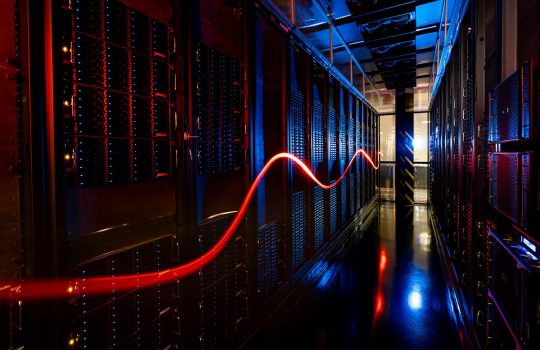
The U.S. Department of Energy’s Genesis Mission is building a new era of AI-driven scientific discovery — and it requires far more than powerful supercomputers to succeed. To support this national effort, Fermilab’s Fermi Data Platform is providing secure, large-scale data infrastructure needed to make advanced AI research possible across the American Science Cloud.
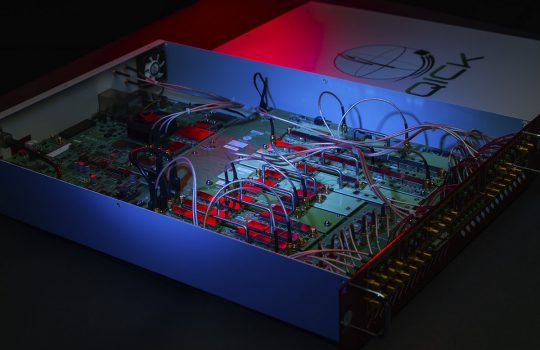
Fermilab developed the Quantum Instrumentation Control Kit, or QICK, as a compact, customizable and cost-effective quantum readout and control option for scientists. Harmoniqs, a quantum computing software company, developed Piccolo.jl, a quantum control and calibration software package. Together, their developers are integrating the two to achieve precise, repeatable qubit control, providing better results in less time.

MicroBooNE, with its large neutrino detector at Fermilab, has wrapped up the data-collecting phase and will continue to conduct analysis under fresh leadership.
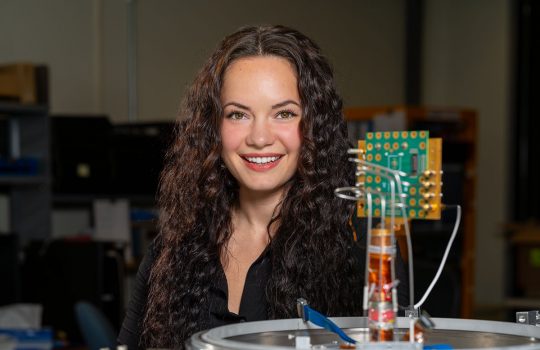
Olivia Seidel’s work draws on Fermilab’s deep expertise in microelectronics and cryogenic devices to support key goals of the Genesis Mission — a sweeping U.S. Department of Energy artificial intelligence initiative.
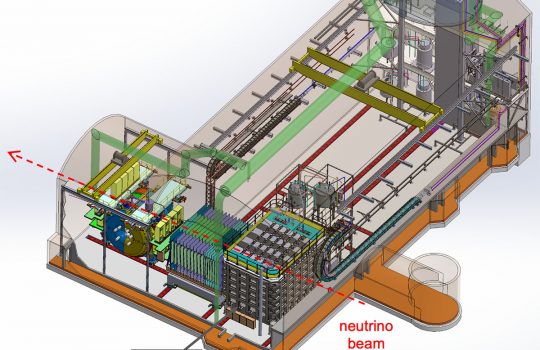
The Deep Underground Neutrino Experiment’s innovative hybrid near detector will be a game changer. An active prototyping program over the last few years has been refining and validating the design of this smaller detector’s key element, a liquid-argon time projection chamber, and the data analysis tools and methods that go with it.
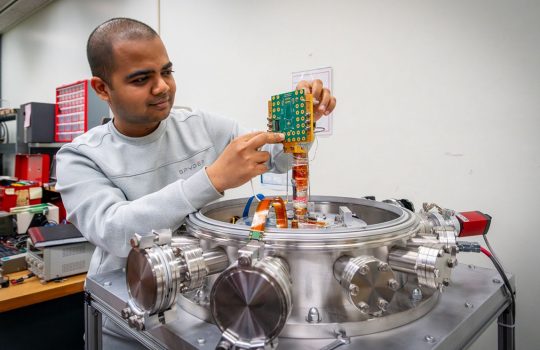
Researchers with Department of Energy national laboratories are working together alongside industry collaborators to support Genesis Mission goals by using the power of artificial intelligence to significantly reduce design times of custom computer chips for use in extreme temperature, high-radiation and ultra-fast environments.
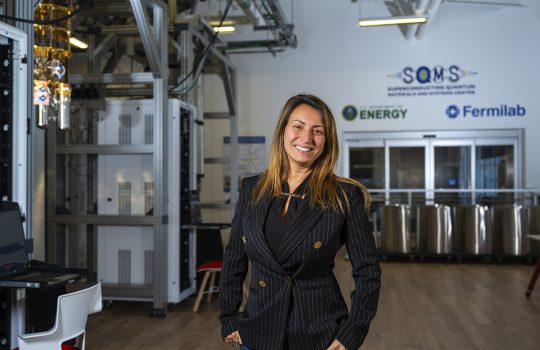
Anna Grassellino of Fermilab will serve on SCAC and chair the quantum subcommittee, tasked with advancing national quantum goals.
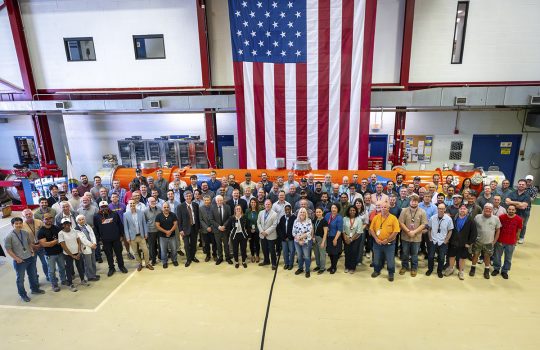
Fermilab sent its final contribution for the high-energy upgrade of the superconducting accelerator for SLAC’s X-ray laser, LCLS. The technology they developed will be transferred to industry for semiconductor-chip production and will be used in the Proton Improvement Plan-II, one of Fermilab’s flagship projects.