
Uncategorized

1 - 9 of 9 results

This graphic shows the engineering design model of the underground DUNE near detector hall. The neutrino beam enters from the right. The liquid-argon time projection chamber (labeled ND-LAr) is the first to encounter the neutrino beam. Directly behind it sits the muon spectrometer, shown in blue and green. Both can move off the beam axis (toward the upper right) to sample different neutrino energies. The third component, the beam monitor at the farthest end of the hall, depicted in yellow and blue, stays in place on axis in the beam. Credit: DUNE Collaboration

DUNE will use liquid-argon time projection chamber technology both near and far

The Deep Underground Neutrino Experiment’s innovative hybrid near detector will be a game changer. An active prototyping program over the last few years has been refining and validating the design of this smaller detector’s key element, a liquid-argon time projection chamber, and the data analysis tools and methods that go with it.

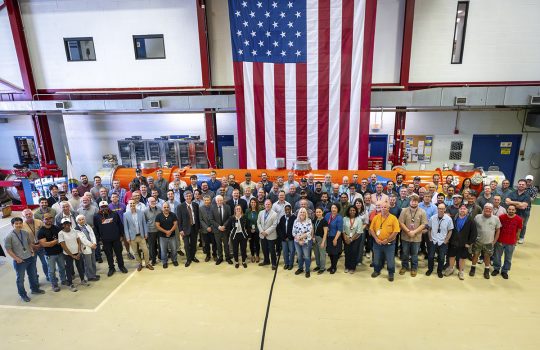
Fermilab team members in front of the 14th and final superconducting cryomodule built for the high-energy LCLS upgrade. Credit: JJ Starr, Fermilab

Fermilab completes its part in upgrading world’s most powerful X-ray laser

Fermilab sent its final contribution for the high-energy upgrade of the superconducting accelerator for SLAC’s X-ray laser, LCLS. The technology they developed will be transferred to industry for semiconductor-chip production and will be used in the Proton Improvement Plan-II, one of Fermilab’s flagship projects.

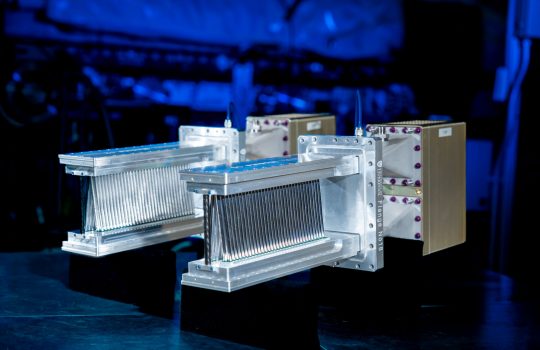
ion trap chip

DOE national quantum research centers reach breakthrough towards building scalable quantum computers

A partnership between the Quantum Science Center and the Quantum Systems Accelerator, two U.S. Department of Energy national quantum information science research centers, has enabled a breakthrough by Fermilab and MIT Lincoln Laboratory. Researchers used cryoelectronics to control ion traps, a key step toward realizing scalable quantum computers.