Editor’s note: This article was originally issued by the Department of Energy.
WASHINGTON, D.C. – On June 4, the U.S. Department of Energy (DOE) announced $75 million in funding for 66 university research awards on a range of topics in high energy physics to advance knowledge of how the universe works at its most fundamental level.
The projects involve scientists at 51 U.S. institutions of higher learning across the nation, and include both experimental and theoretical research into such topics as the Higgs boson, neutrinos, dark matter, dark energy and the search for new physics.
“Research in high-energy physics not only advances our understanding of the universe, but is also critical to maintaining American leadership in science,” said Under Secretary for Science Paul Dabbar. “These research efforts, at dozens of universities across the nation, will not only yield fresh insights into such problems as dark matter and dark energy, but also help build and sustain the nation’s science and technology workforce.”
Projects include experimental work on neutrinos at DOE’s Fermi National Accelerator Laboratory; the search for dark matter with the LZ (LUX-ZEPLIN) experiment one mile below the Black Hills of South Dakota; the analysis of observatory data relating to dark energy and the expansion of the universe; and investigation of the Higgs boson from data collected at the Large Hadron Collider at CERN.
Other projects are aimed at further developments in particle physics theory, in advanced particle accelerators, and in new detector technologies, which scientists will use in continued explorations of the subatomic world.
High energy physics serves as a cornerstone of America’s science efforts. It plays a major role in nurturing top scientific talent and building and sustaining the nation’s scientific workforce. It also provides a deeper understanding of how our universe works at its most fundamental level.
This year’s projects were selected by competitive peer review under the DOE Funding Opportunity Announcement for Research Opportunities in High Energy Physics, sponsored by the Office of High Energy Physics within the DOE Office of Science.
Total funding is $75 million for projects lasting up to four years in duration. The list of projects and more information can be found here.
From May 7-8, I attended the Advanced Manufacturing Summit at Oak Ridge National Laboratory in Tennessee.
The summit was the third in the InnovationXLab Series, which is designed to showcase the vast resources in the Department of Energy national laboratories that can be wielded for innovation in industry. By partnering with the private sector, we can help launch new industries and rejuvenate domestic manufacturing.
At the summit, leaders from the labs and industry met to catalyze public-private partnerships and look for opportunities to commercialize technologies developed in the labs. More than 350 people from 30 states came to the summit. U.S. Secretary of Energy Rick Perry gave the keynote address and, in a fireside chat with Oak Ridge National Laboratory Director Thomas Zacharia, talked about how DOE can be a leader in manufacturing and computing. We heard from several DOE and national lab leaders. And panels of experts discussed a wide range of topics about innovation in industry, including reviving advanced manufacturing; the challenges of manufacturing in an increasingly digital world; and energizing the entrepreneurial economy.
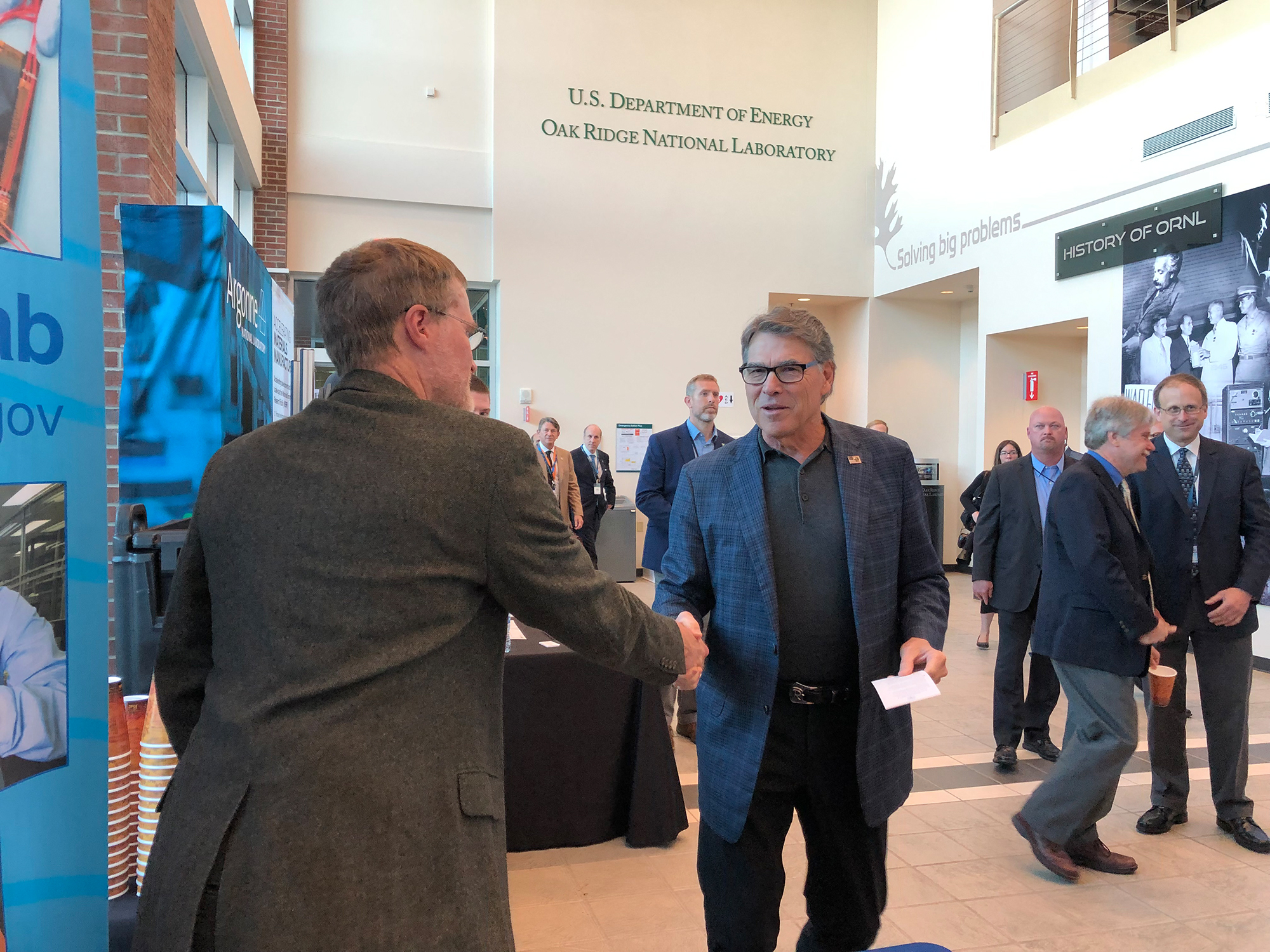
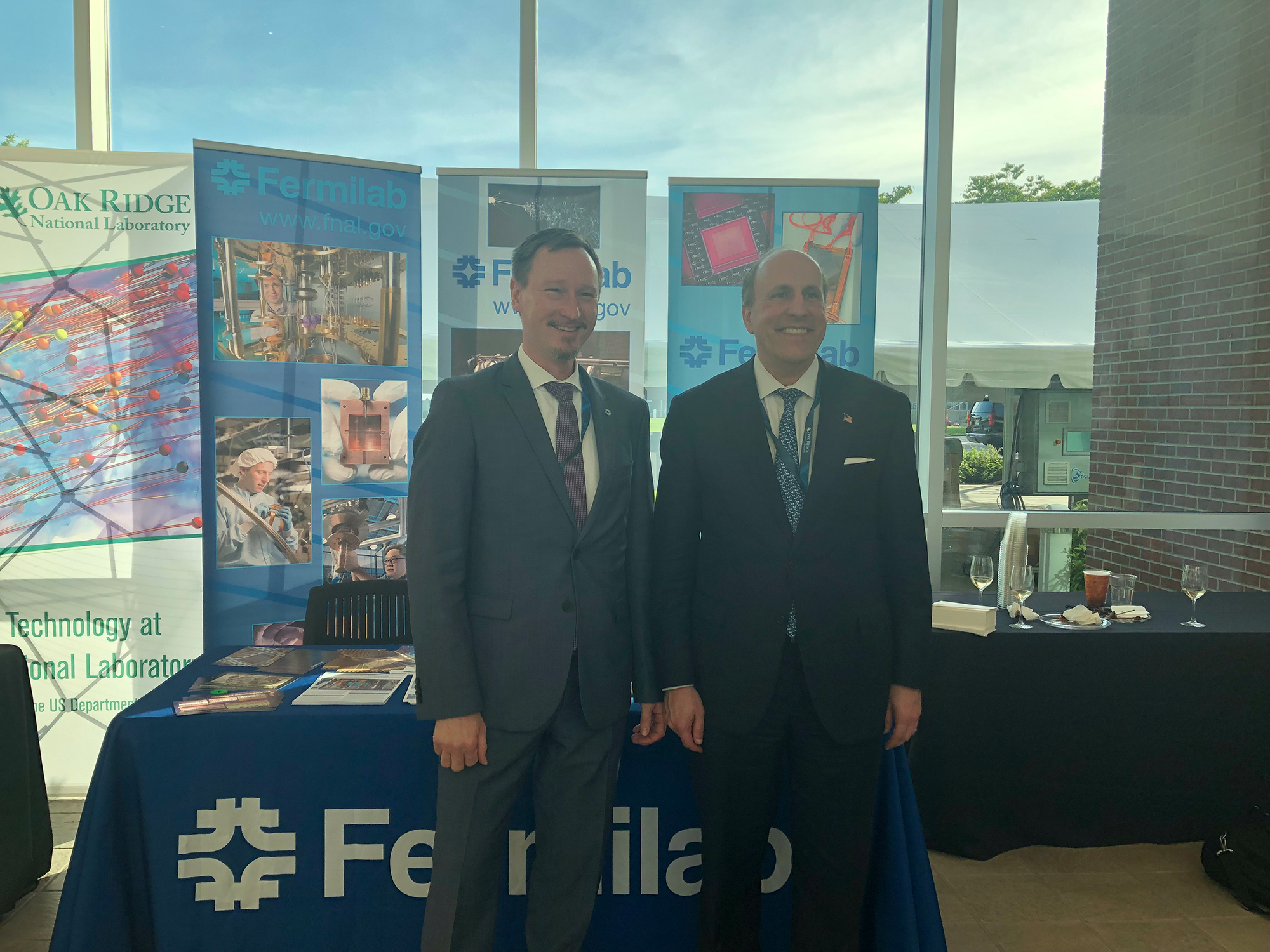
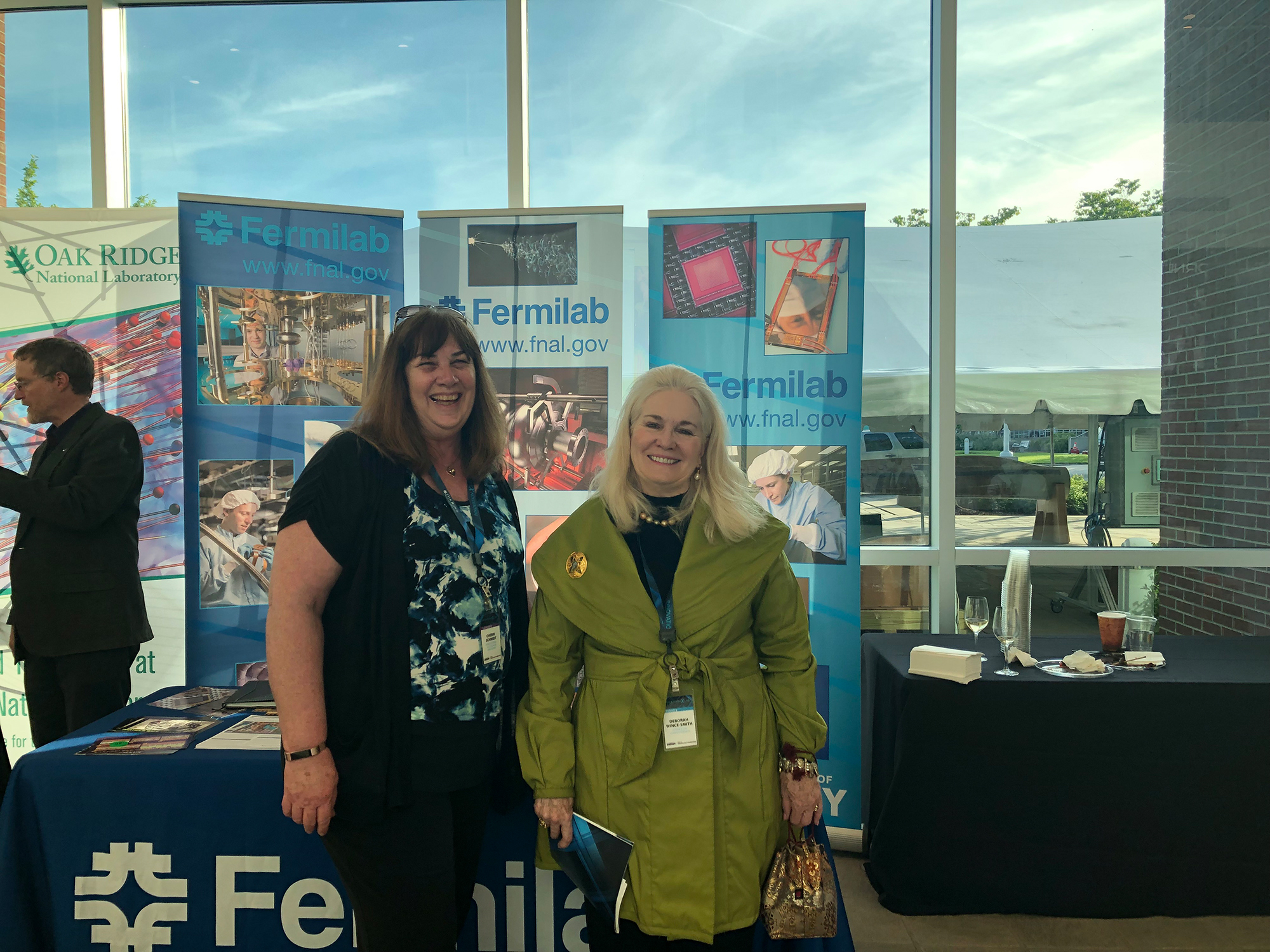
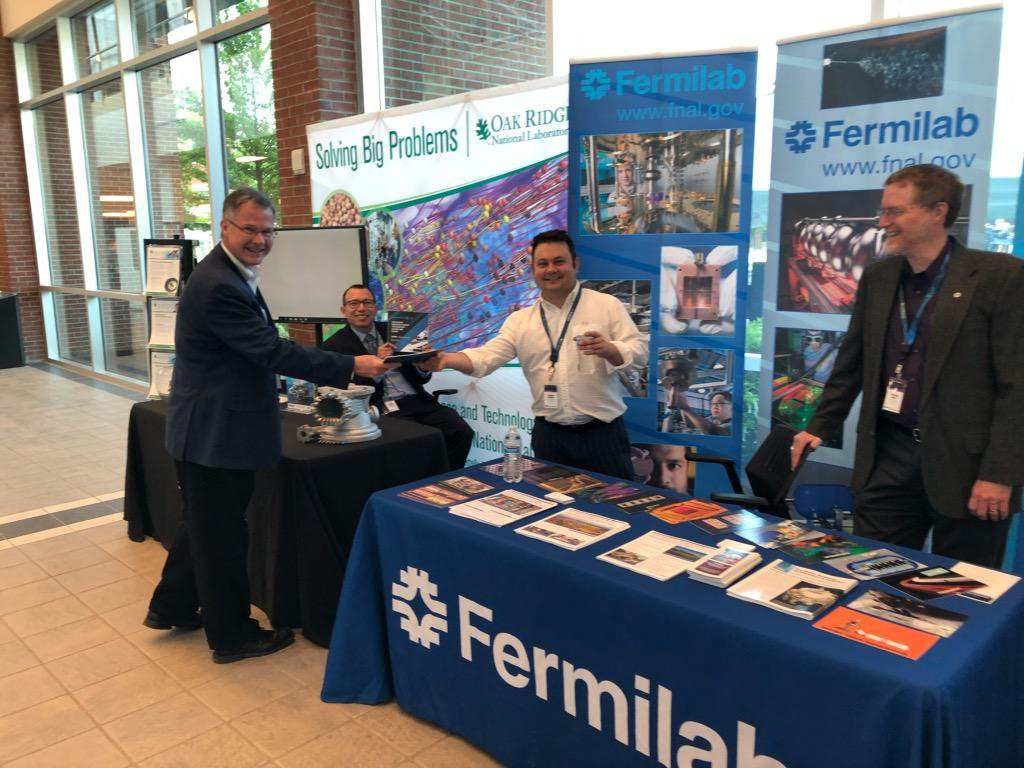
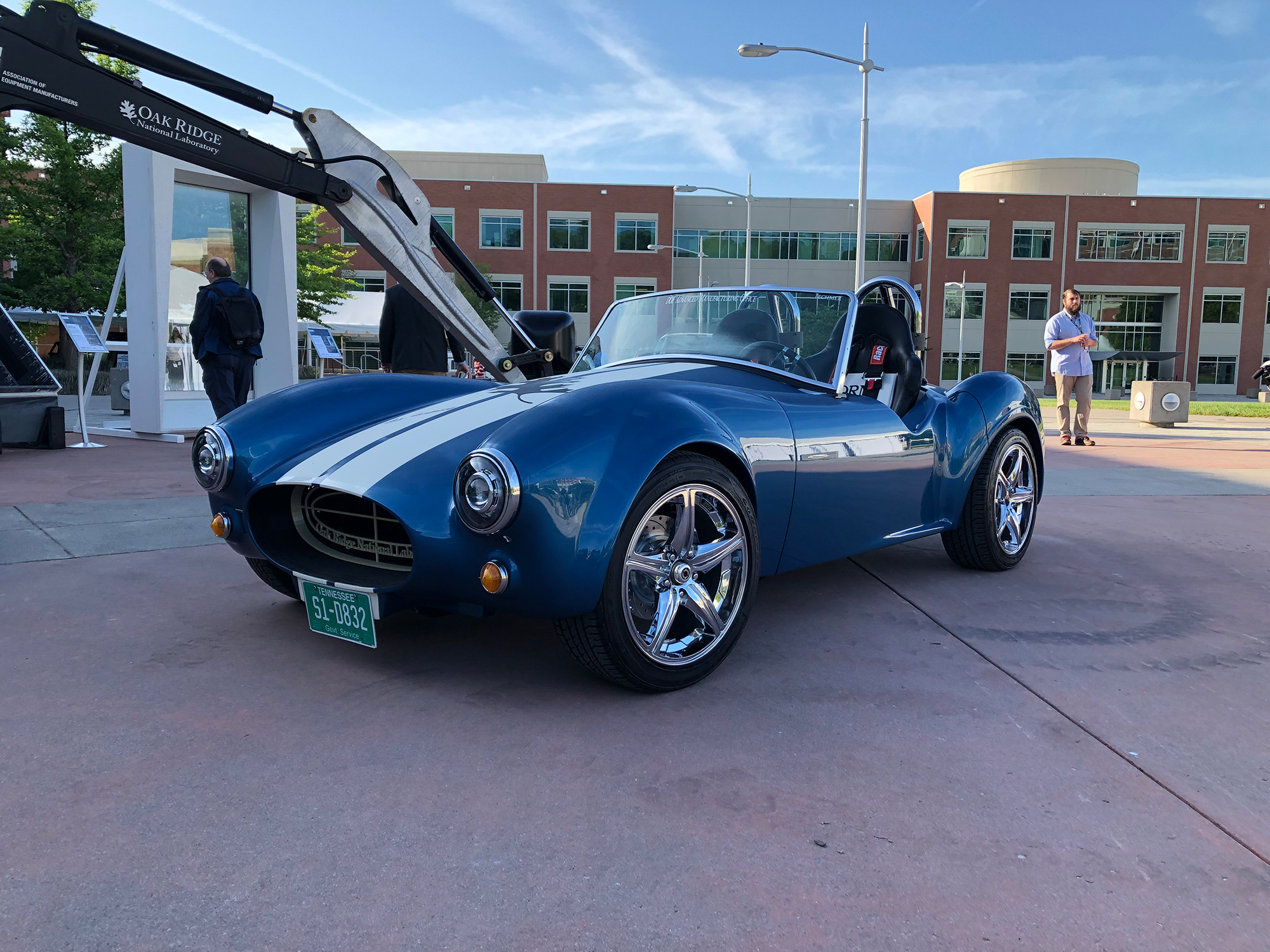
Fermilab Deputy Director for Administration Tim Meyer and Fermilab Office of Technology Transfer Head Cherri Schmidt attended several advanced manufacturing sessions and met with attendees, speakers, and exhibitors. Together, we established several interesting contacts at the event and met our counterparts from across 16 of the 17 national laboratories — and that’s why they put the X in InnovationXLab!
Aaron Sauers is Fermilab’s patent and licensing executive. More information about innovations and technologies at Fermilab is available on our Partnerships and Technology Transfer website.
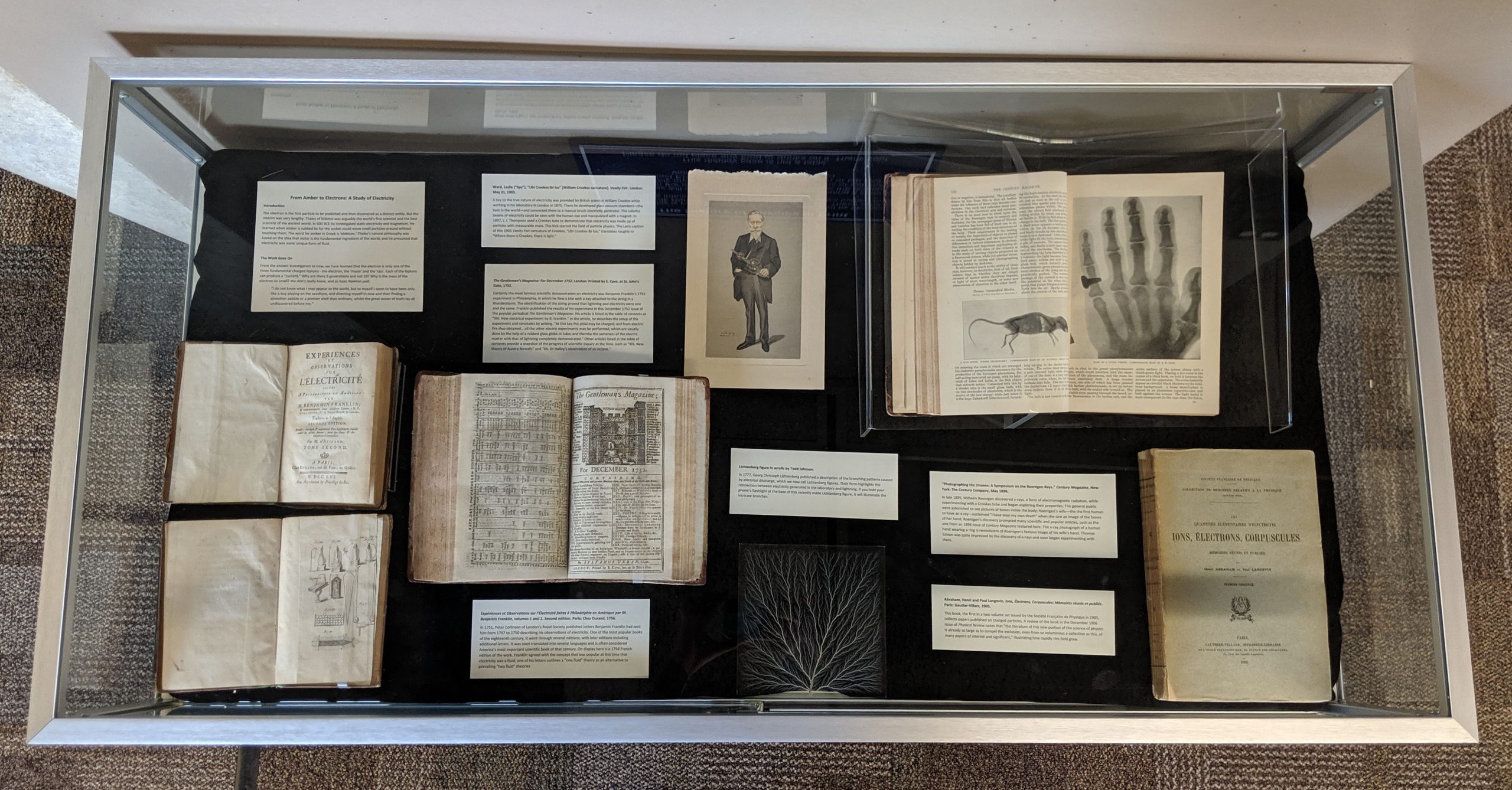
It’s electric! From now through June, see the latest installation in the Fermilab Archives series on the history of physics in print. Photo: Valerie Higgins
Fermilab scientist Erik Ramberg and the Fermilab Archives present a new exhibit, “From Amber to Electrons: A Study of Electricity,” as part of their series on the history of physics in print. The exhibit can be viewed in the glass display case in the Fermilab Art Gallery through the end of June. The gallery is located on the second floor of Fermilab’s Wilson Hall and is open Monday through Friday, 8 a.m. to 4:30 p.m.
The exhibit showcases printed publications, an image, and an object that reflect scientific and conceptual understandings of electricity, from Ben Franklin’s famous kite and key experiment in 1752 to J. J. Thomson’s discovery at the end of the 19th century that electrical currents were made of particles called electrons.
Thales of Miletus was arguably the world’s first scientist and the best scientist of the ancient world. In 600 BC he investigated static electricity. He learned that when amber is rubbed by fur, the amber can move small particles around without touching them. The word for amber in Greek is “elektron.” Thales’s natural philosophy was based on the idea that water is the fundamental ingredient of the world, and he presumed that electricity was some unique form of fluid.
From the ancient investigators to now, we have learned that the electron is only one of the three fundamental charged leptons — the electron, muon and tau. Each of the leptons can produce a “current.” Why are there three generations and not 10? Why is the mass of the electron so small? These are questions scientists are still trying to answer.
This exhibit was designed by Valerie Higgins, Karin Kemp and Erik Ramberg. Exhibited items are from Erik Ramberg’s collection.

Fermilab’s Family Outdoor Fair is scheduled for Sunday, June 9 from 1-4 p.m.
What could be better than spending a fun-filled day outdoors and learning about natural science at the same time?
For the 11th year in a row, Fermi National Accelerator Laboratory is inviting families, scout troops and other youth groups to attend the Family Outdoor Fair on Sunday, June 9, from 1-4 p.m. The fair takes place outside the Lederman Science Center and highlights the plant and animal life found on the 6,800-acre Fermilab site in Batavia.
More than a dozen outdoor activities are planned for the fair, including a prairie scavenger hunt and a visit with Fermilab’s herd of bison. Kids can test whether they can run as fast as a bison, can sweep for insects and pond critters, and thanks to the Naperville Astronomical Association, can safely get a long look at the sun.
Once again, the Northern Illinois Raptor Rehabilitation and Education Center, along with local raptor trainers, will be on hand with live hawks, falcons and owls, as well as a collection of bird bones, feathers and hunting gear for children to enjoy.
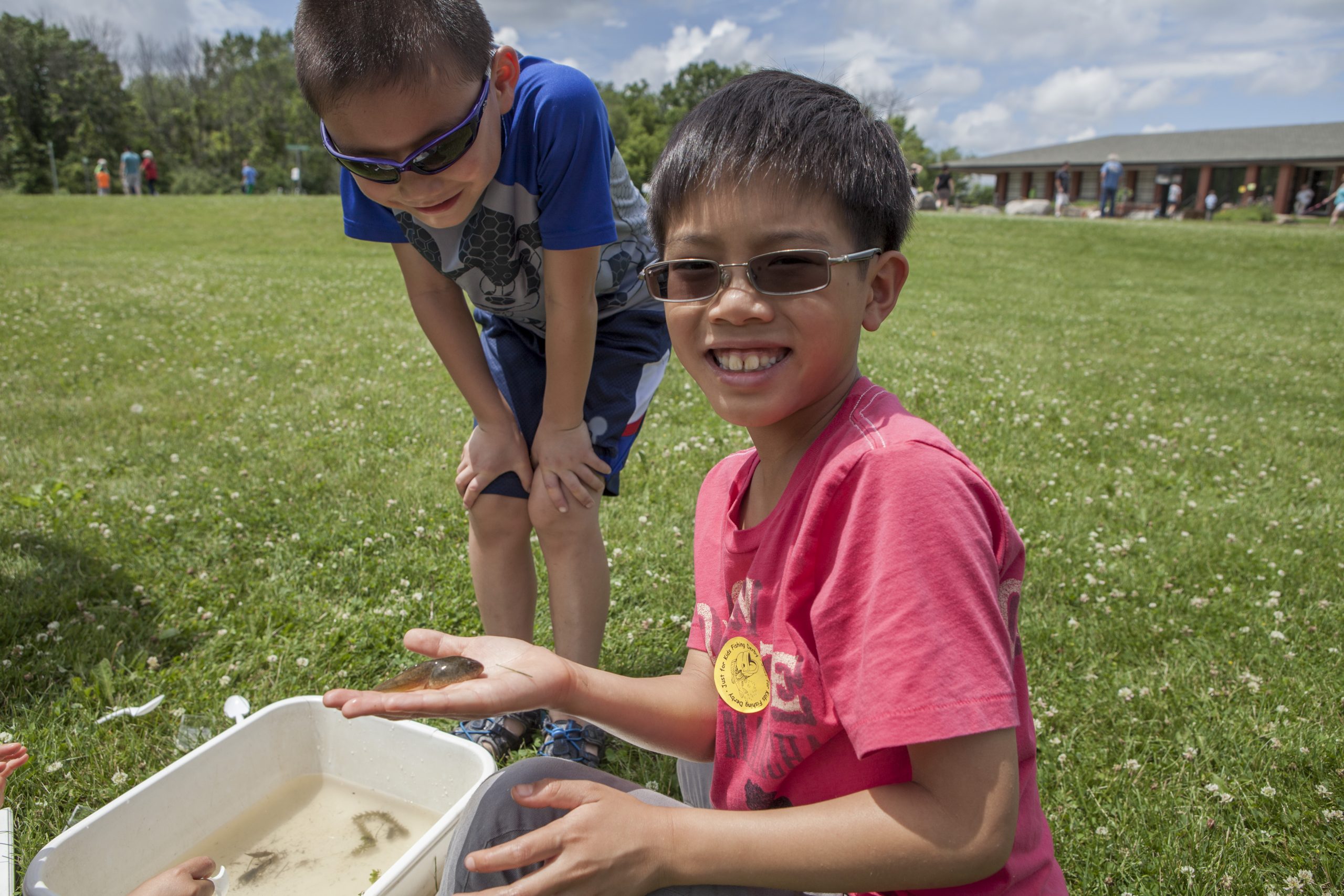
Kids will get to check out critters at the Family Outdoor Fair. Photo: Reidar Hahn
“As a National Environmental Research Park, Fermilab studies our many ecosystems which include the amazing plants and animals that make our natural sites unique,” said Maureen Hix of the Fermilab Office of Education and Public Outreach. “We want kids and parents to connect with this nature through hands-on opportunities, to discover the wonder and value that nature provides us. We hope they will transfer this experience to their own back yards!”
Of course, their back yards probably aren’t quite as vast as Fermilab’s. More than 1,000 acres of the laboratory site is restored natural prairie and restoration continues in woodland and wetland areas as well. This is part of Fermilab’s mission through the U.S. Department of Energy as a National Environmental Research Park.
The Family Outdoor Fair is geared for first through seventh grade students. The fair is free, and will take place rain or shine. Members of the media are welcome to attend. No registration is required. For more information, call 630-840-5588 or email edreg@fnal.gov.
The Fermilab Outdoor Fair is supported by Fermilab Friends for Science Education.
Fermilab is America’s premier national laboratory for particle physics and accelerator research. A U.S. Department of Energy Office of Science laboratory, Fermilab is located near Chicago, Illinois, and operated under contract by the Fermi Research Alliance, LLC. Visit Fermilab’s website at www.fnal.gov and follow us on Twitter at @Fermilab.
The DOE Office of Science is the single largest supporter of basic research in the physical sciences in the United States and is working to address some of the most pressing challenges of our time. For more information, please visit https://energy.gov/science.