Dark Energy Survey scientists release new analysis of how the universe expands
The latest results combined weak lensing and galaxy clustering and incorporated four dark energy probes from a single experiment for the first time.
1 - 10 of 16 results
The latest results combined weak lensing and galaxy clustering and incorporated four dark energy probes from a single experiment for the first time.
NIORLab, August 5, 2025
The Dark Energy Camera, designed specifically for the Dark Energy Survey and built and tested at Fermilab, captured an image assembled from a total of 28 hours of observations. The image gives a tantalizing hint of how intracluster light will be revealed by the Rubin Observatory’s Legacy Survey of Space and Time.
The Dark Energy Survey has measured the BAO scale when the universe was half its present age with an accuracy of 2%, the most accurate determination yet at such an early epoch. It is the first time an imaging-only measurement is competitive with large spectroscopy campaigns specifically designed to detect this signal.
From NIOR Lab, Jan. 8, 2024
The culmination of 25 years of research by astrophysicists of the Dark Energy Survey team has concluded that the Universe is expanding at an accelerating rate. The Dark Energy Survey observed almost two million distant galaxies using the Dark Energy Camera built and tested by Fermilab
making this the largest, deepest supernova sample ever obtained from a single telescope.
From CNET, November 13, 2022: View new photos of radiant galaxies released by NASA using the Dark Energy Camera, developed and tested by Fermilab, and the Hubble Space Telescope. These new images show galaxies scattered across the universe some 200 million light-years away.
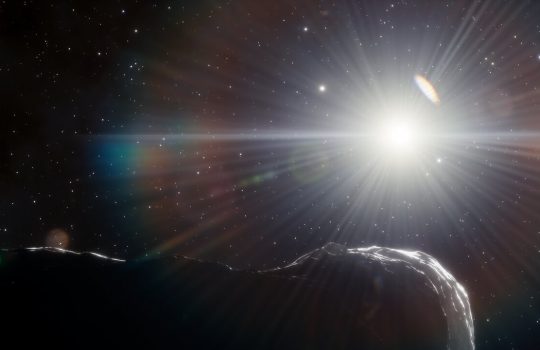
Twilight observations from Cerro Tololo Inter-American Observatory spot three, large near-Earth objects lurking in the inner solar system.
From Science Times, January 31, 2022: The Hubble Space Telescope captured a stunning image of the Phoenix constellation with a group of galaxies collectively known as NGC that is approximately 450 million light-years away from Earth. The picture of three galaxies interacting was taken using a combination of the Hubble’s Advanced Camera for Surveys that includes the Dark Energy Survey Camera (DECam), developed and tested at Fermilab.
From National Geographic, September 28, 2021: Recently, Fermilab ran over 200 computers to analyze Dark Energy Survey images that helped identify a new comet called the Bernardinelli-Bernstein. It is estimated the nucleus of the comet is about 93 miles wide, the biggest size estimate for a comet in decades.
From Jumbo News, March 31, 2021: Fermilab’s Josh Frieman, Tom Diehl, Antonella Palmese, and Rich Kron as part of the Dark Energy Survey collaboration, have completed scanning a quarter of the southern skies for six years and cataloguing hundreds of millions of distant galaxies.
From NOIRLab, Feb. 8, 2021: The Dark Energy Camera, originally used to complete the Dark Energy Survey, has taken the most detailed photo of Messier 83, also known as the Southern Pinwheel galaxy. (In DECam’s second act, scientists can apply for time to use it to collect data that is then made publicly available.) In all, 163 DECam exposures went into creating this image.