Earlier this year, researchers, officials and the public gathered in the Black Hills of South Dakota to mark a major milestone as installation of the Deep Underground Neutrino Experiment at the Long-Baseline Neutrino Facility began.
“We are at a place now where the project is gaining a lot of forward momentum.”
Jim Kerby, LBNF/DUNE-US project director
“We are at a place now where the project is gaining a lot of forward momentum,” said Jim Kerby, LBNF/DUNE-US project director for Fermi National Accelerator Laboratory. “The past decade has seen serious planning, preparation, excavation and outfitting of the underground space. Now the steel is actually here and being sent underground to form the cryostats. DUNE is here. It is a reality.”
DUNE is the largest U.S. Department of Energy science experiment on American soil and an international collaboration hosted by Fermilab. The excavation work for DUNE’s enormous underground footprint began in June 2020 and was completed in 2024. The project has since been recognized by the Underground Construction Association for its outstanding engineering and design.
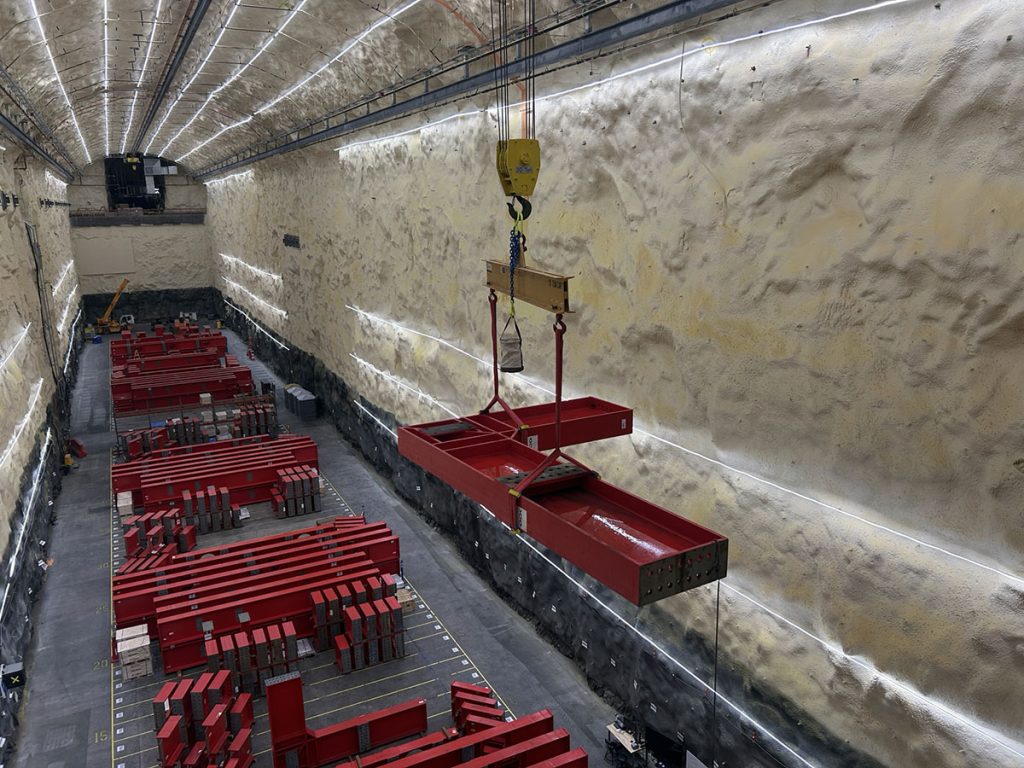
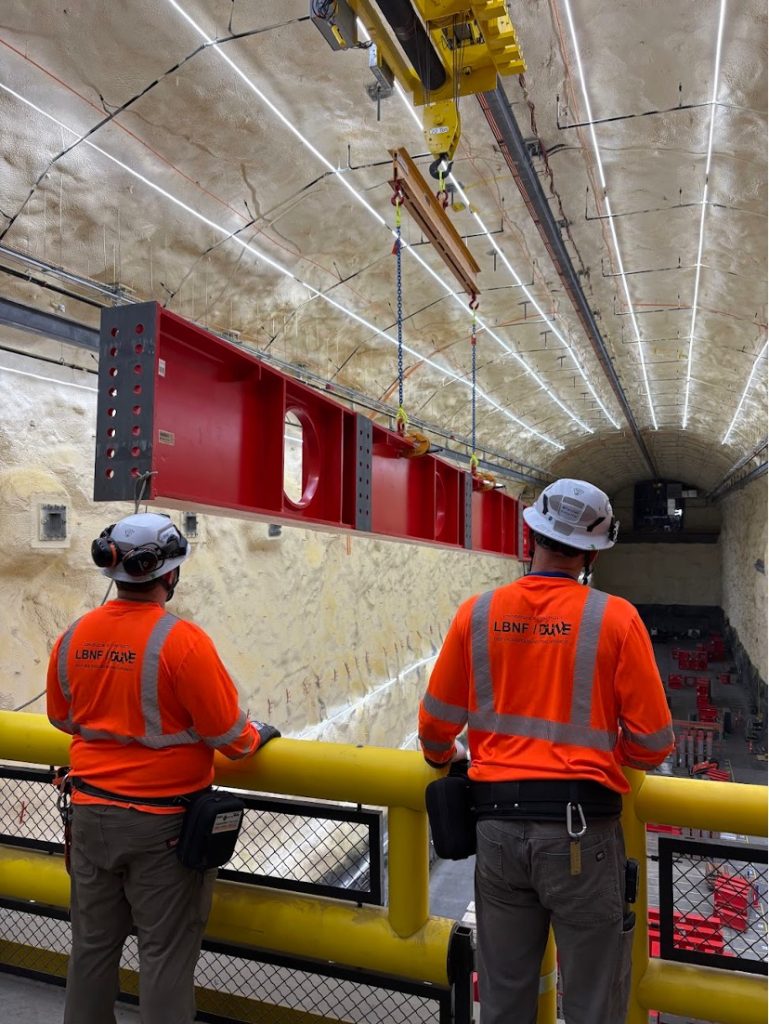
Demonstrating the significance of international partners for the experiment, CERN, the European Organization for Nuclear Research, has contributed more than 5,000 tons of structural steel that will form the cryostats for DUNE’s detector modules.
“This is the first time that CERN has provided infrastructure to a project outside of Europe, so that in itself says something about how important DUNE is to the future of science,” Kerby said. “We fully intend to show that the investment of our partners will be worth it to them.”
The work being done to construct the Long-Baseline Neutrino Facility will enable DUNE to begin its quest to unlock secrets behind neutrinos — often referred to as “ghost particles” because they rarely interact with other matter particles. Neutrinos make things even more interesting by changing between three varieties or what physicists call “flavors.” Thanks to several unique aspects of its design, DUNE will enable researchers not only to advance our understanding of neutrinos but also to search for new physics beyond the Standard Model. The experiment could potentially help explain why we live in a matter-dominated universe.
Building on a legacy of neutrino discovery
Neutrino science has a storied 70-year history, with groundbreaking discoveries coming from global experiments such as the Homestake experiment in the United States, Super-Kamiokande in Japan and SNO in Canada. Now the Sanford Underground Research Facility, the site of the former Homestake Mine in Lead, South Dakota, will be the far site for DUNE.
While DUNE will be the largest neutrino experiment of its kind, it is the latest in a history of neutrino experiments hosted by Fermilab, including MiniBooNE, MicroBooNE, SBND, ICARUS, MINOS, MINERvA, NOvA and DONUT.
As the DUNE at LBNF project moves into its next phase, members of the collaboration are eager to begin taking data — anticipated to start in early 2030 — to continue this legacy of discovery.
Chris Marshall, a University of Rochester researcher and DUNE collaborator who co-leads the experiment’s physics program, believes DUNE’s capabilities will enable researchers to explore deeper questions, including the ordering of neutrino masses, the origin of neutrino mixing, and whether our understanding of neutrinos within the Standard Model is complete.
“In the current three-flavor framework, we’ve been able to measure most of the parameters of neutrinos based on our understanding of the Standard Model,” said Marshall. “But we’re still not sure whether this is the right description of nature.”
DUNE’s unique design holds several key ingredients for successful discovery: the most intense beam of neutrinos in the world, a very long baseline, cutting-edge liquid-argon technology and a movable near detector.
Intense beamline and a long baseline
DUNE will be powered in large part by an upgrade currently being undertaken at the Fermilab Accelerator Complex, called the Proton Improvement Plan-II project. Once operational, the PIP-II linear accelerator will be used to generate this most-intense-in-the-world neutrino beam for the experiment. And just like DUNE at LBNF, PIP-II has important international partners contributing.
“PIP-II at Fermilab is the engine that will drive the LBNF,” Marshall said.
“PIP-II at Fermilab is the engine that will drive the LBNF.”
Chris Marshall, a University of Rochester
The beam of neutrinos from the Fermilab Accelerator Complex will be sent along DUNE’s long baseline — 800 miles through the Earth from Fermilab in Batavia, Illinois, to the Sanford Underground Research Facility. And because neutrinos harmlessly travel through matter, no tunnel is required for their journey.
“This distance from Fermilab to SURF gives us sensitivity to the way that matter affects neutrino oscillations, and we might see something that deviates from the Standard Model of physics,” Marshall said.
The PIP-II team recently installed the first beamline component for the accelerator, the radio-frequency quadrupole, which will focus the accelerator’s beam. And soon, they will begin commissioning the cryogenic system that will cool the superconducting accelerator. “It’s an important year for the PIP-II project,” said Cristian Boffo, PIP-II project director. “We are making lots of important progress and building on our years of momentum to deliver this vital instrument to power DUNE.”
Liquid-argon technology
In addition to the power of PIP-II, the liquid-argon time projection chamber technology employed by DUNE’s detectors will provide researchers with more granular, precise imaging of neutrino interactions than other experiments.
The beam’s broad range of energies will give researchers more ways to investigate the physics of neutrinos, but accurately measuring the neutrino energy will require reconstructing these interactions as precisely as possible.
Liquid-argon time projection chamber technology used in the detectors enables DUNE to provide those reconstructions reliably and with unprecedented clarity. The technology and its potential for scalability have been successfully demonstrated at overwhelming levels in the past decade, from the pioneering ICARUS experiment to the massive ProtoDUNEs — one kiloton-scale prototype detectors at CERN. “The imaging capability is really important for measuring all of the stuff that comes out of these interactions,” Marshall said.
DUNE detectors near and far
Once completed, DUNE will have two detectors: one at the near site on the Fermilab campus and the other at the far site at the SURF.
The near detector at Fermilab measures neutrinos before they have time to oscillate into other flavors, enabling DUNE scientists to understand precisely the composition of the beam. Within DUNE’s ND-LAr — which stands for near detector-liquid argon — is a movable detector offering a higher level of precision measurement and a new way to fully characterize the beam. The near detector’s design will allow researchers to better understand how neutrinos interact with matter across different energies, which in turn allows for more accurate measurements of oscillations. Because neutrinos change their flavor as they travel, the energy spectrum of each neutrino flavor at the far detector will be difficult to predict.
“We want a movable near detector because we want to address a really challenging problem once you get to making precision measurements, which is that the the energy spectra of the neutrinos at the near and far detectors are not the same,” Marshall said.
DUNE’s massive far detector modules at SURF will be the largest and most advanced detectors of their kind. Each will be filled with 17,000 tons of liquid argon and then chilled to about minus 363 degrees Fahrenheit. To ensure the detectors perform as they should, two ProtoDUNEs are demonstrating the technology that will go into the facility.
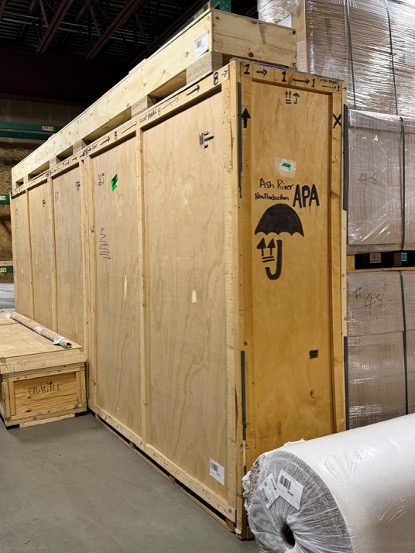
For instance, anode plane assemblies, or APAs, will be installed inside DUNE’s detectors. These screen-door-like panels, each measuring 20 feet by 7 1/2 feet, will be stacked inside the detectors and allow researchers to construct 3D images of neutrino interactions. Bare APA frames are being manufactured in the United Kingdom and then shipped to DUNE’s two production locations — one in the United Kingdom at the Daresbury Laboratory of the U.K. Science and Technology Facilities Council, and the other in the United States at the University of Chicago. Here, they are inspected, cleaned and outfitted with the wiring that will enable them to become fully functional. APA components have recently arrived in South Dakota, where they will be stored until they are ready for installation.
Path to discovery
Once these detector components are installed, DUNE’s key design features will provide the ability to measure all of the oscillation parameters of neutrinos at once, in one experiment, with no ambiguity and at high precision.
Additionally, DUNE will have the potential to reach five-sigma measurements — measurements so precise that there is only a probability of about 0.00003% that new scientific results could arise by chance.
“What we call ‘five-sigma’ is really the gold standard for discovery-level research.”
Chris Marshall, a University of Rochester
“What we call ‘five-sigma’ is really the gold standard for discovery-level research,” Marshall said.
DUNE is expected to have the potential to reach five-sigma measurements within only a few years upon becoming operational, and DUNE could potentially reach mass-ordering measurements within one year.
“Once we get to this discovery level data, we can start connecting neutrino oscillation to really big-picture, open questions in physics,” Marshall said.
This research addresses key physics mysteries: the origin of neutrino mixing, the existence of additional neutrino types and the completeness of the Standard Model. Beyond fundamental physics discovery, the drive to realize neutrino experiments at unprecedented scales could yield unexpected technological breakthroughs and innovation for the benefit of society.
Fermi National Accelerator Laboratory is America’s national laboratory for particle physics and accelerator research. Fermi Forward Discovery Group manages Fermilab for the U.S. Department of Energy Office of Science. Visit Fermilab’s website at www.fnal.gov and follow us on social media.
Recommended reading

Nobel Prize in physics awarded to Francis Halzen for groundbreaking neutrino research
The Royal Swedish Academy of Sciences has awarded the 2026 Nobel Prize in physics to Francis Halzen of the University of Wisconsin–Madison.

URA honors Fermilab researchers advancing laboratory’s top priorities
Tyler Barrett, Charis-Kleio Koraka, Kevin Kelly and Silvia Zorzetti are the recipients of the 2026 URA Honorary Awards. The awards are presented each year by Universities Research Association to recognize significant contributions to research at Fermilab.
Associate lab directors help shape future of Fermilab
Fermilab’s recent reorganization brings its accelerator, physics and technology programs under three unified directorates, each charged with advancing the laboratory’s most important scientific priorities. Together, these directorates form a coordinated leadership structure designed to deliver world class research and guide Fermilab’s future.