On a collision course
Big Picture Science, October 12, 2026
Big Picture Science discusses the breakthroughs around the detection of cosmic neutrinos with Kate Shaw, experimental particle physicist at the University of Sussex who works on DUNE.
1 - 10 of 165 results
Big Picture Science, October 12, 2026
Big Picture Science discusses the breakthroughs around the detection of cosmic neutrinos with Kate Shaw, experimental particle physicist at the University of Sussex who works on DUNE.
Wisconsin Public Radio, October 15, 2026
Wisconsin Public Radio interviewed Francis Halzen on winning the Nobel Prize in Physics and the importance of neutrino research.
Innovation News Network, October 15, 2026
A more precise result can expose a new problem or resolve an apparent discrepancy. That is the case with the Muon g-2 experiment with the most precise measurement of the muon and with the mass of the W boson.
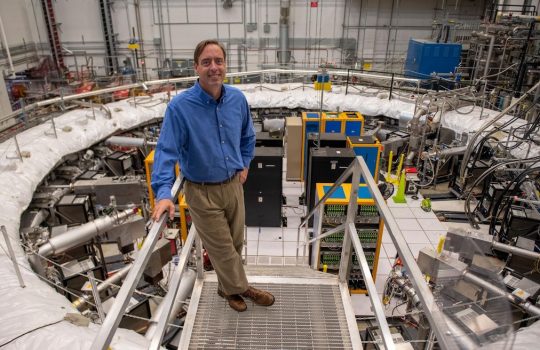
U.S. Secretary of Energy Chris Wright announced that Fermilab’s Chris Polly was one of nine recipients of the prestigious Ernest Orlando Lawrence Award for exceptional contributions to research and development supporting the U.S. Department of Energy’s (DOE) missions in science, energy and national security.
Quantum Insider, October 5. 2026
Researchers from the Fermilab-led SQMS Center identified material and fabrication features associated with variations in superconducting qubit performance. It is one of the most comprehensive studies ever conducted, linking materials and their structures to variations in quantum device performance.
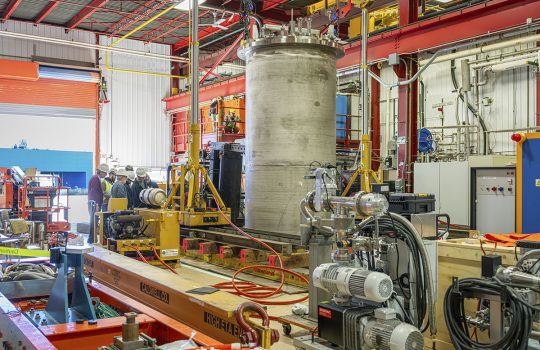
Fermilab’s long legacy of pioneering superconducting magnet technology is entering a new chapter with the launch of the MAGNet Environment Simulator. The test platform will support cutting-edge research aimed at enabling the powerful magnets needed for future fusion energy systems.
HPC Wire, October 9, 2026
Two new awards will expand Fermilab’s critical role in the Genesis Mission by developing custom microelectronics and advancing quantum information science.
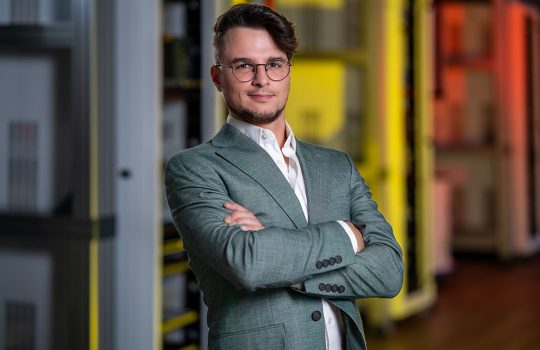
Daniel Bafia will develop a new measurement approach that uses magnetic vortices to investigate defects and interfaces that can limit the performance of superconducting quantum devices. The project could provide researchers with a new way to understand and ultimately reduce sources of energy loss in quantum materials.
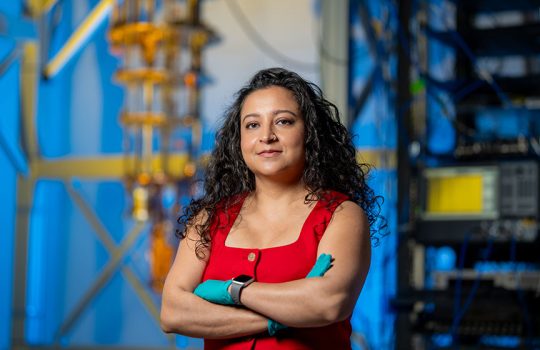
Building on her earlier work with quantum amplifiers for a leading dark matter experiment, Rakshya Khatiwada will use a four-qubit entangled system to test whether it offers a sensing advantage when exposed to a simulated dark matter signal. The project, based at Fermilab, could open the door to detecting dark matter candidates such as axions and dark photons.
Two new awards will expand Fermilab’s critical role in the Genesis Mission by developing custom microelectronics and advancing quantum information science.