
Physicists discovered decades ago that odd little particles called neutrinos, of which there are three known “flavors,” morph between these flavors as they travel, and they call this phenomenon neutrino oscillation. The Deep Underground Neutrino Experiment, developed by an international collaboration and hosted by Fermi National Accelerator Laboratory, aims to answer fundamental questions about the early evolution of the universe through its study of these oscillations. This requires a neutrino beam and the ability to sample the neutrinos right out of the gate in their original state and again after they change.
To capture the data, DUNE is building both a near detector and a far detector in the path of the most intense neutrino beam ever created. The hybrid near detector, located only about 2,000 feet downstream from the neutrino source at Fermilab in Batavia, Illinois, will get the first taste. But most of the neutrinos will travel 800 miles on to the far detector at the Sanford Underground Research Facility in Lead, South Dakota, where only a small proportion will interact with the detector because the beam will spread out over that distance and neutrinos are famously elusive. The rest will harmlessly sail on, largely unimpeded, through the Earth’s crust and beyond.
Since the DUNE far detector will use liquid-argon time projection chamber technology to measure neutrinos, it is critical that the same technology be used for the near detector to facilitate a comparison of data on the same target — liquid argon. This part of DUNE’s near detector is called ND-LAr, short for “near detector liquid argon.”
“Despite being only 1% the size of one far detector module, this ND-LAr detector is still large enough to fully contain the signals from neutrinos.”
Michele Weber, the University of Bern
As part of DUNE’s plan to measure neutrinos over a wide range of energies, the ND-LAr, along with an accompanying muon spectrometer, will be able to move sideways off axis to better characterize the beam. A stationary beam monitor will remain on axis to watch for any beam variations that could affect measurements.
“Despite being only 1% the size of one far detector module, this ND-LAr detector is still large enough to fully contain the signals from neutrinos,” said Michele Weber from the University of Bern who is also the leader of the ND-LAr consortium. “This enables a precise comparison with what is seen at the far detector, thereby revealing the neutrino oscillation that occurs between the two sites.”
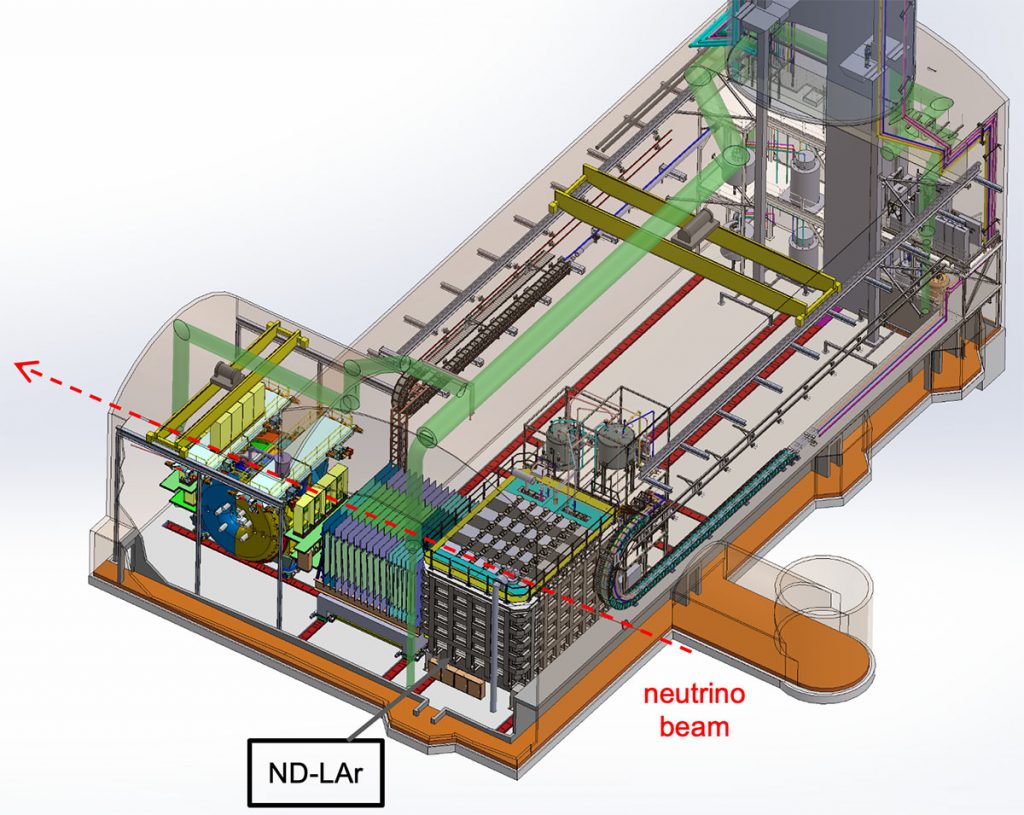
Given that the neutrino beam broadens with distance, more like the light from a flashlight than a laser beam, the near detector will see a much more concentrated flux of neutrinos than will the far detector — one of the reasons the near detector does not have to be so large. This concentration of neutrinos leads to a phenomenon called “pileup” in the detector, where the rate of neutrino interactions overwhelms the rate at which the detector can record the charge signals that emanate from them. The ND-LAr design cleverly mitigates this problem by segmenting its volume into mini detectors, called modules, with individual pixelated readout. The numerous interactions occur in different modules, without overwhelming any of them.
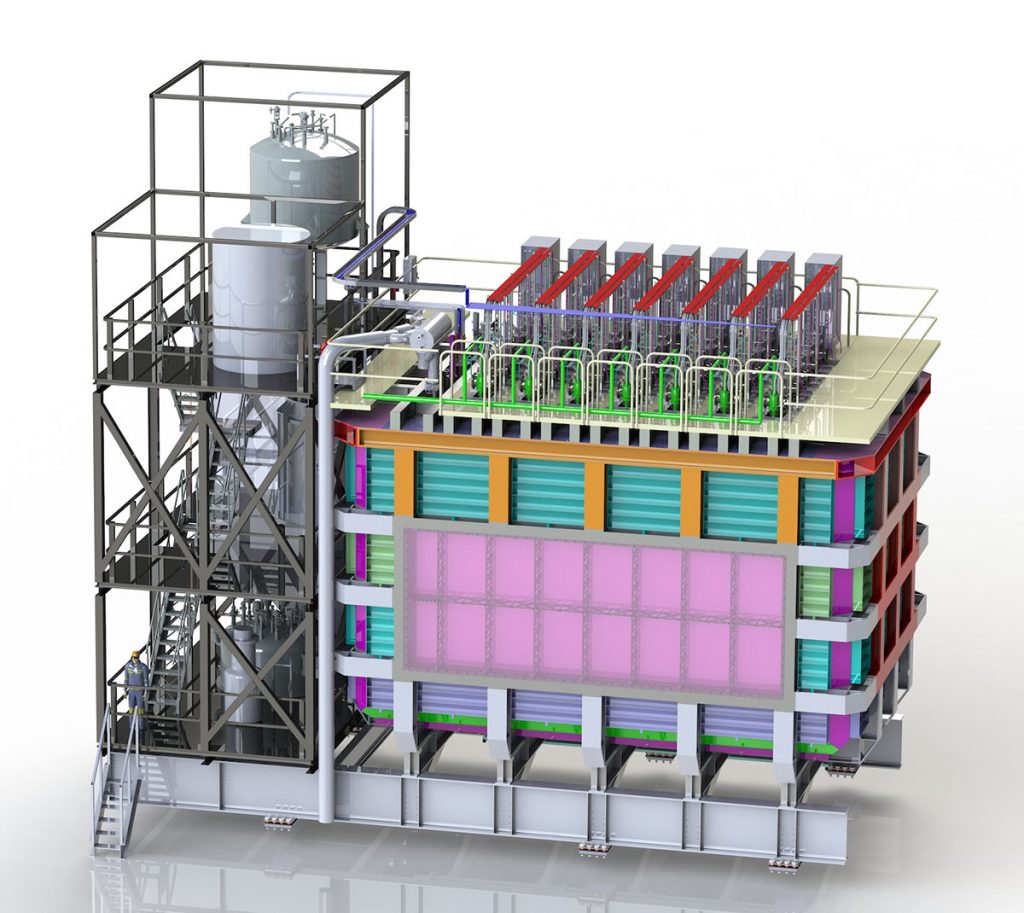
ND‑LAr uses the novel liquid-argon pixel system, or LArPix, that was invented by physicists and engineers at Lawrence Berkeley National Laboratory. This end‑to‑end pixelated sensor and electronics system can image neutrino events in true 3D, which is an important aspect to resolving individual neutrino interactions in the detector.
Brooke Russell, a researcher with the Massachusetts Institute of Technology, is testing reconstruction efforts for this type of pileup mitigation. By anticipating pileup from the neutrino beam, the team hopes to paint as accurate a picture as possible and not be overwhelmed by the rate of neutrino interactions.
“ND-LAr is unique in that we purposely partition neutrino signals across multiple optically segmented volumes and algorithmically stitch these signals back together,” Russell said.
Through these segmentation and reconstruction efforts, DUNE will provide consistent clarity of the recorded neutrino interactions.
Even with the segmentation, interactions that occur very close to one another in space may be misinterpreted as a single event unless light signals are also collected to separate them in time, according to Zoya Vallari of the Ohio State University, an analysis coordinator for the ND-LAr. The instantaneous signals that scintillation light produces in the liquid argon make it possible to distinguish the potentially overlapping charge signals.
“The prototyping program for the DUNE liquid-argon near detector has been wildly successful, advancing multiple novel detector technologies and algorithms for data analysis.”
Dan Dwyer, Lawrence Berkeley National Laboratory
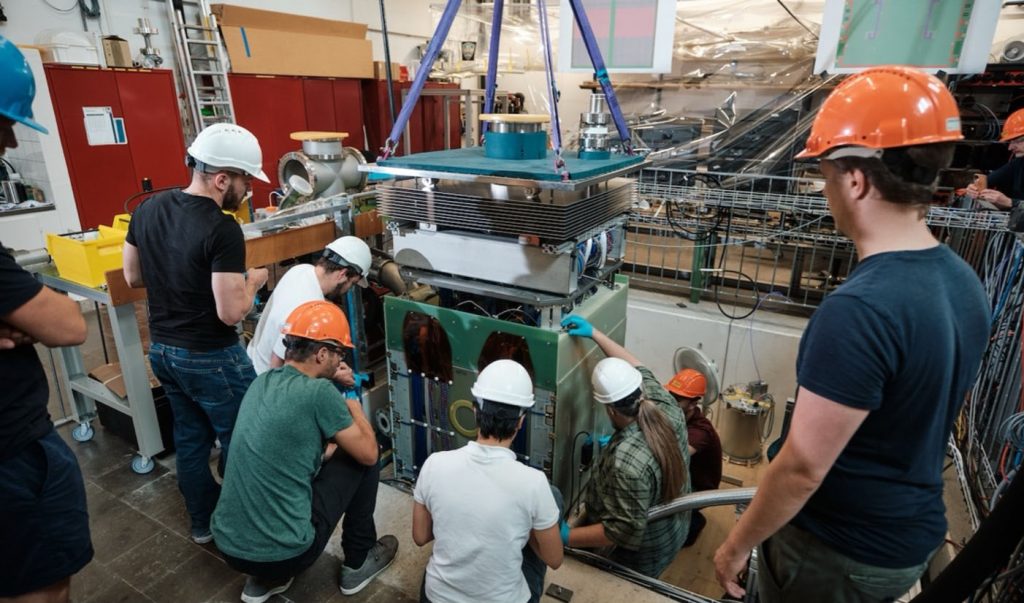
The DUNE ND-LAr team has been developing and prototyping the segmented liquid-argon time projection chamber design, primarily at the University of Bern, in Switzerland, starting in 2016 with a program called ArgonCube to test the component technologies. In 2022 the steadily growing team constructed and tested a demonstrator of four half-size time-projection chamber modules, called 2×2. After collecting data from a neutrino beam source, this detector is now in a non-beam data collection phase at Fermilab, recording events from cosmic rays and other sources, such as calibration data. The effort currently involves more than 100 scientists from roughly 40 institutions.
“The 2×2 program has been pivotal in shaping our software, simulation and analysis frameworks,” said Vallari. “The data we collected is driving progress in calibration, event reconstruction and charge-light matching.”
“The experience gained with 2×2 has enabled us to thoroughly validate the detector concept in a realistic environment,” added Livio Calivers, a freshly minted Ph.D. from Bern. “As a young researcher, it gave me the opportunity to build an experiment from scratch and ultimately analyze real data from neutrino interactions.”
The team built and tested a single full-scale module in 2024 that incorporated improvements guided by insights from the 2×2 effort. A full row of five modules is currently in the works to test production, assembly and integration procedures, aiming for production to start at Fermilab in 2026.
“The prototyping program for the DUNE liquid-argon near detector has been wildly successful, advancing multiple novel detector technologies and algorithms for data analysis,” said Dan Dwyer of Berkeley Lab who is also the technical lead for ND-LAr. “These results give us confidence that we can cope with the very high intensity of the DUNE neutrino beam and achieve DUNE’s ambitious scientific goals.”
Fermi National Accelerator Laboratory is America’s national laboratory for particle physics and accelerator research. Fermi Forward Discovery Group manages Fermilab for the U.S. Department of Energy Office of Science. Visit Fermilab’s website at www.fnal.gov and follow us on social media.
Recommended reading

URA honors Fermilab researchers advancing laboratory’s top priorities
Tyler Barrett, Charis-Kleio Koraka, Kevin Kelly and Silvia Zorzetti are the recipients of the 2026 URA Honorary Awards. The awards are presented each year by Universities Research Association to recognize significant contributions to research at Fermilab.
Associate lab directors help shape future of Fermilab
Fermilab’s recent reorganization brings its accelerator, physics and technology programs under three unified directorates, each charged with advancing the laboratory’s most important scientific priorities. Together, these directorates form a coordinated leadership structure designed to deliver world class research and guide Fermilab’s future.
Scientists travel to Fermilab to discuss future of high-energy physics
Fermilab recently hosted over 500 physicists for the American Physical Society’s biennial Division of Particles and Fields meeting. With presentations by Fermilab Director Norbert Holtkamp and CERN Director-General Mark Thomson, the meeting provided particle physicists the opportunity to come together and consider the future of high-energy physics research.