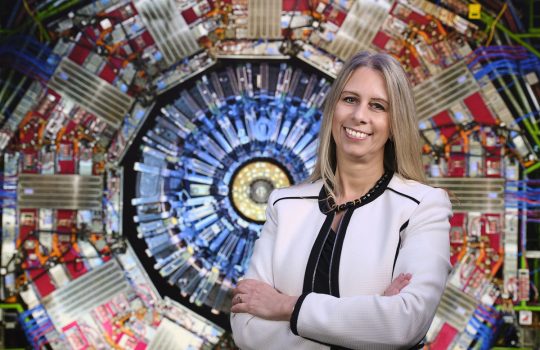
Anadi Canepa begins work as new CMS spokesperson
The Fermilab senior scientist brings a wealth of scientific leadership experience to her new role as the collaboration prepares for the High-Luminosity Large Hadron Collider.
1 - 10 of 37 results
The Fermilab senior scientist brings a wealth of scientific leadership experience to her new role as the collaboration prepares for the High-Luminosity Large Hadron Collider.
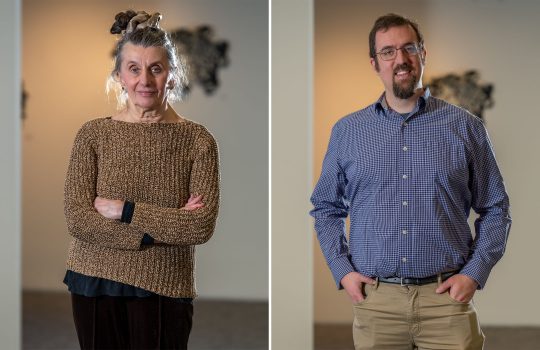
Fermi Forward Discovery Group’s annual guest artist and composer program fosters creative collaborations that help translate Fermilab’s complex scientific research into accessible, engaging experiences. In 2026, visual artist Eleftheria Lialios and composer Isaac Smith will bring their distinct perspectives to transform particle physics data into immersive visual and auditory works for the public.
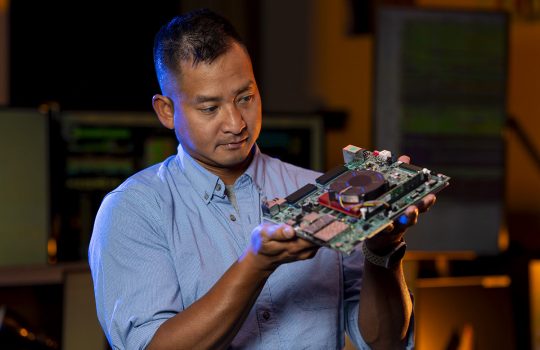
Fermilab researchers have provided expertise and leadership in developing an open-source framework that enables the design of hardware capable of making split-second decisions. These advances aim to prioritize the enormous volumes of data produced by some of humanity’s most ambitious physics experiments.
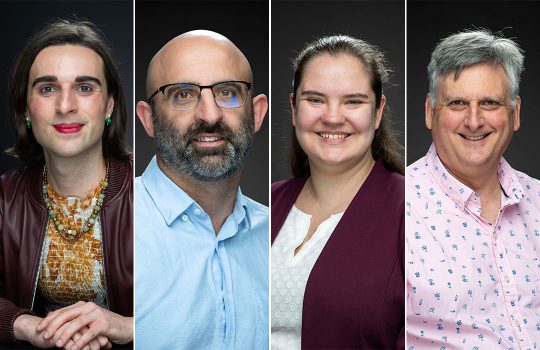
Gray Putnam, James Mott, Lauren Yates and Chris Jensen are this year’s recipients of the URA Honorary Awards. The awards are presented each year to recognize significant contributions to research at Fermilab.
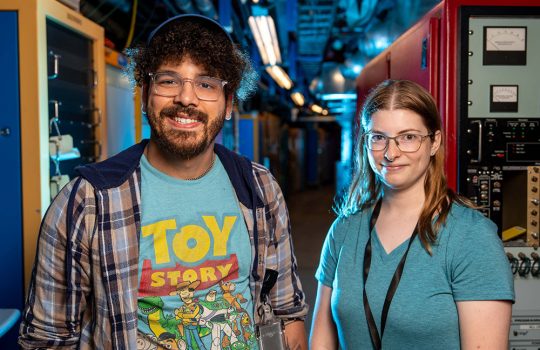
Fermilab is forging innovative partnerships with community colleges to develop the next generation of technical talent. Through hands-on internships and collaborative curriculum development, students are gaining access to real-world experiences that launch meaningful careers in science and engineering.
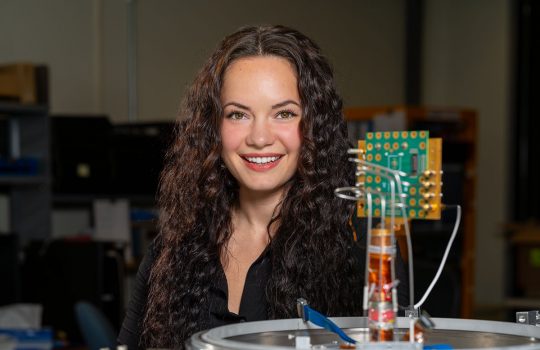
At Fermi National Accelerator Laboratory, postdoctoral researcher Ryan Linehan explores the intersection of quantum information science and particle physics by studying how particles impact superconducting quantum devices. Linehan’s work helps advance both quantum computing and dark matter detection.
Since its inception 50 years ago, the prairie restoration success at Fermilab has become a living laboratory — supporting scientific research, fostering biodiversity and providing essential ecosystem services like erosion control and enhanced soil health.
Physicists are exploring the development of a muon collider — an advanced particle accelerator that could reveal new insights into the nature of our universe. Though great challenges exist in studying fast-decaying muons, technological advancements in accelerators, magnets and detectors could make building the collider a reality. Recent workshops hosted by Fermilab brought together researchers from around the globe to address some of these challenges.
Fermilab earned national recognition for its sustainability efforts, receiving three prestigious awards from the U.S. Department of Energy. The laboratory’s new Integrated Engineering Research Center was celebrated for its environmentally friendly design. The successful transition of 32% of Fermilab’s fleet to zero emission vehicles was also recognized.
Particle accelerator beams can create significant damage to the targets used to generate particles for experiments. Researchers are designing targets to withstand material degradation from radiation damage, shock from thermal expansion and material fatigue — all caused by accelerated protons.