
The world’s largest astronomical movie
The Large Synoptic Survey Telescope will track billions of objects for 10 years, creating unprecedented opportunities for studies of cosmic mysteries.

1761 - 1770 of 2562 results
The Large Synoptic Survey Telescope will track billions of objects for 10 years, creating unprecedented opportunities for studies of cosmic mysteries.
From Gizmodo, April 9, 2018: Some folks are excited about an especially tiny (and especially weird) dark matter candidate that happens to be named after a laundry detergent: the axion. Fermilab is a collaborator on the Axion Dark Matter eXperiment, and scientists on ADMX at the University of Washington think they’re ready to spot this theoretical particle.

U.S. Secretary of Energy Rick Perry and India’s Atomic Energy Secretary Sekhar Basu signed an agreement that opens the way for jointly advancing LBNF/DUNE.
From India Today, April 12, 2018: Thanks to a breakthrough at Fermilab’s MiniBooNE experiment scientists can observe muon neutrinos, a particular type of neutrino, with exactly known energy hit at atoms in their particle detector.
From Motherboard, April 10, 2018: New results from the Axion Dark Matter Experiment, on which Fermilab is a collaborating institution, suggest that it is now well-tuned enough to detect axions, a theoretical low-mass particle that many physicists believe may account for dark matter.

The William & Mary professor will help lead the neutrino program into the future.
From Science News, April 9, 2018: For the first time, physicists are snooping on some of the likeliest hiding places for hypothetical subatomic particles called axions, which could make up dark matter. So far, no traces of the particles have been found, scientists with the Axion Dark Matter Experiment, ADMX, report April 9 in Physical Review Letters.
From UPI, April 9, 2018: For the first time, scientists have precisely measured the interactions between neutrinos hitting the atomic nuclei in the heart of the MiniBooNE neutrino detector. The findings — detailed in the journal Physical Review Letters — remove much of the uncertainty undermining theoretical models of neutrino oscillations and interactions.
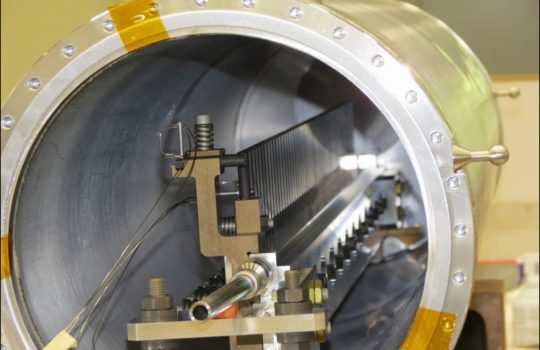
In particle physics, the target is the site of particle creation. It’s a straightforward role with complex considerations.
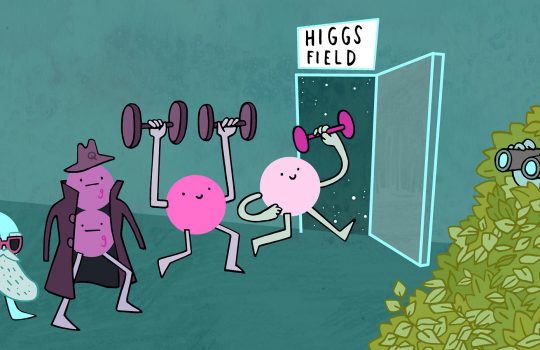
It doesn’t seem like collisions of particles with no mass should be able to produce the “mass-giving” boson, the Higgs. But every other second at the LHC, they do.