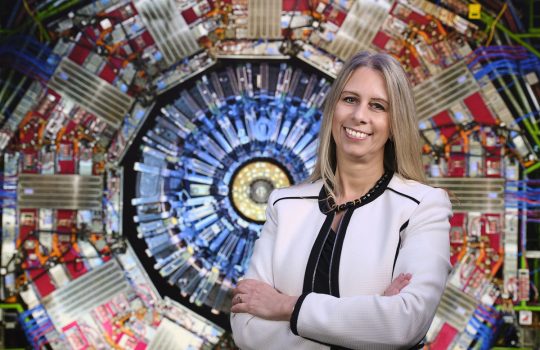
Anadi Canepa begins work as new CMS spokesperson
The Fermilab senior scientist brings a wealth of scientific leadership experience to her new role as the collaboration prepares for the High-Luminosity Large Hadron Collider.
1 - 10 of 125 results
The Fermilab senior scientist brings a wealth of scientific leadership experience to her new role as the collaboration prepares for the High-Luminosity Large Hadron Collider.
The American Physical Society has honored researchers at Fermilab for their outstanding contributions to physics. These recognitions include major APS prizes and fellowships, underscoring the laboratory’s leadership in advancing scientific discovery.
Phys.org, Janauary 29, 2026
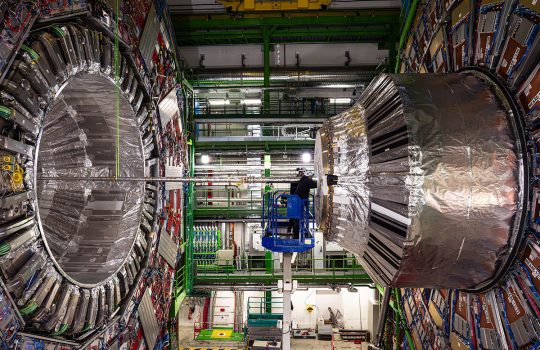
CMS scientists recently formed the first prototype “cassette” for the new endcap calorimeters which will be the largest silicon-based detectors ever built when complete. This technology will increase in the number of particles that the HL-LHC will deliver and result in 4 to 5 times more simultaneous particle collisions than occur with the existing LHC.
Quantum Zeitgeist, April 13, 2025
The discovery of the Higgs boson announced on July 4, 2012 by teams working at the ATLAS and CMS confirmed the theoretical framework proposed in the 1960s by Peter Higgs and others.
Fermilab Distinguished Scientist Patricia McBride was invited to Santa Monica, California to accept the 2025 Breakthrough Prize in Fundamental Physics on behalf of the CMS collaboration.
Nature, April 5, 2025
The ALICE, ATLAS, CMS and LHCb collaborations received the 2025 Breakthrough Prize in Fundamental Physics on behalf of the CMS Collaboration on April 5, 2025.
Phys.org, April 3, 2015
The CMS collaboration has observed an unexpected feature in data produced by the LHC which could point to the existence of the smallest composite particle yet observed.
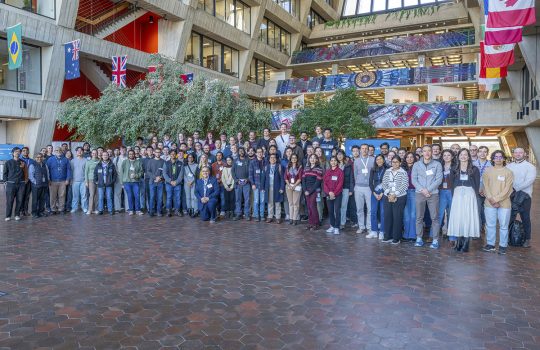
Over 100 participants convened at Fermi National Accelerator Laboratory for the 2025 CMS Data Analysis School, an intensive program dedicated to preparing the next generation of physicists for work on the CMS experiment at CERN. Hosted by the LHC Physics Center at Fermilab, the week-long event included lectures, hands-on exercises and collaborative analysis projects designed to enhance participants’ expertise in particle physics data analysis.
A large and unexpected excess of top quark pairs has the physics community excited, but the interpretation is still up for debate.
A key milestone in the U.S.-funded upgrade to the CMS experiment was achieved with the successful delivery of a 5-meter-long carbon support tube to CERN. Designed and built at Purdue University, the tube will house new inner particle detectors for CMS, which is being prepared for the high-luminosity upgrade of the Large Hadron Collider. The CMS collaboration is composed of scientists from roughly 240 institutions spread across more than 50 countries.