cosmology

61 - 70 of 117 results

Our universe’s first seconds

    From In the Moment, Oct. 31, 2019: In this 42-minute podcast, Fermilab scientist Dan Hooper talks about particles, relativity and the origins of our universe, outlining our growing understanding of the conditions in which our universe began, highlighting what we know about the first few seconds after the Big Bang and how several astronomers and mathematicians throughout history helped us determine that the universe was expanding.
    DESI opens its 5,000 eyes to capture the colors of the cosmos

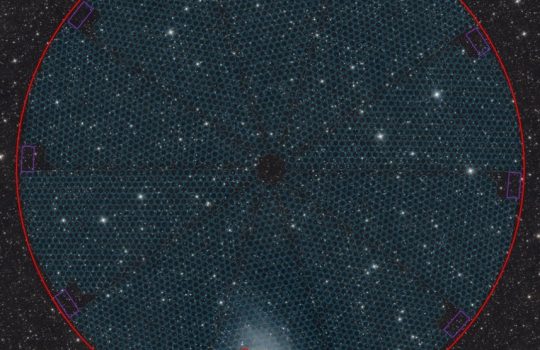
    Berkeley Lab’s Dark Energy Spectroscopic Instrument aimed its robotic array of 5,000 fiber-optic “eyes” at the night sky Oct. 22 to capture the first images showing its unique view of galaxy light. It was the first test DESI with its nearly complete complement of components. Fermilab contributed key elements to DESI, including the corrector barrel, hexapod, cage and CCDs. Fermilab also provided the online databases used for data acquisition and the software for the instrument’s robotic positioners.

    Dark matter has never killed anyone, and scientists want to know why

      From Popular Science, July 29, 2019: “Death by Dark Matter” is not the name of your new favorite metal band; it’s the literal title of a new study by a trio of American of physicists. Fermilab science Dan Hooper is quoted in this article on their paper, which explores what the hypothetical consequences might be on the human population if a certain candidate of dark matter turned out to be true.

      The 9 percent difference

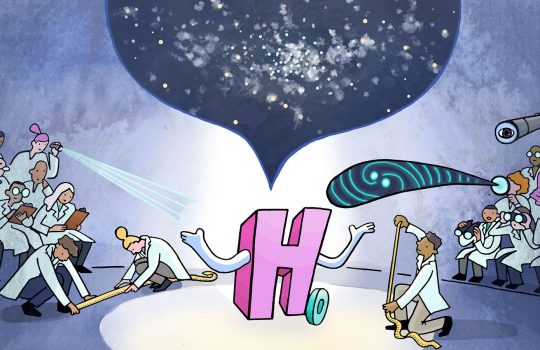
        Few numbers have gotten under astronomers’ skin like the Hubble constant. In fact, experts have debated the value of this single parameter for 90 years, and if astronomers can measure its value with great precision, they’ll be one step closer to solving some of the other grand astronomical mysteries of our age. There’s just one problem: The measurements they’ve taken don’t agree. The discrepancy makes scientists question whether something is amiss in our understanding of the universe.

        Three sky surveys completed in preparation for Dark Energy Spectroscopic Instrument

        It took three sky surveys to prepare for a new project that will create the largest 3-D map of the universe’s galaxies and glean new insights about the universe’s accelerating expansion. This Dark Energy Spectroscopic Instrument project will explore this expansion, driven by a mysterious property known as dark energy, in great detail. The surveys, which wrapped up in March, have amassed images of more than 1 billion galaxies and are essential in selecting celestial objects to target with DESI, now under construction in Arizona.