
Fermi National Accelerator Laboratory’s reputation as America’s particle physics laboratory is based on groundbreaking experiments, powerful particle accelerators and advanced technologies, all pushing the boundaries of discovery. Helping to guide those efforts and chart the path for Fermilab’s future is the lab’s scientific leadership team.
Earlier this year, Fermilab underwent a reorganization that established three science-focused directorates — the Accelerator Directorate, the Physics Directorate and the Technology Directorate led, respectively, by Associate Laboratory Directors Alexander Valishev, Doug Glenzinski and Anna Grassellino.
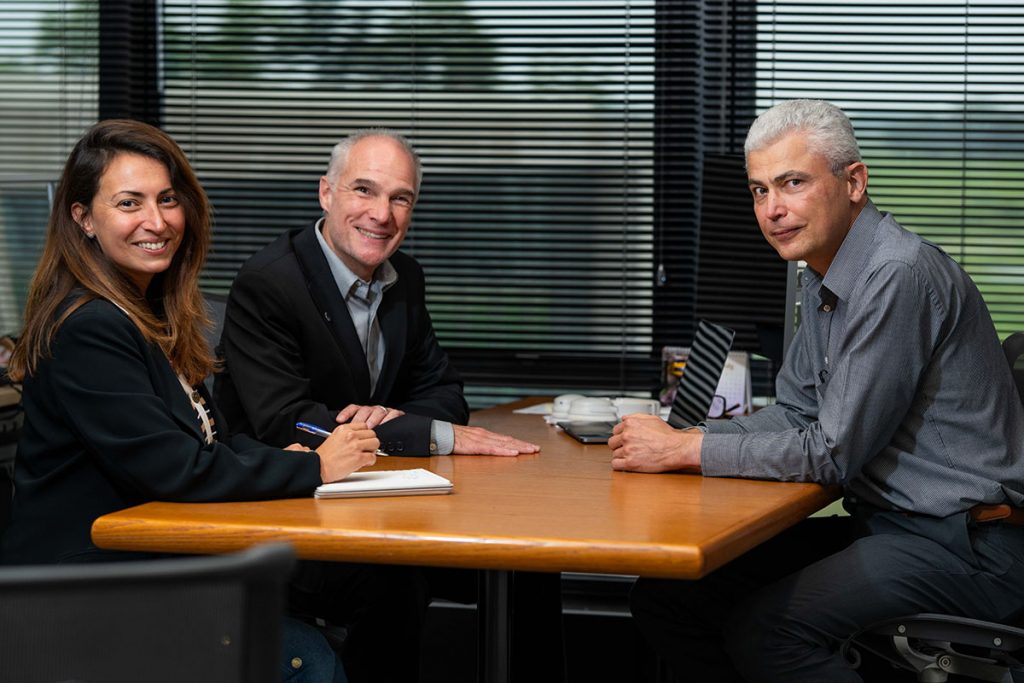
Together, the three organizations oversee the laboratory’s accelerator complex, scientific research programs and technology development that are core to Fermilab achieving its top priorities. This collaborative approach reflects Fermilab’s broader vision of delivering world-leading science through disciplined execution — safely, efficiently and in partnership with the global scientific community.
“The three mission directorates are united to achieve Fermilab’s highest priority, which is the delivery of beam to the Deep Underground Neutrino Experiment at the Long-Baseline Neutrino Facility by 2031,” Valishev said. “Each has a significant, well-defined area of responsibility in this common goal. The Accelerator Directorate is focused on the delivery of primary proton beam to the LBNF target. The Physics Directorate is working on particle detectors. The Technology Directorate is tasked with producing state-of-the-art accelerator and detector components. Collaboration is key to achieving the top priority, and we share knowledge and resources amongst ourselves and within the lab broadly.”
Three directorates, one team
Valishev, who holds a doctorate in physics from the Budker Institute of Nuclear Physics in Russia, has been with Fermilab for more than two decades. He began his career at Fermilab as a guest scientist in 2003 and has held a series of increasing leadership roles in the laboratory’s accelerator organization.
As head of the Accelerator Directorate, Valishev leads a team responsible for operating and enhancing the Fermilab Accelerator Complex. They deliver particle beams for researchers while maintaining and modernizing one of the world’s most sophisticated accelerator facilities. His long-term vision is an accelerator complex capable of reliably delivering megawatt-class proton beams for DUNE — protons that will be converted into neutrinos at the end of the beamline — while expanding its capabilities to support future particle physics, accelerator science and emerging applications such as fusion research.
“Our core responsibility is delivering particle beams for researchers. But we also have to continue innovating so the accelerator complex can support the science of tomorrow.”
Alexander Valishev, Fermilab Accelerator Directorate
“Our core responsibility is delivering particle beams for researchers,” Valishev said. “But we also have to continue innovating so the accelerator complex can support the science of tomorrow.”
Glenzinski leads the Physics Directorate, home to Fermilab’s particle physics research. The directorate oversees experimental programs spanning the cosmic, energy and neutrino frontiers. Holding a doctorate in physics from Johns Hopkins University, he began his career at Fermilab as a Wilson Fellow in 1999. Since then, Glenzinski has held an array of leadership roles at Fermilab, including deputy chief research officer, chief project officer and co-spokesperson for the Mu2e experiment, which is designed to probe for new physics through observing muons converting directly into electrons with no accompanying neutrinos.
“I see the mission of the Physics Directorate as conceiving, designing, building and operating experimental facilities to accomplish world-class science together with our collaborators and international partners,” Glenzinski said. “It’s everything from conceptualizing new experiments to choosing the experiments that are the most promising and executing them.”
“I see the mission of the Physics Directorate as conceiving, designing, building and operating experimental facilities to accomplish world-class science together with our collaborators and international partners.”
Doug Glenzinski, Fermilab Physics Directorate
Glenzinski’s directorate is also home to Fermilab’s theory division. “We have a world-class theory group that plays an important role in understanding the underlying science and tying together the broader physics community around the new ideas that inspire future experiments,” he said.
Grassellino, who also holds the positions at Fermilab of chief technology officer and director of the Superconducting Quantum Materials and Systems Center, heads the Technology Directorate. This directorate is central to Fermilab’s priority of advancing technology and innovation for the benefit of science and society. Grassellino has been with Fermilab since 2014 and has served in various leadership and management roles for projects and programs at the lab and currently serves on the DOE Office of Science Advisory Committee, chairing its quantum subcommittee. She holds a doctorate in physics from the University of Pennsylvania.
“The Technology Directorate is about pushing the boundaries of what is technologically possible so that we can push the boundaries of science.”
Anna Grassellino, Fermilab Technology Directorate
Grassellino’s directorate brings together Fermilab’s expertise in superconducting technologies, cryogenics, quantum information science, artificial intelligence, material science, microelectronics, fabrication, and SRF and magnet accelerator technologies. This consolidation has unified Fermilab’s technology portfolio under a single strategic vision and positions the laboratory for leadership in DOE priorities, including the department’s flagship AI initiative, the Genesis Mission.
“The Technology Directorate is about pushing the boundaries of what is technologically possible so that we can push the boundaries of science,” Grassellino said. “Many of the discoveries we aspire to make require capabilities that simply do not exist yet. Our role is to invent them and advance them beyond today’s state of the art. In that sense, technology is not only an enabler of the scientific frontier; it is a scientific frontier in its own right. And when we push those boundaries, we create new possibilities for discovery at Fermilab and new capabilities that can benefit science and society far beyond particle physics.”
Creating momentum
With the new leadership structure in place, each associate laboratory director has established clear goals to achieve by the end of this year.
For Valishev, those priorities include successfully completing accelerator maintenance, restoring full Main Injector operations, preparing for future high-power beam delivery, completing long-term accelerator readiness planning for DUNE and continuing organizational improvements that strengthen execution.
Glenzinski is focused on advancing major projects — including Fermilab’s contributions to upgrades for the High-Luminosity Large Hadron Collider at CERN, constructing the Mu2e experiment and continuing to host experiments across a broad science portfolio. At the same time the directorate is improving communication and operational efficiency across the physics program.
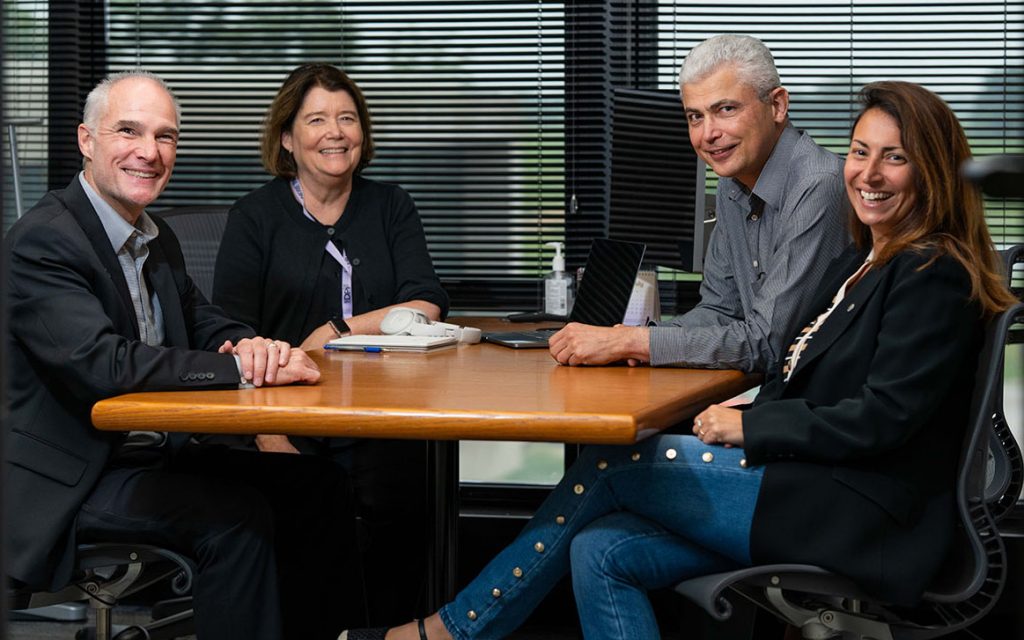
Grassellino’s priorities center on delivering technologies essential to Fermilab’s flagship projects while demonstrating how AI and quantum can transform scientific discovery. In her role of chief technology officer, Grassellino is overseeing the laboratory-wide AI initiatives spanning neutrino science, particle physics, quantum science, and operations, while also expanding technology transfer and commercialization efforts to move laboratory technologies into broader scientific, industrial and commercial applications.
Rather than pursuing dozens of initiatives simultaneously, Grassellino wants the directorate to demonstrate measurable progress on a focused set of ambitious goals and science questions. “I would like us to set clear goals and achieve them,” she said. “If we can execute exceptionally well on a few transformative objectives, we’ll create momentum for everything that follows.”
Fermi National Accelerator Laboratory is America’s national laboratory for particle physics and accelerator research. Fermi Forward Discovery Group manages Fermilab for the U.S. Department of Energy Office of Science. Visit Fermilab’s website at www.fnal.gov and follow us on social media.
Recommended reading

URA honors Fermilab researchers advancing laboratory’s top priorities
Tyler Barrett, Charis-Kleio Koraka, Kevin Kelly and Silvia Zorzetti are the recipients of the 2026 URA Honorary Awards. The awards are presented each year by Universities Research Association to recognize significant contributions to research at Fermilab.
Scientists travel to Fermilab to discuss future of high-energy physics
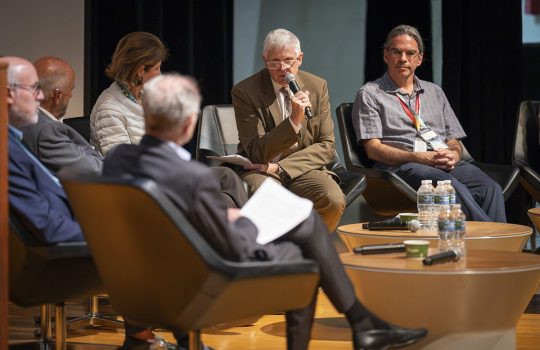
Fermilab recently hosted over 500 physicists for the American Physical Society’s biennial Division of Particles and Fields meeting. With presentations by Fermilab Director Norbert Holtkamp and CERN Director-General Mark Thomson, the meeting provided particle physicists the opportunity to come together and consider the future of high-energy physics research.

DUNE uses AI to transform the future of neutrino research
DUNE is pioneering the future of neutrino research by integrating artificial intelligence into its experiment, drawing on decades of machine learning work at Fermilab.