
Linda Cremonesi elected as co-spokesperson for NOvA neutrino experiment
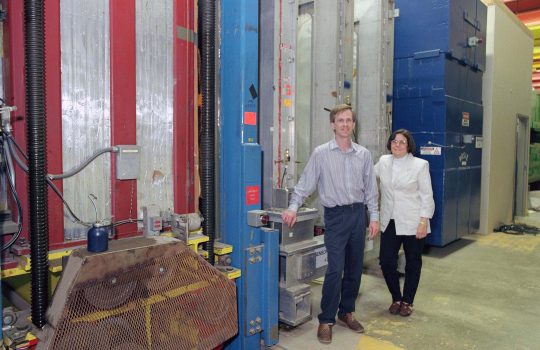
Currently, NOvA is Fermilab’s leading long-baseline neutrino experiment. Cremonesi is now co-leading the international collaboration of scientists behind it.
1 - 10 of 49 results
Currently, NOvA is Fermilab’s leading long-baseline neutrino experiment. Cremonesi is now co-leading the international collaboration of scientists behind it.
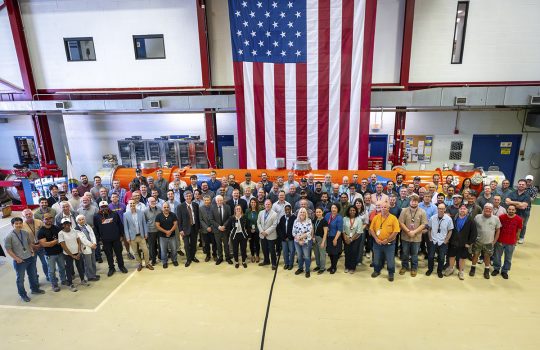
Fermilab sent its final contribution for the high-energy upgrade of the superconducting accelerator for SLAC’s X-ray laser, LCLS. The technology they developed will be transferred to industry for semiconductor-chip production and will be used in the Proton Improvement Plan-II, one of Fermilab’s flagship projects.
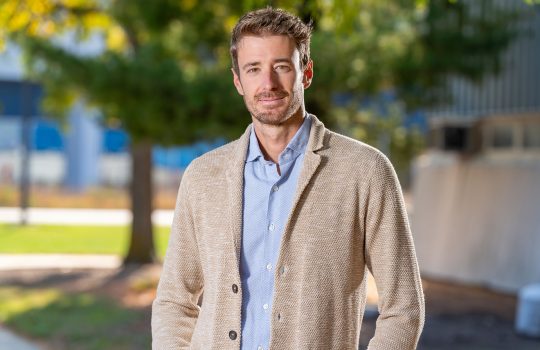
After joining Fermilab in 2020, Jacopo Bernardini was recently appointed level-3 manager for the 650-MHz cryomodules for the Proton Improvement Plan-II project. PIP-II is building a new, powerful linear accelerator that will create the world’s most intense beam of neutrinos for the Deep Underground Neutrino Experiment. An amateur triathlete outside of work, Bernardini enjoys working with collaborators around the world as well as watching a design become reality.
With a sharp focus on Fermilab’s core scientific mission, Norbert Holtkamp is establishing clear priorities and a disciplined strategy that align the laboratory with the nation’s most ambitious research goals. His leadership is positioning Fermilab for long‑term success.

Aleksandra Ćiprijanović will use artificial intelligence to solve the domain shift problem in high-energy physics research. Fermilab’s computing capabilities make it uniquely positioned to support this project.
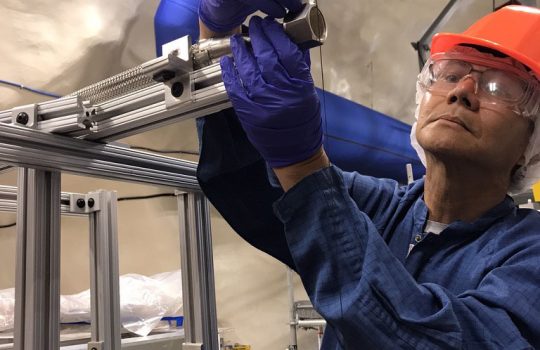
Fermilab has contributed vital components to the SuperCDMS experiment, located deep underground in a nickel mine outside of Sudbury, Canada.
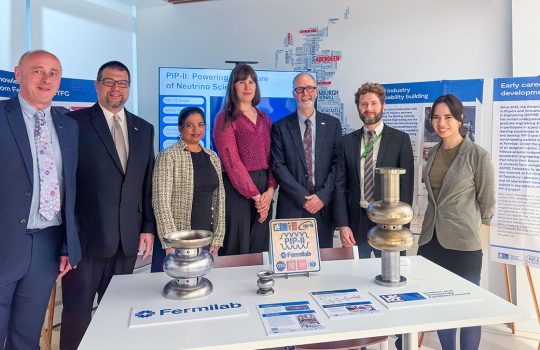
During an event at the British Embassy in Washington, D.C., officials honored the successful collaboration between the United States and United Kingdom for building the PIP-II particle accelerator at Fermilab. The powerful new accelerator will be used to send a beam of neutrinos through the Earth for the Deep Underground Neutrino Experiment.
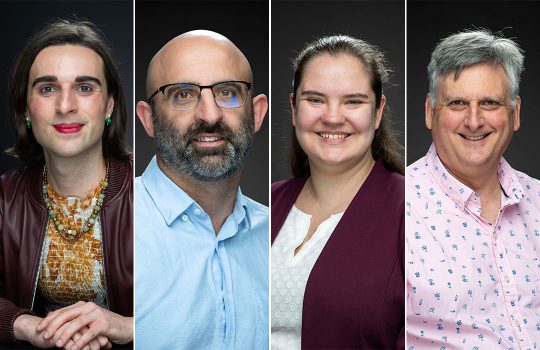
Gray Putnam, James Mott, Lauren Yates and Chris Jensen are this year’s recipients of the URA Honorary Awards. The awards are presented each year to recognize significant contributions to research at Fermilab.
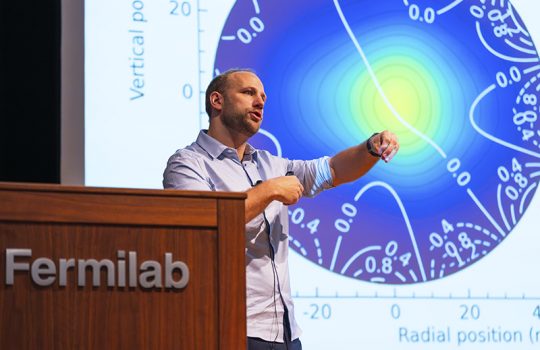
Throughout this year, Fermilab’s dedicated scientists, engineers, technicians and operations staff came together to drive discoveries, advance American innovation and prepare the lab for a bright future.
On July 21, 2000, the DONUT collaboration at Fermilab announced the first direct evidence for tau neutrinos. The particles remain elusive to this day, but physicists continue to seek new ways of studying them.