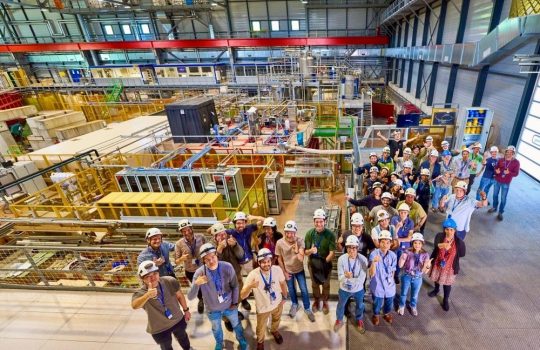
New DUNE technology put to the ultimate stress test
A prototype for the world’s biggest neutrino experiment is running under extreme conditions to see how well the technology performs under pressure.

1 - 10 of 124 results
A prototype for the world’s biggest neutrino experiment is running under extreme conditions to see how well the technology performs under pressure.
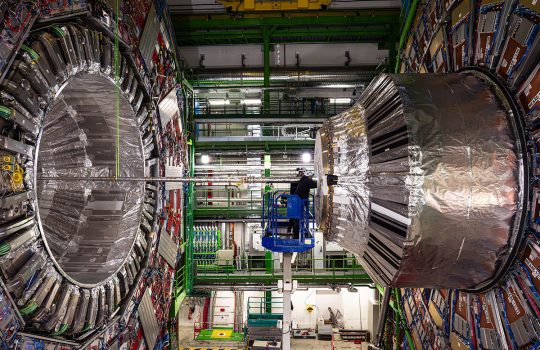
The CMS experiment at CERN is building a new detector that will unravel the chaotic particle collisions at the Large Hadron Collider, helping scientists identify particles based on their speeds.
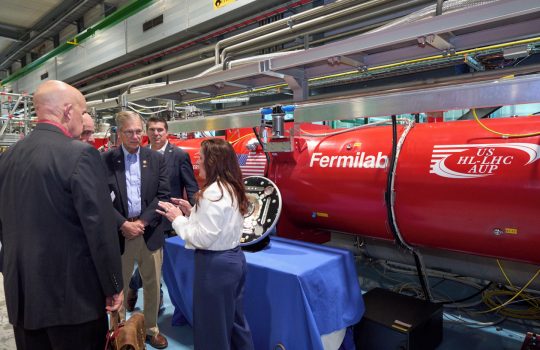
Several components developed, assembled and tested by the HL-LHC Accelerator Upgrade Project, a consortium of U.S. national laboratories and institutions, including Lawrence Berkeley National Laboratory, Brookhaven National Laboratory and Fermi National Accelerator Laboratory, take center stage as engineers at CERN build and test a section of the High-Luminosity Large Hadron Collider, a major upgrade to the world’s most powerful supercollider.
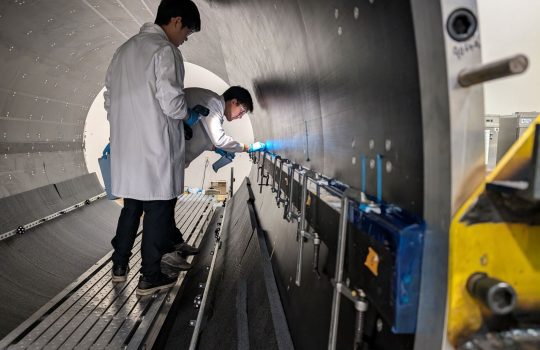
A key milestone in the U.S.-funded upgrade to the CMS experiment was achieved with the successful delivery of a 5-meter-long carbon support tube to CERN. Designed and built at Purdue University, the tube will house new inner particle detectors for CMS, which is being prepared for the high-luminosity upgrade of the Large Hadron Collider. The CMS collaboration is composed of scientists from roughly 240 institutions spread across more than 50 countries.
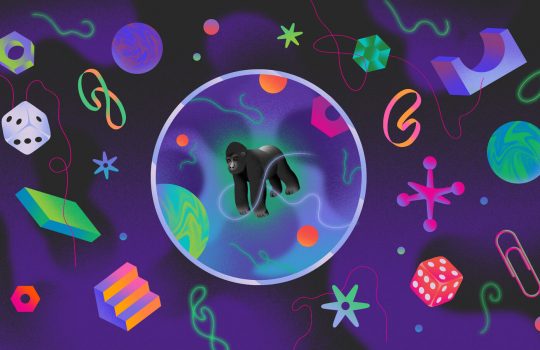
The CMS experiment is developing a new type of trigger that looks for anomalies — one-in-a-billion events that show something new or unexpected.

During a ceremony at ICHEP, Ngadiuba’s contributions to ultra-fast machine learning techniques and anomaly detection were recognized by the International Union of Pure and Applied Physics.

For more than 20 years in experimental particle physics and astrophysics, machine learning has been accelerating the pace of science, helping scientists tackle problems of greater and greater complexity.
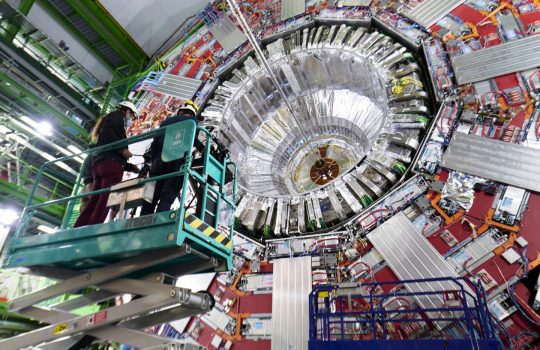
The U.S. Department of Energy has given the green light for the U.S.-funded portion of the upgrades to the CMS experiment at CERN. The massive overhaul will prepare the experiment for the high-luminosity era of particle collisions at the Large Hadron Collider.
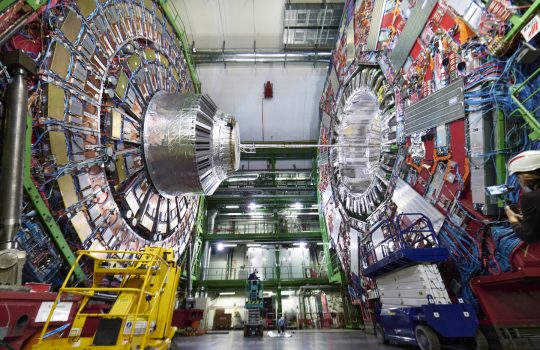
One of the big, recent innovations by the CMS collaboration—a new trigger installed in their experiment at the Large Hadron Collider—has produced its first data set. The analysis of this data has started. Scientists expect it will either reveal new physics or set more stringent limits in the search for long-lived particles.
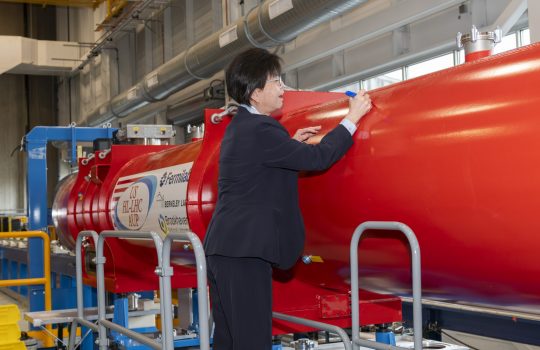
After twenty years of research, development, testing and production, the United States is now shipping state-of-the-art superconducting accelerator magnets to CERN for the high-luminosity upgrade to the Large Hadron Collider. At the heart of these powerful magnets is a new superconducting material used for the first time in a particle accelerator.