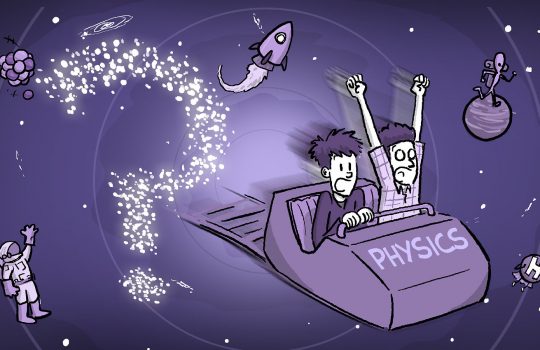
Understanding the unknown universe
The authors of We Have No Idea remind us that there are still many unsolved mysteries in science.

2031 - 2040 of 2263 results
The authors of We Have No Idea remind us that there are still many unsolved mysteries in science.
From Astronomy, May 4, 2017: Fermilab’s Dan Hooper sat down with Astronomy Editor-in-Chief Dave Eicher to discuss cutting-edge research into the unknowns of the universe.
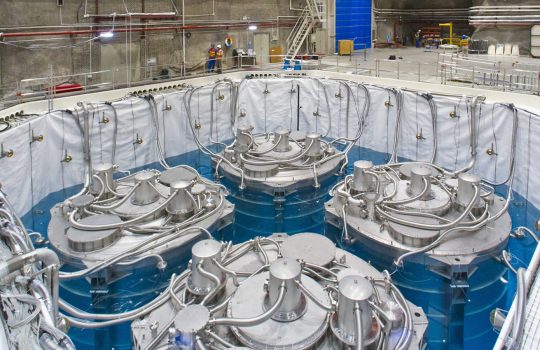
A new result from the Daya Bay collaboration reveals both limitations and strengths of experiments studying antineutrinos at nuclear reactors.
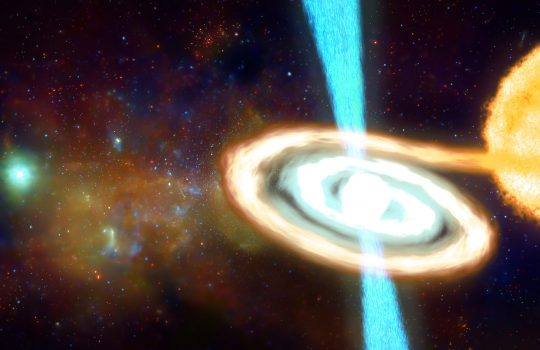
According to the Fermi LAT collaboration, the galaxy’s excessive gamma-ray glow likely comes from pulsars, the remains of collapsed ancient stars.
From American Institute of Physics’ FYI, May 1, 2017: Lawmakers have reached an agreement on a fiscal year 2017 catchall spending package that includes annual appropriations and programmatic guidance for the science agencies through Sept. 30 of this year.
From CERN Courier, April 13, 2017: It took decades for dark matter to enter the lexicon of particle physics. Today, explaining the nature and abundance of dark matter is one of the most pressing problems in the field. Fermilab and University of Chicago’s Dan Hooper and University of Amsterdam’s Gianfranco Bertone review the 80-year history.
See Boston University physicist Tulika Bose’s answers to readers’ questions about research at the Large Hadron Collider.
From SCOAP3, April 27, 2017: High-energy physics articles published in the three APS journals Physical Review C, Physical Review D and Physical Review Letters will be open-access as of January 2018.
Boston University physicist Tulika Bose explains why there’s more than one large, general-purpose particle detector at the Large Hadron Collider.
From The Beacon-News, April 25, 2017: At the high-tech scientific center that is Fermilab in Batavia, Cleo Garcia has a unique job – herdsman.