The scientific theories battling to explain the universe
From CNN, Aug. 17, 2018: Fermilab scientist Don Lincoln discusses the conflict between superstring theory and the phenomenon of dark energy, mentioning the Dark Energy Survey.

71 - 80 of 101 results
From CNN, Aug. 17, 2018: Fermilab scientist Don Lincoln discusses the conflict between superstring theory and the phenomenon of dark energy, mentioning the Dark Energy Survey.
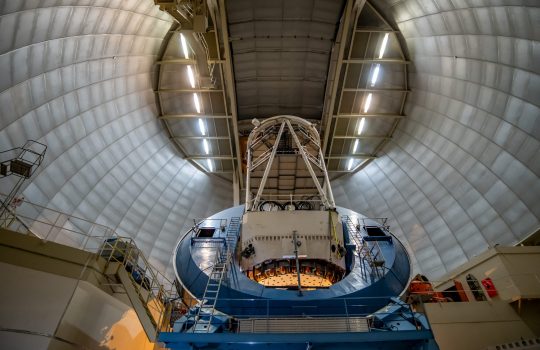
DESI, an instrument to help scientists get to the bottom of the dark energy mystery, is getting a little help from Fermilab.
From UQ News, Aug. 1, 2018: A scientist from the Dark Energy Survey, which is hosted by Fermilab, is selected for the television program Australian Survivor.
From FAPESP’s Pesquisa, March 2018: International researchers are constantly looking for lighter particles in the hope of finding dark matter, including at the DarkSide-50 experiment, CDMS and the Dark Energy Survey.
From Universe Today, June 20, 2018: A Fermilab astrophysicist recently conducted a study that indicates how a sufficiently advanced civilization might be able to harvest Local Group stars and prevent them from expanding outward.
From Russia Today, June 21, 2018: Expansion of the universe, thought to be further accelerated by dark energy, is flinging matter apart, while galaxies are being pushed away from each other. This is a challenge alien technologies will have to deal with in order for them to survive, Fermilab’s Dan Hooper writes in a new study.
From Science News, June 19, 2018: Fermilab physicist Dan Hooper proposes that, to offset a future cosmic energy shortage caused by the accelerating expansion of the universe, a super-advanced civilization could pluck stars from other galaxies and bring them home. It’s a far-out idea, tackling a dilemma in a future so distant that human beings can hardly fathom it: 100 billion years from now, each neighborhood of the universe will be marooned as if on a cosmic island, with resources from the rest of the universe inaccessible.
From PBS’s NOVA Wonders, May 30, 2018: Fermilab’s Josh Frieman and Brian Nord appear in this episode on the dark sector.
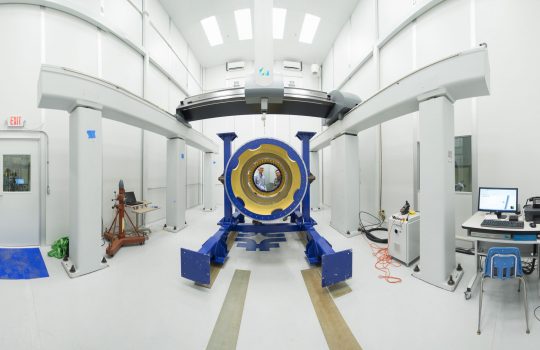
Installation has begun for the Dark Energy Spectroscopic Instrument, a next-generation astrophysics tool. Fermilab is managing key parts of the construction of the instrument, which will begin its five-year observation run in 2019.