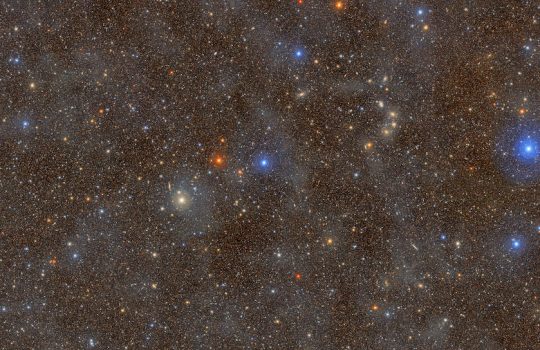
Action! NSF–DOE Vera C. Rubin Observatory begins capturing the greatest cosmic movie ever made
The 10-year Legacy Survey of Space and Time has officially started, marking the beginning of a new era in astronomy and astrophysics.

1 - 10 of 101 results
The 10-year Legacy Survey of Space and Time has officially started, marking the beginning of a new era in astronomy and astrophysics.
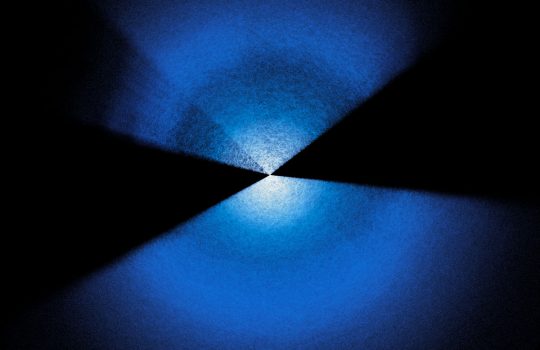
The Dark Energy Spectroscopic Instrument has completed its originally planned five-year mission and mapped more than 47 million galaxies and quasars, creating the largest high-resolution 3D map of our universe to date. Because of the instrument’s excellent performance and hints that dark energy might evolve, DESI will continue observations into 2028 and further expand the map.
Astronomy, February 13, 2026
After 25 years of planning, six years of data collection and six more years of analysis, scientists have published a portion of the final results of the Dark Energy Survey — the largest, most comprehensive survey of its kind — yielding the tightest constraints to date on models of our universe’s expansion.
AZO Quantum, Janauary, 27, 2026
Dark Energy Survey researchers have published their most comprehensive results to date of the Universe’s expansion over the past six billion years in Physical Research D.
Space.com, January 26, 2026
The DES collaboration recently released six years worth of data collected by the Dark Energy Camera (DECam). The analysis represents the first time the four separate methods of studying dark energy have been united as one.
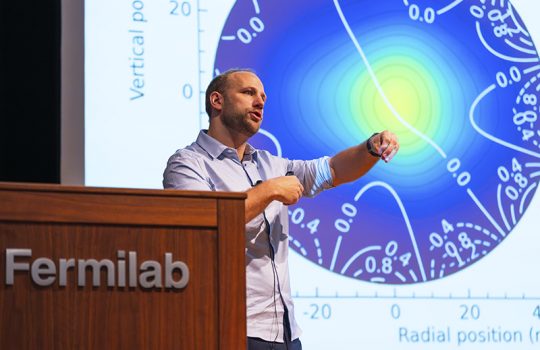
Throughout this year, Fermilab’s dedicated scientists, engineers, technicians and operations staff came together to drive discoveries, advance American innovation and prepare the lab for a bright future.
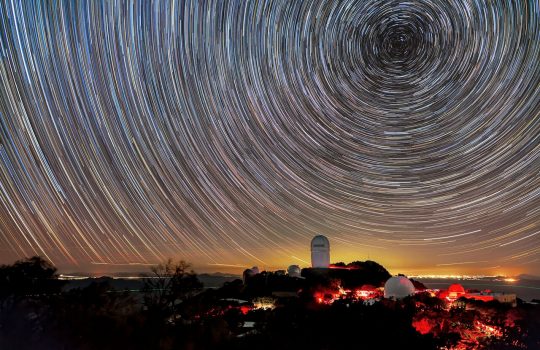
The Dark Energy Spectroscopic Instrument used millions of galaxies and quasars to build the largest 3D map of our universe to date. Combining the DESI data with other experiments shows signs that the impact of dark energy may be weakening over time — and the standard model of how the universe works may need an update.
From Supercluster, Aug. 20, 2024
In a trillion or so years’ time, the Universe will have exhausted all of its star-forming material. The last star will be born and from thereon the Universe will face a slow death as gradually each and every star burns out. Fermilab’s Dan Hooper discusses how life will struggle to survive into the deep future but dark energy is intent on stealing the stars 100–150 billion years into the future.
From NPR, WBEZ-Chicago
NPR’s Short Wave host spoke with Fermilab Cosmologist Brian Nord about what dark energy could be and what it implies about the end of our universe.
Big Think, April 16, 2024
Here’s what recent DESI measurements suggest — and why it’s too early to update conventional predictions about the Universe’s distant future.