Did you see it?
Boston University physicist Tulika Bose explains why there’s more than one large, general-purpose particle detector at the Large Hadron Collider.

111 - 120 of 153 results
Boston University physicist Tulika Bose explains why there’s more than one large, general-purpose particle detector at the Large Hadron Collider.
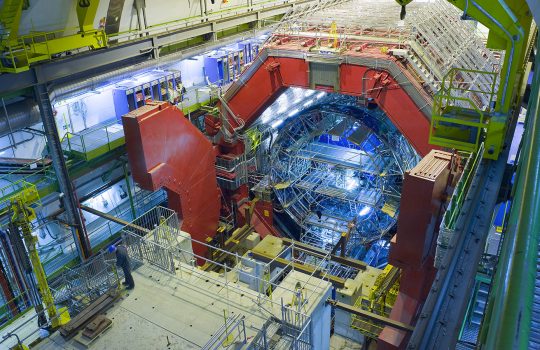
Particles seen by the ALICE experiment hint at the formation of quark-gluon plasma during proton-proton collisions.

From Inverse, March 9, 2017: In the latest issue of the Justice League-Power Rangers crossover comic, superheroes gather at the mouth of what seems to be the LHC to discuss how to use it to jump across universes. A Vanderbilt University scientist and others believe LHC collisions could produce the Higgs singlet, which had the power to travel back and forth in time.
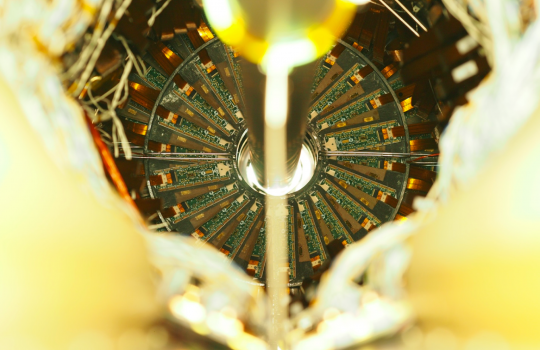
This month U.S. scientists embedded sophisticated new instruments in the heart of a Large Hadron Collider experiment.
New research could tell us about particle interactions in the early universe and even hint at new physics.
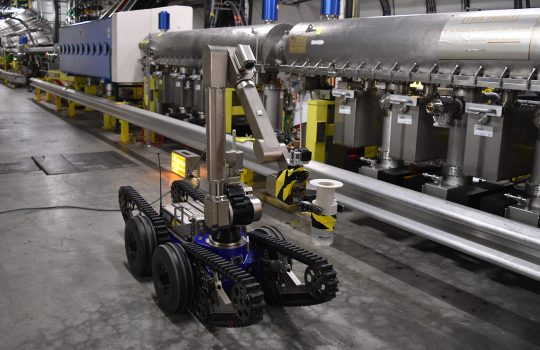
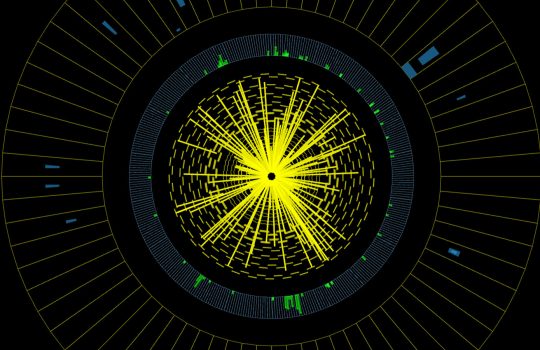
The Large Hadron Collider is now producing about a billion proton-proton collisions per second.
From Chicago Tribune, Sept. 1, 2016: There is little as exhilarating in science as a group of really smart people slapping their foreheads and admitting, hey, we got it wrong. Sorry, our bad.
From Nature, Aug. 19, 2016: The next steps for particle physics now seem less certain, as discussions at the International Conference on High Energy Physics (ICHEP) suggest. Much hinges on whether the LHC unearths phenomena that fall outside the standard model of particle physics and whether China’s plans to build an LHC successor move forward.