A minute with Maria Barba
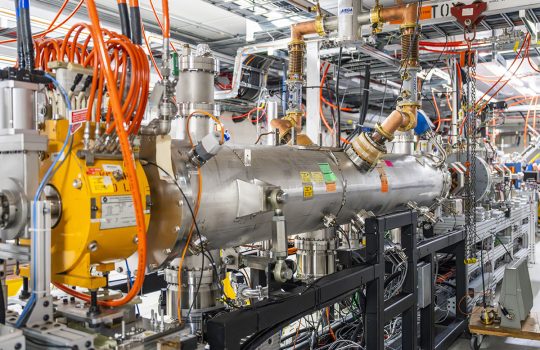
Meet Maria Barba, a cryogenic engineer at Fermi National Accelerator Laboratory whose work helps keep systems that support the testing of critical particle accelerator components running smoothly.
1 - 10 of 25 results
Meet Maria Barba, a cryogenic engineer at Fermi National Accelerator Laboratory whose work helps keep systems that support the testing of critical particle accelerator components running smoothly.
Big Think, April 2, 2024
Physicists use particle accelerators to replicate the early Universe’s conditions, revealing insights from the Big Bang to the formation of atoms. Data generated in particle physics experiments and theoretical physics can offer a glimpse into the earliest moments of the cosmos.
From Nature, Dec. 7, 2023
The Particle Physics Project Prioritization Panel presented their report for the next decade with recommendations for the two main U.S. agencies that fund high-energy physics research. The report has five key recommendations and suggests the U.S. should explore programming to demonstrate the feasibility of two new kinds of particle accelerators.
From msn.com, July 26, 2023: The story of Felicia the ferret with her amazing contribution of helping clean and decontaminate the tunnels of main ring particle accelerator in 1971 is still making headlines around the world.
From Big Think, July 23, 2023: Fermilab’s Don Lincoln discusses how using a powerful particle accelerator, researchers at Fermilab have attempted to create a very light form of dark matter and recently published their results.
Scientists in the particle physics community are bringing environmental and climate issues to the table in discussions about future research.
From UK Research and Innovation, October 13, 2022: The Science and Technology Facilities Council has begun testing of Diamond Light Source for an energy-saving super-magnet for our next generation of particle accelerator. Designed by scientists and engineers at STFC, the zero power tuneable optics magnet (ZEPTO) is a permanent, tuneable magnet that consumes zero electrical power.
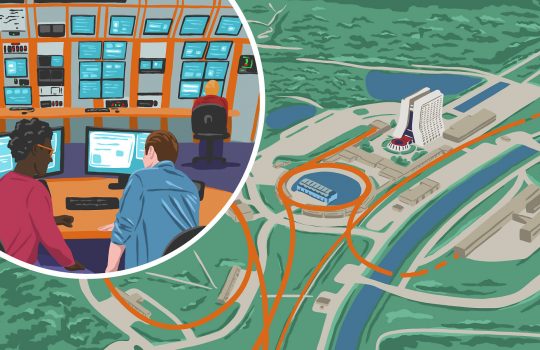
It takes years of on-the-job training to learn the ins and outs of particle accelerator operation.
For the Muon g-2 experiment, researchers create billions of muons to study their surprising properties.
From World Nuclear News, December 7, 2021: A neutrino detection kit has been installed in the containment of Argentina’s Atucha 2 reactor in support of a US-Argentine experiment to learn more about the mysterious particles. Scientists of the vIOLETTA Project are using sensitive Skipper CCD equipment designed and prepared by Fermilab and Berkeley labs. It will be able to detect interactions between neutrinos and a silicon matrix. The experimental arrangement will give them insights on neutrinos at previously unexplored low energy ranges.