How to put together an international physics experiment
To build the DUNE neutrino experiment and its associated accelerator upgrade, experts invent customized ways to transport fragile, expensive and highly specialized components.
21 - 30 of 42 results
To build the DUNE neutrino experiment and its associated accelerator upgrade, experts invent customized ways to transport fragile, expensive and highly specialized components.
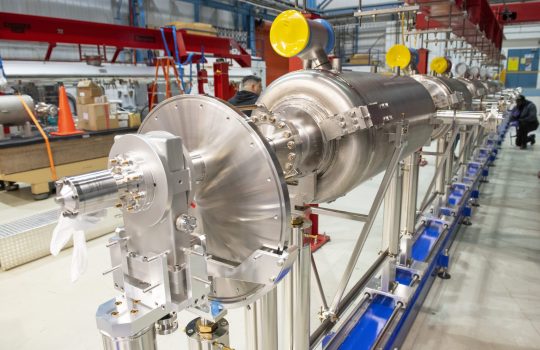
The 10-meter-long cryomodule, part of the PIP-II particle accelerator project at Fermilab, is now undergoing testing to validate all its components and finalize its design. In a few years, Fermilab and international partners will produce four similar cryomodules that will propel particles in the new linear accelerator.
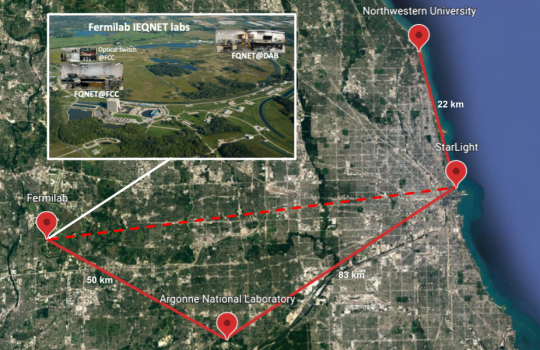
Anton Zeilinger, who received the 2022 Nobel Prize in Physics, pioneered research on quantum teleportation and entanglement swapping. These technologies are instrumental in the success of the Illinois-Express Quantum Network, which recently published a paper outlining its design concepts and implementation. The technologies are also the basis for the quantum devices that generate the network.
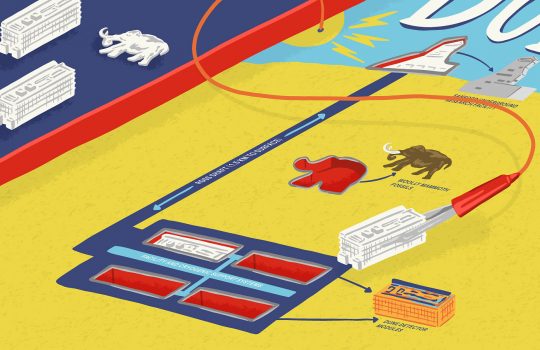
Construction may now begin on the PIP-II Linac Complex. The tunnel and building will house the new linear particle accelerator that will power the physics programs and neutrino research at Fermilab for the coming decades.
To prepare for the shipment of large, delicate particle accelerator components from the UK to Fermilab, the PIP-II team flew a “dummy load” across the Atlantic Ocean, recording every little bump the dummy experienced. After careful validation of all transportation data, the team will ship a 10-meter-long prototype cryomodule early next year.
For the first time, physicists have a statistically significant measurement of the joint polarization of W and Z bosons.
With CMB-S4, scientists hope to connect a sandy desert with a polar desert—and revolutionize our understanding of the early universe.
A postdoc on the PIP-II project, Wijethunga is working on investigating the presence of an electron cloud in the Fermilab Booster.
Successful assembly was the result of a collaboration among three institutions in three countries.
In new papers by the CMS and ATLAS Collaborations, physicists detail high-precision results from their latest Higgs boson studies.