Public

1341 - 1350 of 2562 results

Searching for dark matter among the rocks

    From Inside Science, March 6, 2019: Scientists may be able to look for dark matter in rocks that host minerals with which dark matter particles may have interacted. Fermilab scientist Dan Hooper is quoted in this article.

    Japan defers ILC decision

      Scientists have proposed building the International Linear Collider, which would be the longest linear collider in the world, in the Kitakami mountains in the Iwate prefecture of northern Japan. Scientists had called on the Japanese government to come to a decision about whether they support hosting the ILC by today’s meeting of the International Committee for Future Accelerators. The Japanese government declined to stake a claim to hosting the ILC.

      The astonishing power of a thunderstorm

        From CNN, March 3, 2019: Fermilab scientist Don Lincoln talks about muons, thunderstorms and the GRAPES-3 experiment, located in India. Scientists noticed that when a thunderstorm passed over their detector, the number of muons they observed got smaller compared to the rate before the thunderstorm arrived.

        University of Wisconsin–Madison joins Chicago Quantum Exchange

          From UChicago News, Feb. 28, 2019: The Chicago Quantum Exchange, a growing hub for the research and development of quantum technology, is adding the University of Wisconsin–Madison as its newest member. UW–Madison is joining forces with the University of Chicago, Argonne National Laboratory, Fermilab, and the University of Illinois at Urbana-Champaign in developing a national leading collaboration in the rapidly emerging field of quantum information.

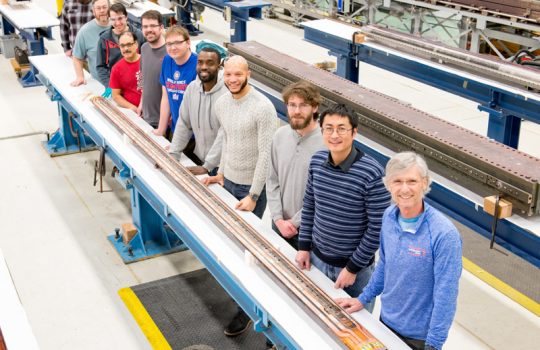
          Fermilab engineers and technicians stand by a magnet coil made for the High-Luminosity LHC. Photo: Reidar Hahn

          Large Hadron Collider upgrade project leaps forward

          The U.S. Department of Energy has approved the scope, cost and schedule for the U.S. LHC Accelerator Upgrade Project and has given the first approval for the purchase of materials. This project brings together scientists, engineers and technicians from national laboratories — such as Fermilab, Brookhaven, Berkeley, SLAC and Jefferson labs — to develop two cutting-edge technologies to advance the future of both the Large Hadron Collider and broader collider research.