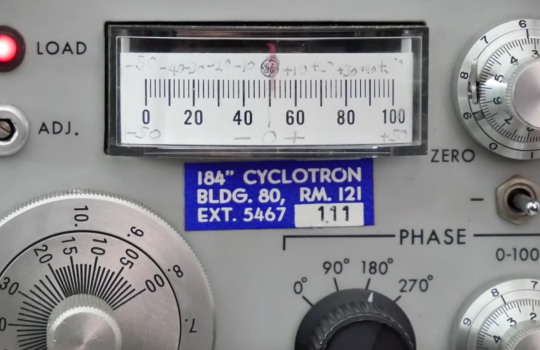
Upcycled instrument tied to auspicious accelerator
A composer has given new life to an amplifier used within a historically significant particle accelerator.

51 - 60 of 103 results
A composer has given new life to an amplifier used within a historically significant particle accelerator.
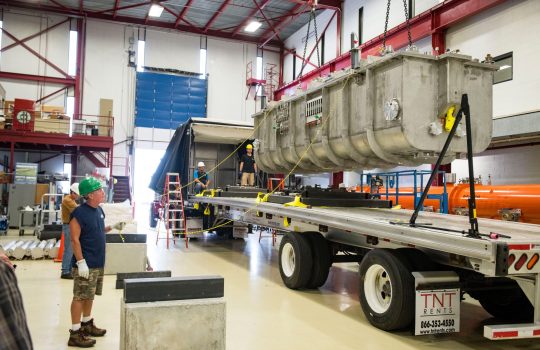
The first major superconducting section of the PIP-II accelerator has come to Fermilab: the first of 23 cryomodules for the future accelerator. The cryomodules’ job is to get the lab’s powerful proton beam up and moving, sending it to higher and higher energies, approaching the speed of light. This first cryomodule also represents a successful joint effort between Argonne National Laboratory and Fermilab to design and produce a critical accelerator component for the future heart of Fermilab.

Particle accelerators are some of the most complicated machines in science. In today’s more autonomous era of self-driving cars and vacuuming robots, efforts are going strong to automate different aspects of the operation of accelerators, and the next generation of particle accelerators promises to be more automated than ever. Scientists are working on ways to run them with a diminishing amount of direction from humans.
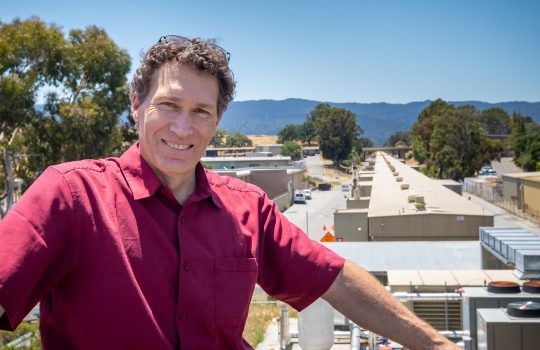
What do particle accelerators and craggy outcrops have in common? Both have Tor Raubenheimer trotting the globe. Thanks to both his work at SLAC National Accelerator Laboratory and his passion for rock climbing, he has gotten to know people and places on several continents.
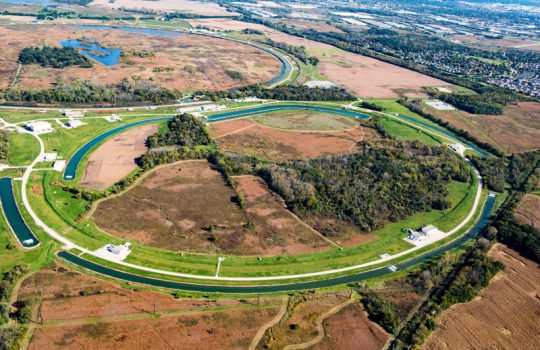
In particle accelerators, the greater a beam’s intensity, the more opportunities there are to study particle interactions. One way to increase the intensity is to merge two beams with a technique called slip-stacking. However, when combining them, the beams’ interaction may cause instability. A Fermilab scientist has created a successful model of the fraught dynamics of two particle beams in close contact, leading to smoother sailing in this area of particle acceleration.
From Gizmodo, May 15, 2019: Fermilab scientist David Harding talks to Gizmodo about a particle accelerator’s sonic environment. You can’t hear subatomic particles colliding inside the experiment. But the world’s largest science experiments certainly make a lot of mechanical commotion.
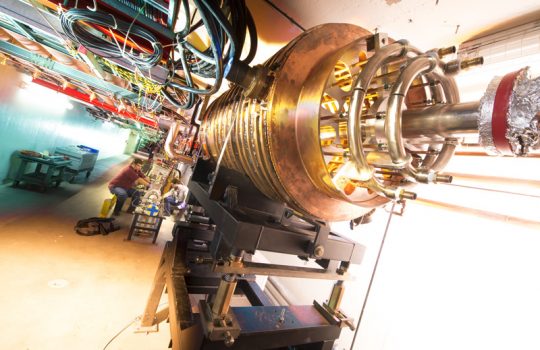
It’s always great when every one of Fermilab’s nine particle accelerators are turned on and provide beam. With the lab again firing on all accelerator-cylinders, we thought it would be a good time to provide a rundown of each of the members of Fermilab’s accelerator complex. Get to know Fermilab’s suite of accelerators and storage rings.
From WDCB’s First Light, March 24, 2019: Brian O’Keefe interviews Fermilab PIP-II Project Director Lia Merminga about PIP-II, an accelerator project critical to the lab’s future. Fermilab broke ground on PIP-II on March 15. Learn about how PIP-II will power the international Deep Underground Neutrino Experiment, hosted by Fermilab, and the lab’s experimental program in this 15-minute piece.
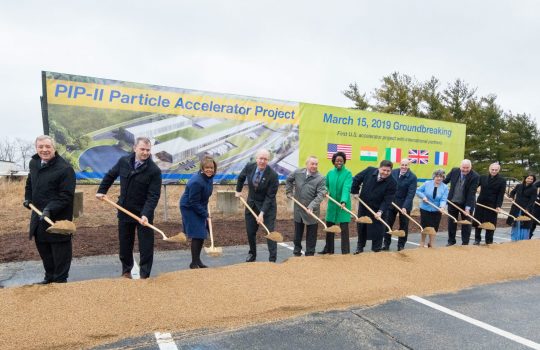
On March 15, Fermilab broke ground on PIP-II, a major new particle accelerator project at Fermilab. Dignitaries from the United States and international partners celebrated the start of the project at the groundbreaking ceremony. The PIP-II accelerator will power the long-term future of the laboratory’s research program, including the international Deep Underground Neutrino Experiment and a suite of on-site experiments.
From INFN, March 15, 2019: Si è tenuta oggi al Fermilab, negli Stati Uniti, la cerimonia di posa della prima pietra di uno dei più importanti progetti per il futuro della fisica, in cui l’Italia porta un contributo tecnologico e scientifico di primo piano. Si tratta del progetto PIP-II (Proton Improvement Plan II) per la realizzazione di un nuovo acceleratore lineare superconduttore, lungo 215 metri.