
CERN

61 - 70 of 236 results

USCMS collaboration gets green light on upgrades to CMS particle detector

The USCMS collaboration has received approval from the Department of Energy to move forward with final planning for upgrades to the giant CMS particle detector at the Large Hadron Collider. The upgrades will enable it to take clearer, more precise images of particle events emerging from the upcoming High-Luminosity LHC, whose collision rate will get a 10-fold boost compared to the collider’s design value when it comes online in 2027.

CERN’s oldest particle accelerator is still running 60 years later

    From Gizmodo, Nov. 25, 2019: The oldest particle accelerator at CERN, home to the world’s most powerful particle accelerator, is celebrating its 60th birthday. It’s still running. The Proton Synchrotron accelerated its first protons on Nov. 24, 1959. It was the world’s highest-energy accelerator when it first began running.

    CERN Council appoints Fabiola Gianotti for second term of office as CERN director-general

      From CERN, Nov. 6, 2019: The CERN Council has selected Fabiola Gianotti as the organization’s next director-general, her second term of office. The appointment will be formalized at the December session of the Council, and Gianotti’s new five-year term of office will begin on Jan. 1, 2021. This is the first time in CERN’s history that a director-general has been appointed for a full second term.

      Put it to the test beam

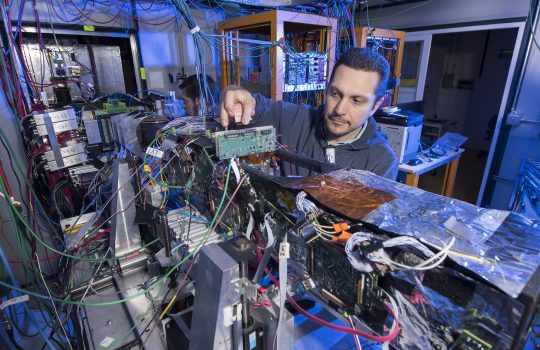
      Test beams generally sit to the side of full-on accelerators, sipping beam and passing it to the reconfigurable spaces housing temporary experiments. Scientists bring pieces of their detectors — sensors, chips, electronics or other material — and blast them with the well-understood beam to see if things work how they expect, and if their software performs as expected. Before a detector component can head to its forever home, it has to pass the test.

      DUNE scientists see particle tracks with dual-phase technology

      Advances in subatomic physics heavily depend on ingenuity and technology. And when it comes to discovering the nature of some of the most elusive particles in the universe, neutrinos, scientists need the best and most sensitive detector technology possible. Scientists working at CERN have started tests of a new neutrino detector prototype, using a very promising technology called “dual phase.”

      Tests start at CERN for large-scale prototype of new technology to detect neutrinos

      Scientists working at CERN have started tests of a new neutrino detector prototype using a promising technology called “dual phase.” If successful, this new technology will be used at a much larger scale for the international Deep Underground Neutrino Experiment, hosted by Fermilab. Scientists began operating the dual-phase prototype detector at CERN at the end of August and have observed first tracks. The new technology may be game-changing, as it would significantly amplify the faint signals that particles create when moving through the detector.