dark energy

61 - 70 of 98 results

The last night of the Dark Energy Survey

    From 365 Days of Astronomy, Jan. 12, 2019: The Dark Energy Survey is the subject of this 30-minute podcast. DES started in 2013 to map dark energy over 5000 square degrees of sky. It used a massive 500-megapixel camera attached to the Blanco Telescope at Cerro Tololo Inter-American Observatory in Chile. The survey concluded on Jan. 9, 2019, with its last night of observing. At the American Astronomical Society meeting in Seattle, they conferenced with observers on the last night. Listen to the conversation at the end of this journey.

    After mapping millions of galaxies, Dark Energy Survey finishes data collection

      From University of Chicago, Jan. 9, 2019: After scanning about a quarter of the southern skies over 800 nights, the Dark Energy Survey finished taking data on Jan. 9. It ends as one of the most sensitive and comprehensive surveys of its kind, recording data from more than 300 million distant galaxies. Fermilab, an affiliate of the University of Chicago, served as lead laboratory on the survey, which included more than 400 scientists and 26 institutions.

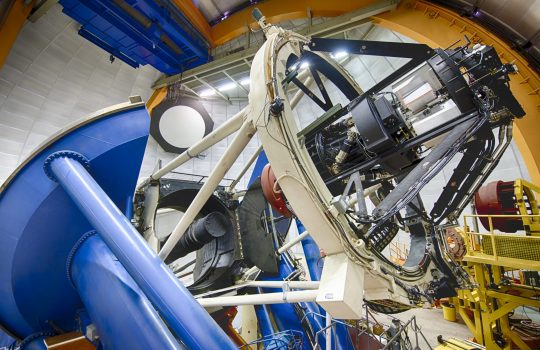
      The Dark Energy Camera mounted on the 4-meter Blanco telescope at the Cerro Tololo Inter-American Observatory in Chile. The final day of data-taking for the Dark Energy Survey is Jan. 9.

      Dark Energy Survey completes six-year mission

      After scanning in depth about a quarter of the southern skies for six years and cataloguing hundreds of millions of distant galaxies, the Dark Energy Survey will finish taking data on Jan. 9. DES scientists recorded data from more than 300 million distant galaxies. More than 400 scientists from over 25 institutions around the world have been involved in the project, hosted by Fermilab. The collaboration has already produced about 200 academic papers, with more to come.

      Topping off a telescope with new tools to explore dark energy

        From Berkeley Lab, Dec. 4, 2018: Key components of Berkeley Lab’s Dark Energy Spectroscopic Instrument are installed after months of planning, prep work. A team at Fermilab built the corrector, hexapod, and other top-end support structures. The structures are designed to align the lenses with an accuracy of tens of microns (millionths of a meter) – similar to the width of the thinnest human hair.