Une nouvelle matière ? Trois particules dévoilent un univers caché
From Science & Vie, March 4, 2021: Fermilab was included with other accelerator labs for their discoveries of new particles and materials in this French science magazine.

21 - 28 of 28 results
From Science & Vie, March 4, 2021: Fermilab was included with other accelerator labs for their discoveries of new particles and materials in this French science magazine.
From the Science of the Francis Mule, March 1, 2021: Scientists at Fermilab and Argonne publish new results from SeaQuest experiment showing the asymmetry of protons.
From Reccom Magazine, Feb. 26, 2021: Chuck Brown of the Fermilab SeaQuest research team is quoted in this piece on the sea of quarks inside the proton. The article discusses Fermilab’s contributions to the SeaQuest and NuSea experiments.
From Los Alamos Laboratory News, Feb. 24, 2021: The E-906/SeaQuest experiment, hosted by Fermilab, has produced results that are the opposite of what had previously been understood about proton structure and the dynamics of strong interacting antiquarks and gluons.
Protons are built from three quarks — two “up” quarks and one “down” quark. But they also contain a roiling sea of transient quarks and antiquarks that fluctuate into existence before swiftly annihilating one another. At the Fermilab-hosted SeaQuest experiment, researchers report that that lopsidedness persists in a realm of previously unexplored quark momenta.

Asymmetry in the proton confounds physicists, but a new discovery may bring back old theories to explain it.
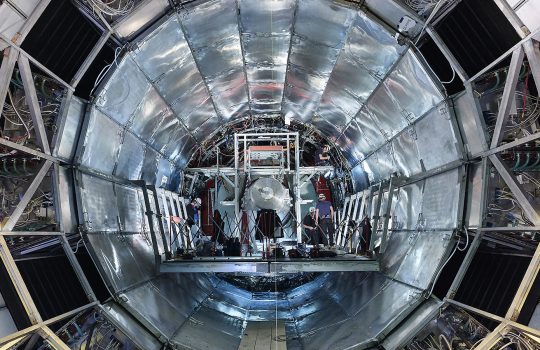
Only 1% of the mass of the proton comes from the Higgs field. ALICE scientists examine a process that could help explain the rest.
From Exascale Computing Project, May 28, 2019: Fermilab scientist Andreas Kronfeld is featured in this piece on the Excascale Computing Project, quantum chromodynamics and lattice QCD. Kronfeld, the principal investigator of ECP’s LatticeQCD project, explains how exascale computing will be essential to extending the work of precision calculations in particle physics to nuclear physics. The calculations are central for interpreting all experiments in particle physics and nuclear physics.