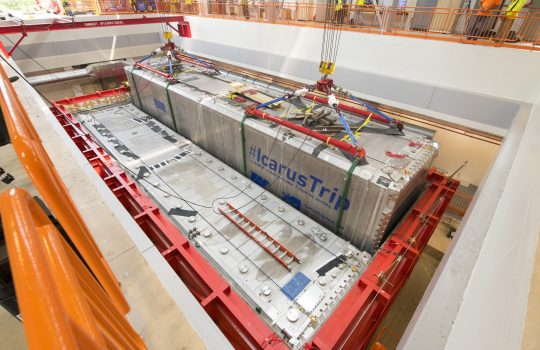
ICARUS neutrino detector installed in new Fermilab home
ICARUS now sits in the path of Fermilab’s neutrino beam, a milestone that brings the detector one step closer to taking data.
21 - 30 of 35 results
ICARUS now sits in the path of Fermilab’s neutrino beam, a milestone that brings the detector one step closer to taking data.
From WDCB’s First Light, July 8, 2018: In this 20-minute audio story, WDCB interviews Fermilab user and University of Chicago scientist David Schmitz about the search for a fourth neutrino.
From Meteoweb, June 30, 2018: Accordo tra Stati Uniti e Italia per lo Short Baseline Neutrino (SBN), che sarà il progetto americano di punta per la ricerca sui neutrini.
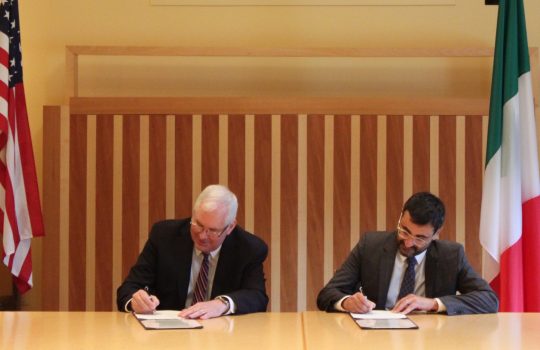
On June 28, the U.S. Department of Energy and the Italian Embassy signed an agreement for collaboration on research with the international Short-Baseline Neutrino program hosted at Fermilab.
New data shows that a MiniBooNE signal that may point to additional types of neutrinos has grown even stronger. Significantly stronger.
Fermilab’s Short-Baseline Neutrino program buildings, which translate the requirements of neutrino experiments into architecture, win ALA Gold Award.

Meet the detectors of Fermilab’s Short-Baseline Neutrino Program, hunting for signs of a possible fourth type of neutrino.
From Daily Herald, July 26, 2017: The ICARUS neutrino detector — the largest liquid-argon particle detector ever built — ended its intercontinental journey Wednesday, rolling through the gates of its new home at Fermi National Accelerator Laboratory in Batavia.
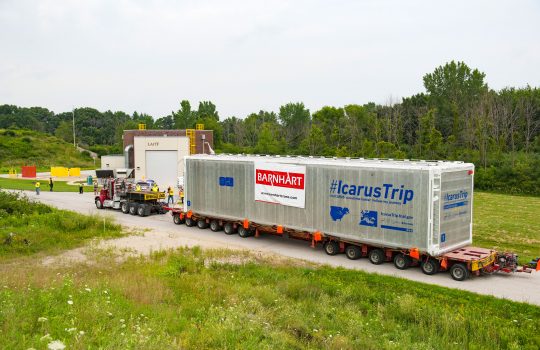
After six weeks’ passage across the ocean, up rivers and on the road, the newest member of Fermilab’s family of neutrino detectors has arrived.
From The Beacon-News, July 26, 2017: Fermilab scientist Catherine James reflects on the large box sitting on a flatbed that contained half of the ICARUS liquid-argon particle detector, at 60 feet long and 120 tons the largest of its kind, which she will work with when its installed and running by the end of the year.