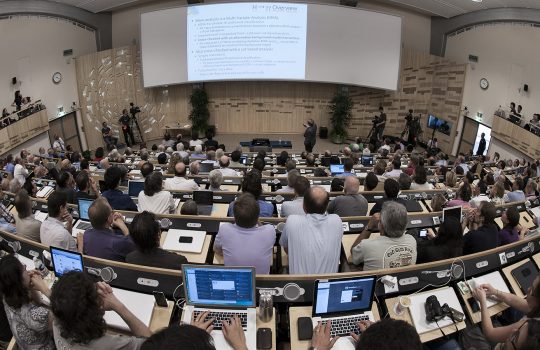
When was the Higgs actually discovered?
The announcement on July 4 was just one part of the story. Take a peek behind the scenes of the discovery of the Higgs boson.

101 - 110 of 131 results
The announcement on July 4 was just one part of the story. Take a peek behind the scenes of the discovery of the Higgs boson.
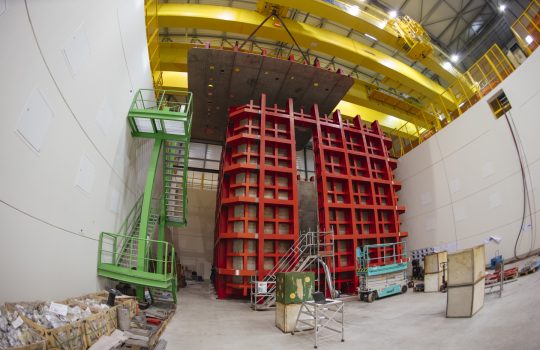
DOE and CERN last week signed three new agreements outlining the contributions CERN will make to the Fermilab neutrino program and DOE’s contributions to the High-Luminosity Large Hadron Collider upgrade program.
See Boston University physicist Tulika Bose’s answers to readers’ questions about research at the Large Hadron Collider.
Boston University physicist Tulika Bose explains why there’s more than one large, general-purpose particle detector at the Large Hadron Collider.
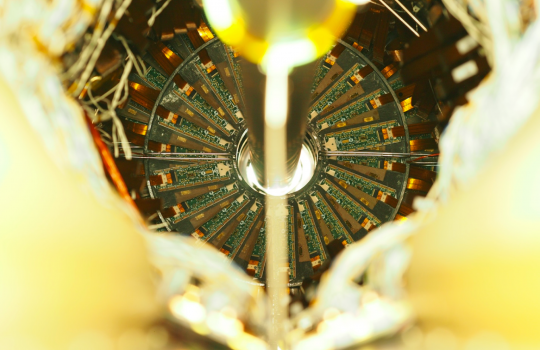
This month U.S. scientists embedded sophisticated new instruments in the heart of a Large Hadron Collider experiment.
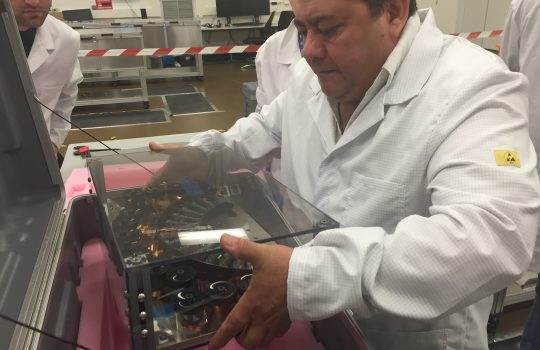
Sometimes being a physicist means giving detector parts the window seat.
From Forbes, Dec. 2, 2016: The latest search results released by the CMS collaboration rule out two classes of hypothetical particles, gluinos and squarks, below about 1.4 TeV in energy.
From Nature, Aug. 5, 2016: The intriguing data “bump” at the Large Hadron Collider — first reported in December — turns out to be nothing more than a statistical fluctuation.
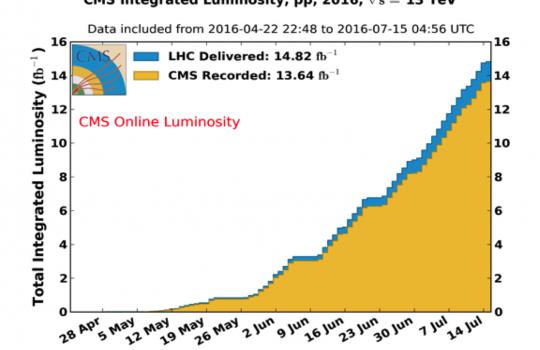
What’s it like to be part of an experiment collaboration in the weeks and days before a big announcement?
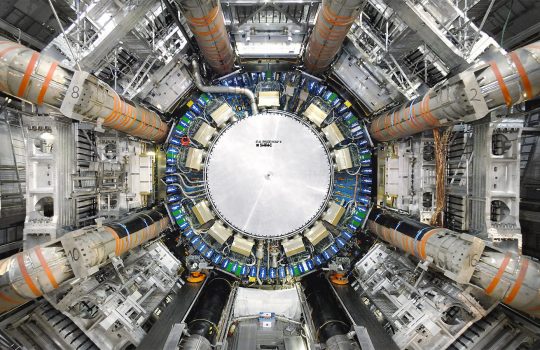
Possible signs of new particle seem to have washed out in an influx of new data.