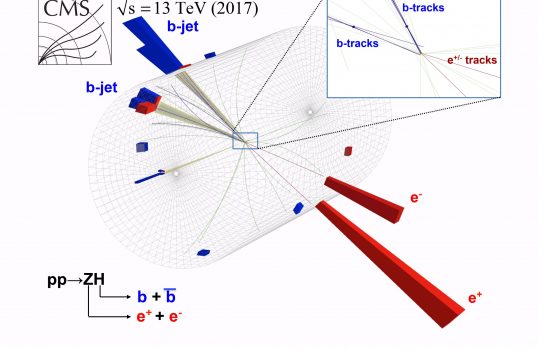
LHC scientists detect most favored Higgs decay
Scientists now know the fate of the vast majority of all Higgs bosons produced in the LHC.

81 - 90 of 131 results
Scientists now know the fate of the vast majority of all Higgs bosons produced in the LHC.
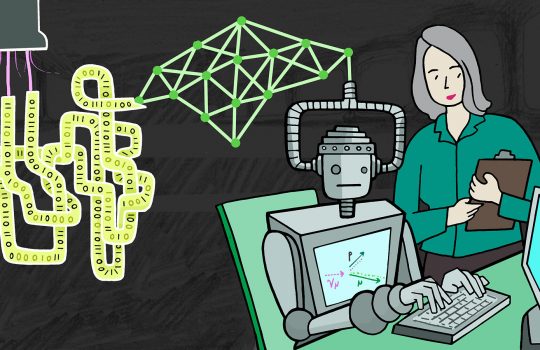
A new review in Nature chronicles the many ways machine learning is popping up in particle physics research.
From Brown University, July 18, 2018: Meenakshi Narain will lead the collaboration board for U.S. institutions participating in the CMS experiment at the Large Hadron Collider. Fermilab is the U.S. center for research at CMS.
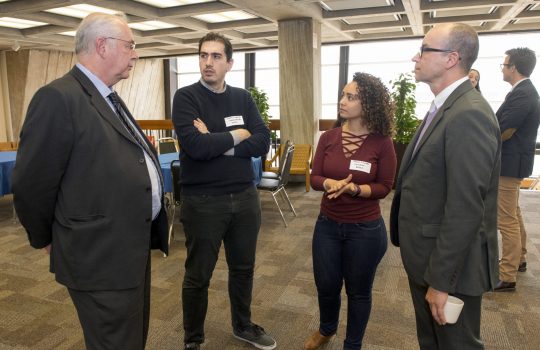
A program funded by the São Paulo Research Foundation supports scientists and students to engage with Fermilab’s neutrino program.
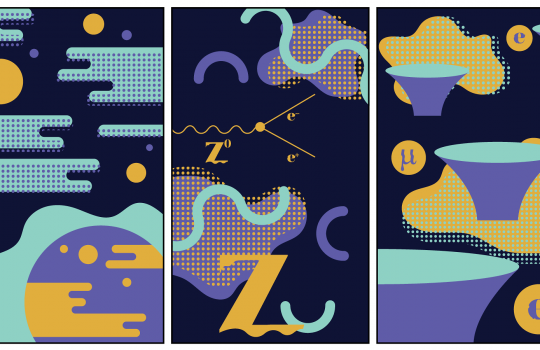
These are the event displays of Large Hadron Collider physicists’ dreams.
From Scientific American, June 6, 2018: Fermilab’s Don Lincoln explains the significance of scientists’ first observation of the famous Higgs boson, responsible for imparting mass, interacting with the heaviest particle in the universe.

Some scientists spend decades trying to catch a glimpse of a rare process. But with good experimental design and a lot of luck, they often need only a handful of signals to make a discovery.
From UPI, June 4, 2018: Fermilab Deputy Director Joe Lykken says that “deeply understanding how the Higgs interacts with known particles could help lead us to physics beyond the Standard Model.”
From Live Science, June 4, 2018: Fermilab scientist Don Lincoln writes about two new results on how scientists found the Higgs boson popping up along with the heaviest particle ever discovered. The results could help us better understand one of the most fundamental problems in physics — why matter has mass.
From Live Science, June 4, 2018: The Higgs boson appeared again at the world’s largest atom smasher — this time, alongside a top quark and an antitop quark, the heaviest known fundamental particles.