Will quantum computers revolutionize the world?
From the College of DuPage’s The Courier, Nov. 14, 2019: Fermilab scientists Jim Kowalski and Stephen Mrenna talk about Fermilab is using quantum computing to solve the problems of the universe.

81 - 90 of 93 results
From the College of DuPage’s The Courier, Nov. 14, 2019: Fermilab scientists Jim Kowalski and Stephen Mrenna talk about Fermilab is using quantum computing to solve the problems of the universe.
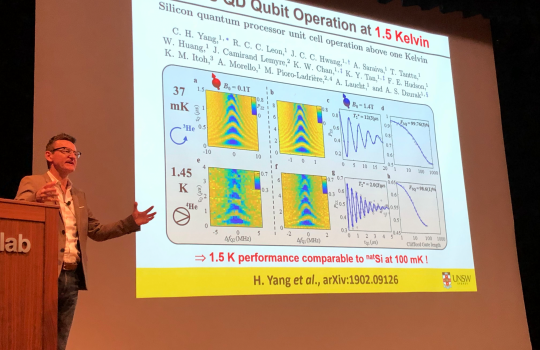
Today’s quantum computing processors must operate at temperature close to absolute zero, and that goes for their electronics, too. Fermilab’s cryoelectronics experts recently hosted a first-of-its-kind workshop where leaders in quantum technologies took on the challenges of designing computer processors and sensors that work at ultracold temperatures.

The funding supports initiatives in the rapidly evolving field of quantum computing. Fermilab scientists and engineers are simulating advanced quantum devices that will in turn improve particle physics simulations. They’re also developing novel electronics to work with large arrays of ultracold qubits.
From Machine Design, May 6, 2019: Fermilab scientists use quantum computing to simulate a family of particles that, until recently, has been relatively neglected in quantum simulations.
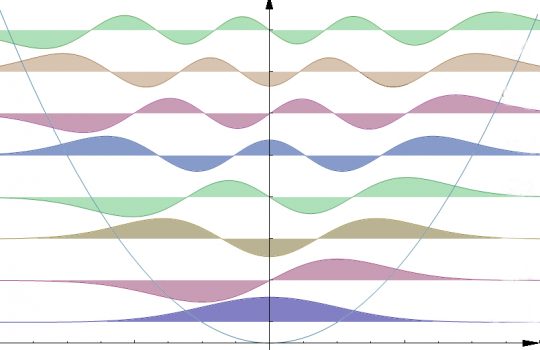
A Fermilab group has found a way to simulate, using a quantum computer, a class of particles that had resisted typical computing methods. Their novel approach opens doors to an area previously closed off to quantum simulation in areas beyond particle physics, thanks to cross-disciplinary inspiration.

Fermilab’s quantum program includes a number of leading-edge research initiatives that build on the lab’s unique capabilities as the U.S. center for high-energy physics and a leader in quantum physics research. On the tour, researchers discussed quantum technologies for communication, high-energy physics experiments, algorithms and theory, and superconducting qubits hosted in superconducting radio-frequency cavities.

Representatives from industry joined physicists to present software and share ideas about the future of quantum science and technology.
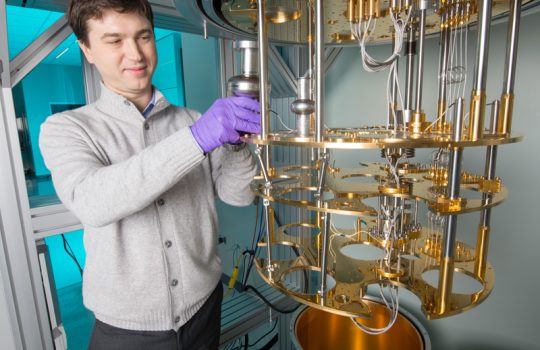
Fermilab scientists are adapting the lab’s cutting-edge accelerator technology for qubits and quantum sensors.
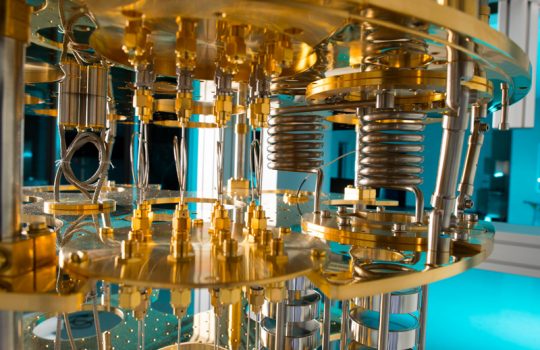
Through its Quantum Information Science-Enabled Discovery program, DOE is awarding Fermilab researchers funding for five quantum-science initiatives. It also funds Fermilab’s participation in three further initiatives led by other institutions.
From Space.com, July 2, 2018: Scientists test the first experiment sensitive enough to detect axions — ADMX. Fermilab scientist Andrew Sonnenschein highlights the connection between the ADMX experiment and quantum computing.