Public

1151 - 1160 of 2562 results

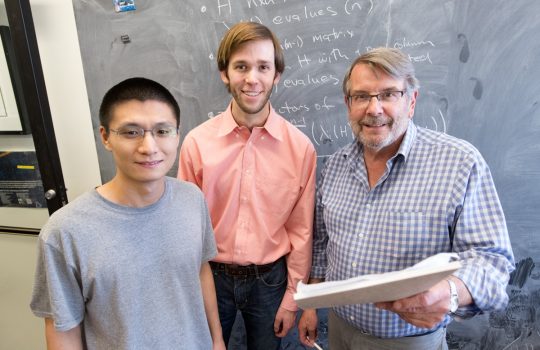
MAGIS-100: Atoms in free fall to probe dark matter, gravity and quantum science

A collaboration led by Fermilab and Stanford University combines their expertise in quantum science and accelerator technologies to build the world’s largest atom interferometer. The instrument will push the boundaries of quantum physics into macroscopic scales, providing a gateway for dark matter searches and tests of gravitational waves.
Can neutrinos help explain what’s the matter with antimatter?

    From Penn Today, Sept. 23, 2019: A team of researchers the University of Pennsylvania published results from the first set of experiments that can help answer these and other questions in fundamental physics. Their results are an important first step towards building the international Deep Underground Neutrino Experiment, hosted by Fermilab.

    Fighting cancer with physics

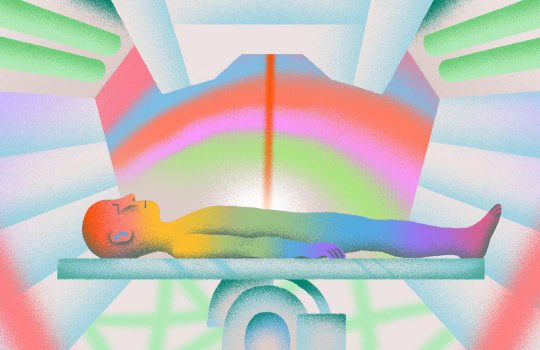
      Researchers at CERN are investigating how very high-energy electrons could help target tumors. The possibility of using high-energy electrons for cancer treatment combined with new experimental dose-delivery techniques poises the medical field for a revolution in cancer treatment.

      Cool and dry: a revolutionary method for cooling a superconducting accelerator cavity

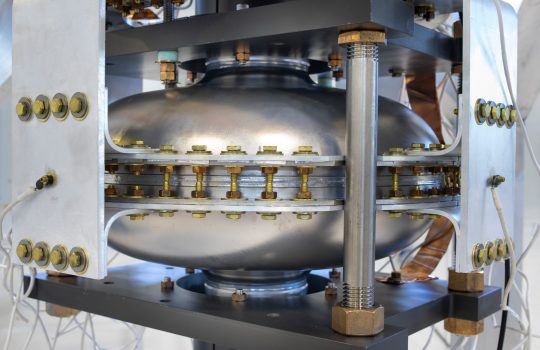
      For the first time, a team at Fermilab has cooled and operated a superconducting radio-frequency cavity — a crucial component of superconducting particle accelerators — using cryogenic refrigerators, breaking the tradition of cooling cavities by immersing them in a bath of liquid helium. The demonstration is a major breakthrough in the effort to develop lean, compact accelerators for medicine, the environment and industry.

      Where physics (still) doesn’t work: the global quest to solve the universe’s enduring mysteries

        From the World Conference of Science Journalists, Aug. 26, 2019: In this video, Fermilab Director Nigel Lockyer participates in a panel discussion on the big questions that remain unexplained today regarding the origin, nature and ultimate fate of the universe. The other panelists are CERN Director-General Fabiola Gianotti, French National Institute of Nuclear and Particle Physics Director Reynald Pain, and University of Zürich Professor Laura Baudis. Physics Today’s Toni Feder) moderates.