
How to put together an international physics experiment
To build the DUNE neutrino experiment and its associated accelerator upgrade, experts invent customized ways to transport fragile, expensive and highly specialized components.
11 - 20 of 22 results
To build the DUNE neutrino experiment and its associated accelerator upgrade, experts invent customized ways to transport fragile, expensive and highly specialized components.
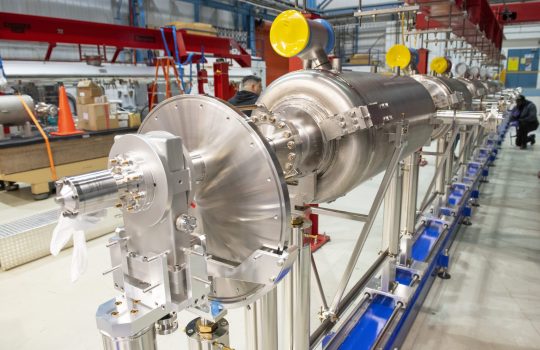
The 10-meter-long cryomodule, part of the PIP-II particle accelerator project at Fermilab, is now undergoing testing to validate all its components and finalize its design. In a few years, Fermilab and international partners will produce four similar cryomodules that will propel particles in the new linear accelerator.
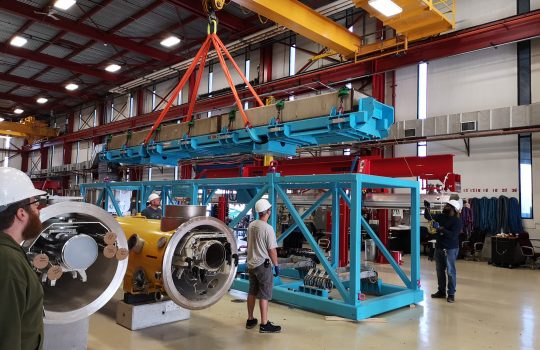
Successful assembly was the result of a collaboration among three institutions in three countries.
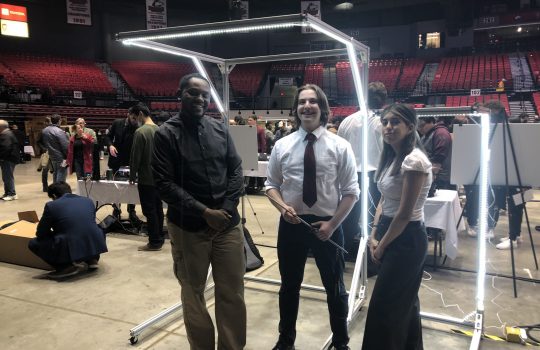
Senior engineering students designed a portable cleanroom and a modular cryomodule mockup for Fermilab’s new accelerator complex upgrade project.
From Engineering Update, January 6, 2022: Illinois-based Caldwell Group Inc. has customized a lifting frame that may be used in the summer of 2022 during transatlantic transportation of cryomodules to Fermilab for the Proton Improvement Program II (PIP-II) project. STFC-UKRI in the UK designed and assembled the lifting frame to meet impact, vibration, lifting, and transport load requirements in both the United States and Europe.

Accelerator experts at three national labs have advanced the next generation of cryomodules, the building blocks of particle accelerators. A prototype built for the high-energy upgrade of SLAC’s LCLS-II X-ray laser has advanced the state of the art, packing more acceleration into a smaller distance, and could dramatically improve future accelerators.
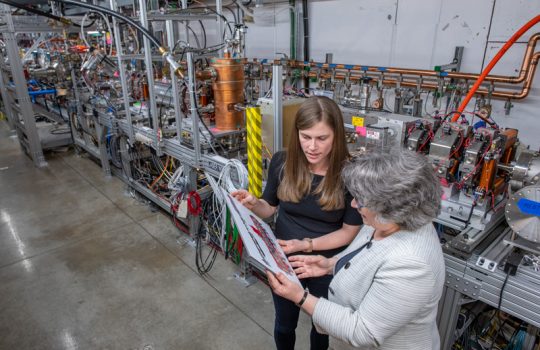
This spring testing wrapped up at the PIP-II Injector Test Facility, or PIP2IT. The successful outcome paves the way for the construction of PIP-II, a new particle accelerator that will power record-breaking neutrino beams and drive a broad physics research program at Fermilab for the next 50 years.
From the STFC, May 12, 2021: STFC and US-based Fermi National Accelerator Laboratory have agreed to collaborate on building one of the world’s most powerful linear accelerators.
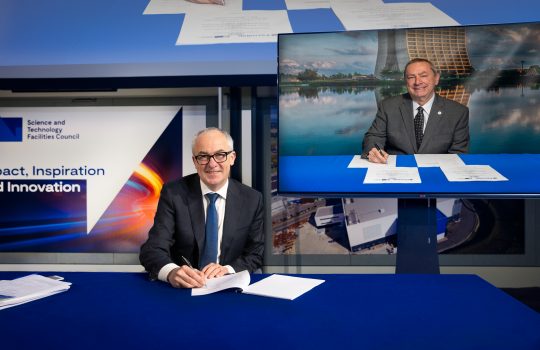
The Science and Technology Facilities Council, or STFC, has signed an agreement with Fermi National Accelerator Laboratory, in the United States, designating how the two organizations will collaborate to build one of the world’s most powerful linear accelerators.
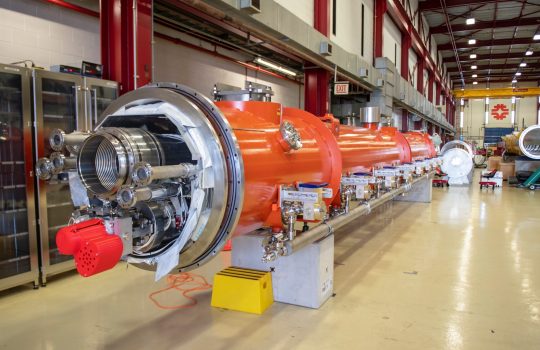
Fermilab gives a sendoff to the final superconducting component for the LCLS-II particle accelerator at SLAC National Accelerator Laboratory in California. LCLS-II will be the world’s brightest and fastest X-ray laser. A partnership of particle accelerator technology, materials science, cryogenics and energy science, LCLS-II exemplifies cross-disciplinary collaboration across DOE national laboratories.