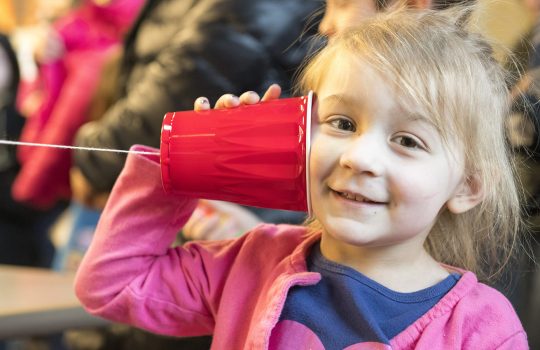
Particle physics for preschoolers
Particle physics might seem too complex for young children, but educators are finding enthusiasm and understanding even among the “Sesame Street” set.
411 - 420 of 1785 results
Particle physics might seem too complex for young children, but educators are finding enthusiasm and understanding even among the “Sesame Street” set.
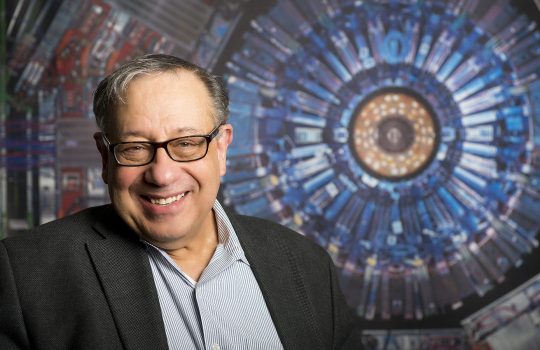
Fermilab scientist Joel Butler has been elected vice chair of its Executive Committee. He will begin as vice chair on Jan. 1, 2020, rotating to chair-elect in 2021 and chair in 2022.
Spack, a software package management tool, was recognized with an R&D 100 Award in November. Developed for high-performance computing applications, Spack is used as an end-to-end development tool within the high-energy physics community. Fermilab is a contributor to Spack, whose initial development was led by Lawrence Livermore National Laboratory.
Grab your cocoa or pumpkin spice — as today we examine what’s naughty and nice.
From New Scientist, Dec. 11, 2019: Fermilab scientist Dan Hooper is quoted in this article on what scientists mean when they talk about the Big Bang. The best evidence for the big bang is all around us in the cosmic microwave background, the radiation released once the universe had cooled sufficiently for atoms to form, when it was about 380,000 years old. And that is the point: everywhere in today’s universe was where the big bang was.
From DOE, Dec. 11, 2019: Secretary Brouillette served in the U.S. Army and has three decades of experience in both the public and private sector, most recently as the deputy secretary of energy.
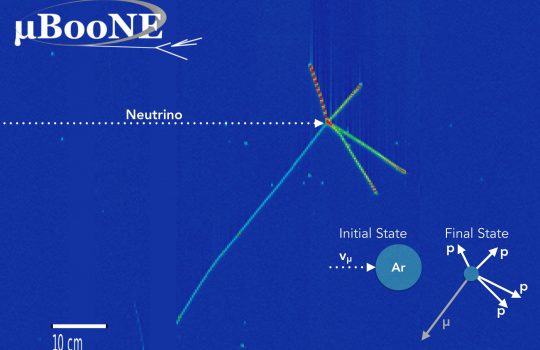
Scientists on Fermilab’s MicroBooNE experiment have measured neutrino interactions on argon with unprecedented statistics and precision using data on the resultant muons — in particular, the muon’s momentum and angle. The experiment features the first liquid-argon time projection chamber with the resolution and statistics to carry out such a measurement. Researchers will use the result to improve simulations of neutrino interactions. These improvements are important for neutrino experiments in general, including the Short-Baseline Neutrino program experiments and the international Deep Underground Neutrino Experiment, both hosted by Fermilab.
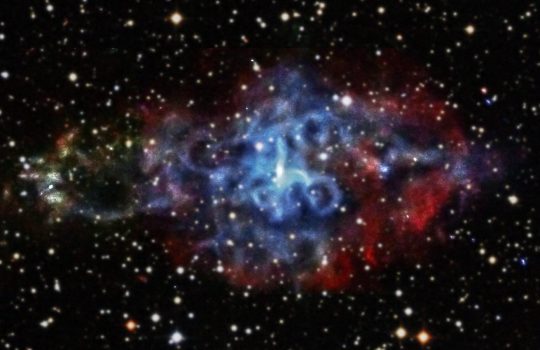
Scientists at CERN have found a way to learn more about the interior of neutron stars using the Large Hadron Collider. Researchers on the ALICE experiment are uncovering the properties of elusive hyperon particles hypothesized to be found inside neutron stars.

In November, the Chicago Quantum Exchange held a workshop about ethics and societal impacts of artificial intelligence and quantum computing technologies. Participants from a wide variety of academic backgrounds, from physicists to sociologists, discussed the implications of technology on society and vice versa and identified critical steps scientists need to take so technology is developed and implemented ethically and responsibly.
From DOE, Dec. 9, 2019: Fermilab scientist Josh Frieman writes about the search for the nature of dark energy at the national laboratories and how the Office of Science’s High Energy Physics program has been at the vanguard of a number of cosmic surveys.