Why I went birdwatching at a particle physics lab
From Gizmodo, Jan. 23, 2020: Fermilab scientist Peter Kasper guides Gizmodo writer and birder Ryan Mandelbaum around the Fermilab site to look for birds.
391 - 400 of 1785 results
From Gizmodo, Jan. 23, 2020: Fermilab scientist Peter Kasper guides Gizmodo writer and birder Ryan Mandelbaum around the Fermilab site to look for birds.
From STFC, Jan. 23, 2020: Representatives from UK Research and Innovation and the U.S. Department of Energy have signed an agreement that outlines £65 million worth of contributions that UK research institutions and scientists will make to the international Deep Underground Neutrino Experiment and related projects hosted by Fermilab. DUNE will study the properties of mysterious particles called neutrinos, which could help explain more about how the universe works and why matter exists at all.
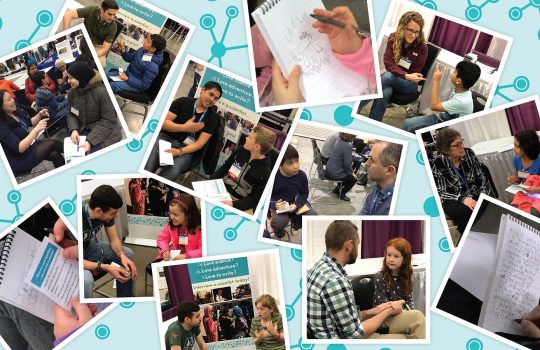
Science Storytellers brings together two groups of innately curious individuals: scientists and children. In the Science Storytellers program, kids act as science journalists interviewing real-life scientists. Afterward, they share what they learned. Research shows that transmitting scientific knowledge to the public is important, but actually shifting someone’s opinions requires engaging with them in a two-way dialogue and treating them as a whole, complicated person with knowledge, experiences and influences of their own.
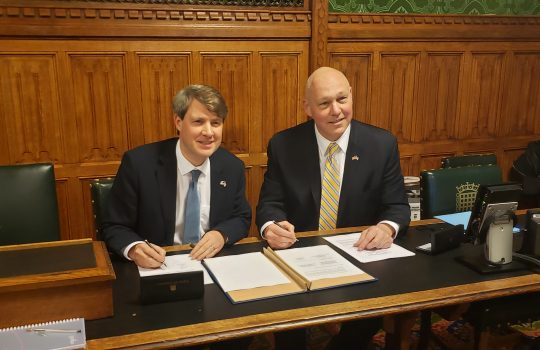
Representatives from UK Research and Innovation and the U.S. Department of Energy signed an agreement that outlines £65 million worth of contributions that UK research institutions and scientists will make to the international Deep Underground Neutrino Experiment and related projects hosted by Fermilab.
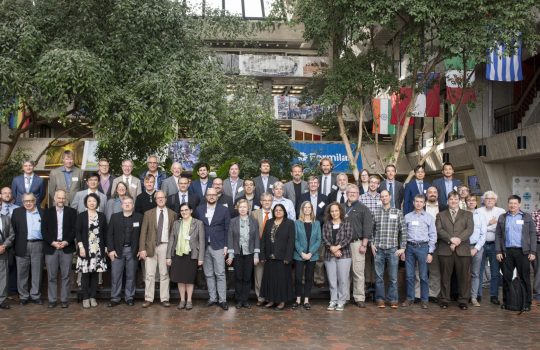
The USCMS collaboration has received approval from the Department of Energy to move forward with final planning for upgrades to the giant CMS particle detector at the Large Hadron Collider. The upgrades will enable it to take clearer, more precise images of particle events emerging from the upcoming High-Luminosity LHC, whose collision rate will get a 10-fold boost compared to the collider’s design value when it comes online in 2027.

As technology improves, scientists discover new ways to search for theorized dark matter particles called axions. Four decades after they were first theorized, axions are enjoying a moment in the sun, and may even be on the verge of detection, poised to solve two major problems in physics at once.
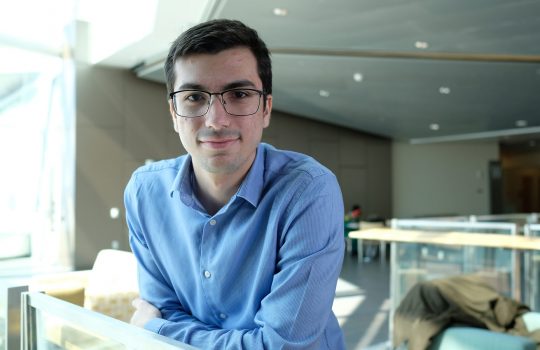
The first undergraduate on the Event Horizon Telescope to receive junior collaborator status thrives in the unknown. In his nearly two years with the team, he has developed computer libraries for data analysis and modeling, made movies of black holes and assisted with weather prediction.
From Scientific American, February 2020: Collaborators from eight institutions have come together to turn a mine shaft at Fermilab into the world’s largest atom interferometer — MAGIS-100. The researchers plan to assemble the instrument in 2021 and start harnessing lasers to expand submicroscopic strontium atoms into macroscale “atom waves” soon after. Fermilab scientist Rob Plunkett comments on the mind-boggling experiment.
From SLAC, Jan. 13, 2020: Matching up maps of matter and light from the Dark Energy Survey, hosted at Fermilab, and Fermi Gamma-ray Space Telescope may help astrophysicists understand what causes a faint cosmic gamma-ray glow.
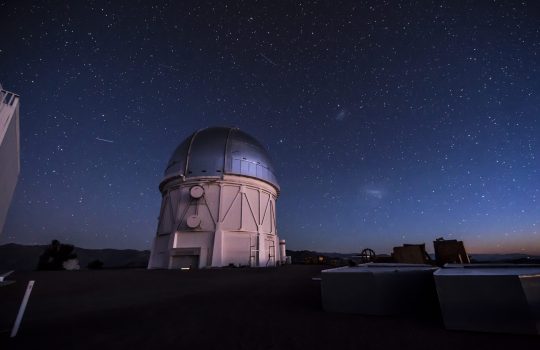
For the first time, a team of scientists has used the orientation of light left over from the early universe to detect gravitational lensing from galaxy clusters – the bending of light around these massive objects. Using gravitational lensing data taken by the South Pole Telescope and the Dark Energy Camera, Fermilab scientist Brad Benson and colleagues have demonstrated a new way to “weigh” galaxy clusters and ultimately shed light on dark matter, dark energy and other mysteries of the cosmos.