Duke physicists share prize for discovery of the top quark
From Duke Today, July 17, 2019: Teams behind the 1995 discovery are recognized for first observations of tiny but hefty particle at the heart of matter.
601 - 610 of 1785 results
From Duke Today, July 17, 2019: Teams behind the 1995 discovery are recognized for first observations of tiny but hefty particle at the heart of matter.
From CNN, July 16, 2019: On the occasion of the 50th anniversary of the moon landing, Fermilab scientist Don Lincoln talks about the past, present and future of spaceflight. There is no denying the allure of manned space travel. It tugs at our imagination. Ironically, we must both temper our imagination and dream even bigger.
From Physics World, June 12, 2019: Physics World posts a video recorded inside the ProtoDUNE neutrino detector by the particle physicist and vocalist Anastasia Basharina-Freshville, who sing-explains why the noble gas is used to detect the elusive particles.
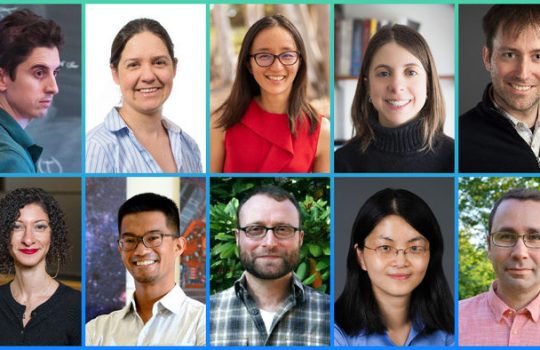
Right now could be considered one of the best — and most uncertain — times in theoretical physics. That’s what Symmetry heard in interviews with 10 junior faculty in the field. They talk about what keeps them up at night, their favorite places to think and how they explain their jobs to nonscientists.
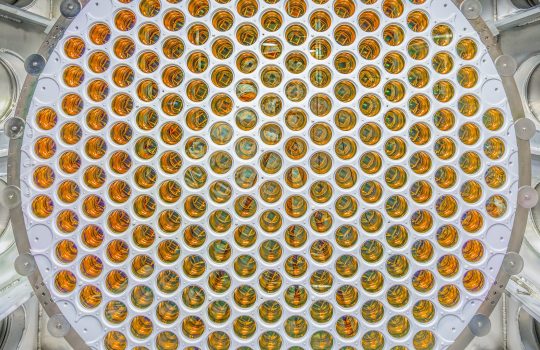
Major deliveries in June set the stage for the next phase of work on LUX-ZEPLIN project, led by Lawrence Berkeley National Laboratory. A Fermilab group is responsible for implementing key parts of the critical systems that handle the xenon in the detector.
From Rapid City Journal, July 12, 2019: Fermilab Director Nigel Lockyer was the guest for a free public speaker series held one day prior to Neutrino Day, a full day of neutrino-themed public activities in Lead. Lockyer spoke about is known as the Deep Underground Neutrino Experiment (DUNE), housed in the Long Baseline Neutrino Facility (LBNF), which will have its South Dakota component at the Sanford Underground Research Facility in the former Homestake mine. It’s a billion-dollar international collaboration, and it’s described as the largest particle physics project ever built in the United States.
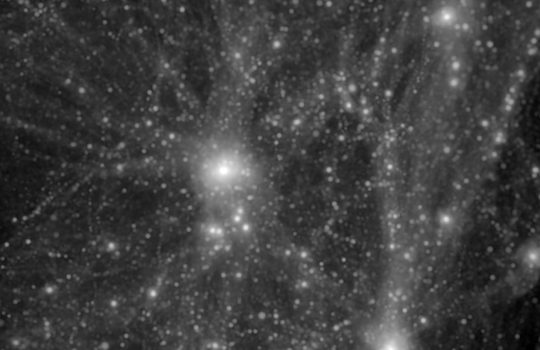
A new study shows that light dark matter is 1000 times less likely to bump into regular matter than previous analyses allowed.
From Inside HPC, July 3, 2019: Particle physics researchers are using custom integrated circuits called FPGAs in combination with other computing resources to process massive quantities of data at extremely fast rates to find clues to the origins of the universe. This requires filtering sensor data in real time to identify novel particle substructures that could contain evidence of the existence of dark matter and other physical phenomena. A growing team of physicists and engineers from Fermilab, CERN and other institutions, co-led by Fermilab scientist Nhan Tran, wanted to have a flexible way to optimize custom-event filters in the CMS detector they are working on at CERN.
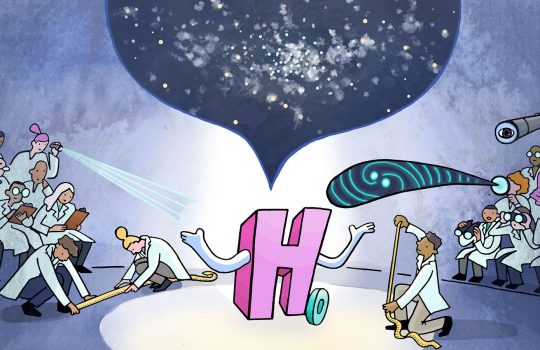
Few numbers have gotten under astronomers’ skin like the Hubble constant. In fact, experts have debated the value of this single parameter for 90 years, and if astronomers can measure its value with great precision, they’ll be one step closer to solving some of the other grand astronomical mysteries of our age. There’s just one problem: The measurements they’ve taken don’t agree. The discrepancy makes scientists question whether something is amiss in our understanding of the universe.
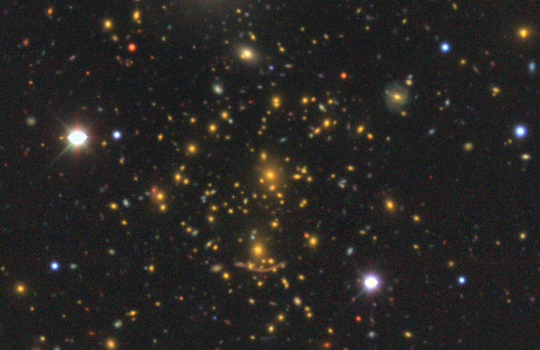
It took three sky surveys to prepare for a new project that will create the largest 3-D map of the universe’s galaxies and glean new insights about the universe’s accelerating expansion. This Dark Energy Spectroscopic Instrument project will explore this expansion, driven by a mysterious property known as dark energy, in great detail. The surveys, which wrapped up in March, have amassed images of more than 1 billion galaxies and are essential in selecting celestial objects to target with DESI, now under construction in Arizona.