581 - 590 of 1785 results

Resurrected detector will hunt for some of the strangest particles in the universe

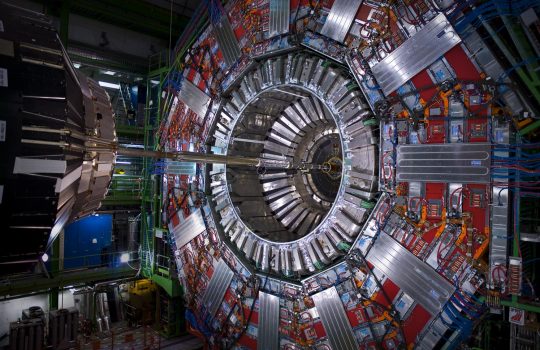
    From Science, Aug. 8, 2019: Fermilab physicists are resurrecting a massive particle detector by lowering it into a tomblike pit and embalming it with a chilly fluid. In August, workers eased two gleaming silver tanks bigger than shipping containers, the two halves of the detector, into a concrete-lined hole. Hauled from Europe two years ago, ICARUS will soon start a second life seeking perhaps the strangest particles physicists have dreamed up, oddballs called sterile neutrinos.
    Dark matter has never killed anyone, and scientists want to know why

      From Popular Science, July 29, 2019: “Death by Dark Matter” is not the name of your new favorite metal band; it’s the literal title of a new study by a trio of American of physicists. Fermilab science Dan Hooper is quoted in this article on their paper, which explores what the hypothetical consequences might be on the human population if a certain candidate of dark matter turned out to be true.

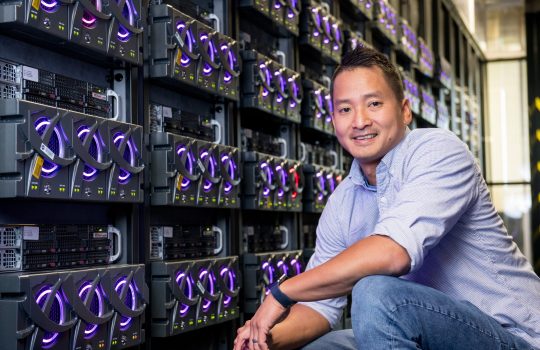
      Fermilab’s HEPCloud goes live

      A pioneer in particle physics and high-performance computing, Fermilab has launched HEPCloud, a cloud computing service that will enable the lab’s demanding experiments to make the best, most efficient use of computing resources. This flagship project lets experiments rent computing resources from external sources during peak demand, reducing the costs of providing for local resources while also providing failsafe redundancy.

      Karen Kosky

      One minute with Karen Kosky, head of the Fermilab Facilities Engineering Services Section

      Karen Kosky gets to see many different aspects of Fermilab. She is the head of the Facilities Engineering Services Section, which manages everything from buildings and high-voltage electric systems to prairie burns and our herd of bison. She and her team work hard to maintain the site and keep Fermilab’s conventional facilities and property operations running smoothly.

      Powered by pixels

      Scientists are working on a pixelated detector capable of clearly and quickly capturing neutrino interactions — a crucial component for the near detector of the Deep Underground Neutrino Experiment. Using technological solutions developed at University of Bern and Berkeley Lab, a prototype detector called ArgonCube is under construction in Bern and will arrive at Fermilab next year.

      Gravity’s waterfall

      In recent years, scientists have found ways to study black holes, listening to the gravitational waves they unleash when they collide and even creating an image of one by combining information from radio telescopes around the world. But our knowledge of black holes remains limited. So scientists are figuring out how to make do with substitutes — analogs to black holes that may hold answers to mysteries about gravity and quantum mechanics.

      A smashing summer

        From Independent, July 27, 2019: A high school student spends his summer working on neutrinos and Fermilab’s NOvA neutrino experiment.

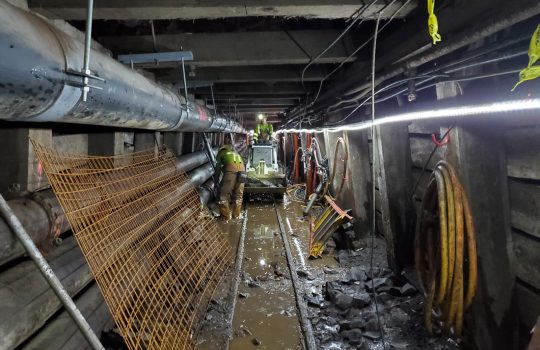
        In photos: LBNF rebuilds portal for rock transportation system

        The Long-Baseline Neutrino Facility team is in the process of rehabilitating an old mining tunnel in South Dakota for the installation of a conveyor system to transport rock. In June, they reached a milestone when they finished the rebuilding of the portal to the tunnel.