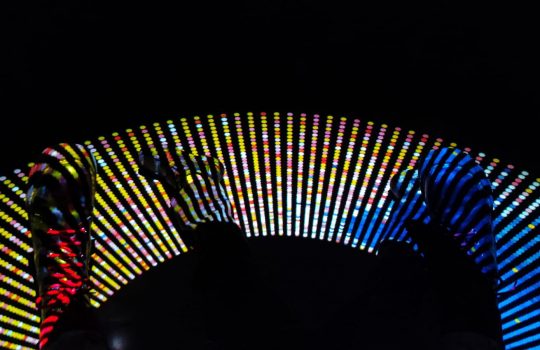
Feeling the universe in the ‘Particle Shrine’
A physicist, a composer and a creative technician team up to translate the unseen particles around us into a format that human bodies can understand.
521 - 530 of 2261 results
A physicist, a composer and a creative technician team up to translate the unseen particles around us into a format that human bodies can understand.
From Big Think, Jan. 6, 2023: While astronomers debate the existence of dark matter, Don Lincoln breaks down a new paper published in Nature Astronomy that claims to debunk a key observation that strengthens the case that the Universe is full of unseen matter.
From Virginia Tech, Jan. 4, 2023: Learn more about what researchers from the Virginia Tech Center for Neutrino Physics are contributing to the international DUNE collaboration. The Center is well-known for combining experimental and theoretical physics to study neutrinos as they bump into the argon inside the DUNE detector and leave behind trails of energy.
From Big Think, Jan.3, 2023: Does negative energy really exist? Don Lincoln explores what it is, what it isn’t and what the state of having less energy than empty space means.
From the College of DuPage, Jan. 4, 2023: Who says robots can’t be fashionable? This video tells the story of why SPOT the Fermilab robot needed a little fashion in his life. Thanks to the College of DuPage Fashion Studies students, SPOT now has designer protective gear.
Forces Net, Jan. 3, 2023: Fermilab researchers recently collaborated with the U.S. Army Engineer Research and Development Center to build a compact SRF electron accelerator prototype at the IARC. This collaborative work used electron beam accelerator technology to create surfacing materials to serve military transport to improve and extend the lifespan of modern runways and other surfaces.
From Live Science, Dec. 29, 2022: This past year proved successful for particle physics research. Read more about the eight projects identified by Live Science as the biggest and best physics stories of 2022 and how Fermilab was a part of two of them.
From Nasdaq, Dec. 15, 2022: Quantum computing can perform calculations in ways that are impossible for classical computers. It was recently announced that Google’s Sycamore quantum processor was used by researchers from Caltech, Google, Fermilab, MIT and Harvard to generate and control what is equivalent to an Einstein-Rosen bridge, or more commonly referred to as a wormhole.
From New Scientist, Dec. 16, 2022: This year was another busy year in science and technology and New Scientist news editors’ have chosen some of the biggest scientific developments, discoveries and events in 2022. Included in this year’s selections is the April 2022 announcement of the mass of the W boson that used Fermilab’s Tevatron.
From CNN Opinion, Dec. 14, 2022: Don Lincoln examines the result from the National Ignition Facility at Lawrence Livermore National Laboratory that fusing elements released more energy than the lasers supplied. While this is a monumental step for science and a spectacular technical achievement, the process has to be repeated again and again and engineers need to construct a containment structure that can survive the bath of neutrons that a functional fusion generator will create.