Fermilab features

421 - 430 of 659 results

Fermilab engineers and technicians stand by a magnet coil made for the High-Luminosity LHC. Photo: Reidar Hahn

Large Hadron Collider upgrade project leaps forward

The U.S. Department of Energy has approved the scope, cost and schedule for the U.S. LHC Accelerator Upgrade Project and has given the first approval for the purchase of materials. This project brings together scientists, engineers and technicians from national laboratories — such as Fermilab, Brookhaven, Berkeley, SLAC and Jefferson labs — to develop two cutting-edge technologies to advance the future of both the Large Hadron Collider and broader collider research.

CSI: Neutrinos cast no shadows

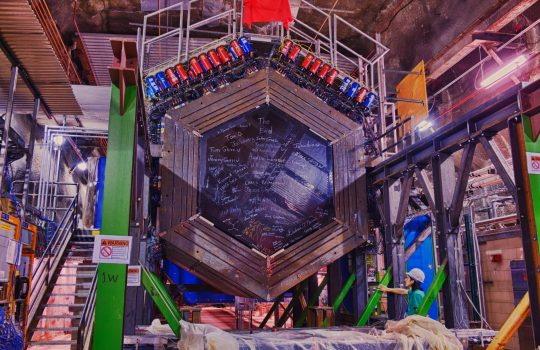
The MINERvA neutrino experiment has a new crime scene investigation technique, one that takes a hard look at the traces that particles leave before fleeing the scene. Researchers used a new technique in a recent MINERvA neutrino investigation. And the new insights they gained on the workings of nuclear effects can help other neutrino experiments.

ArgoNeuT hits a home run with measurements of neutrinos in liquid argon

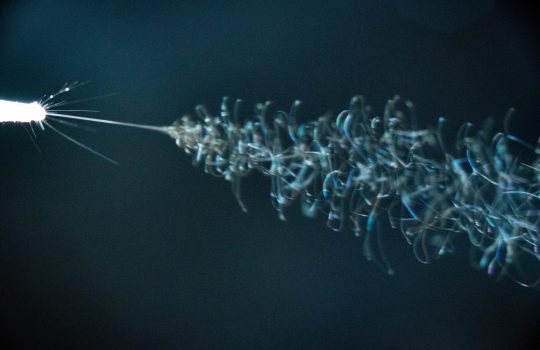
Scientists on the ArgoNeuT experiment have developed a method that enables them to better distinguish the tracks that particles leave behind in liquid argon, as well as a way to better differentiate between signals and background. And thanks to the software’s great performance, ArgoNeuT will aid larger neutrino experiments in their quest to understand the nature of the subtle neutrino.

DOE Under Secretary for Science Paul Dabbar visits Fermilab to discuss quantum program

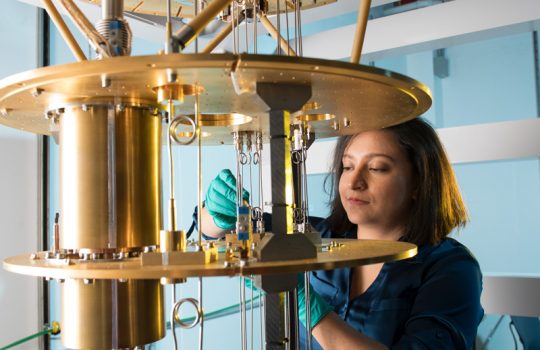
Fermilab’s quantum program includes a number of leading-edge research initiatives that build on the lab’s unique capabilities as the U.S. center for high-energy physics and a leader in quantum physics research. On the tour, researchers discussed quantum technologies for communication, high-energy physics experiments, algorithms and theory, and superconducting qubits hosted in superconducting radio-frequency cavities.

Pushpa Bhat elected to AAAS Council

Fermilab scientist Pushpa Bhat was recently elected to the Council of the American Association for the Advancement of Science, the world’s largest scientific society, as a representative for the Section on Physics. Her three-year term begins on Feb. 18. The AAAS Council establishes general policies for the association and reviews all of its programs.

Pre-excavation work on LBNF/DUNE begins in South Dakota

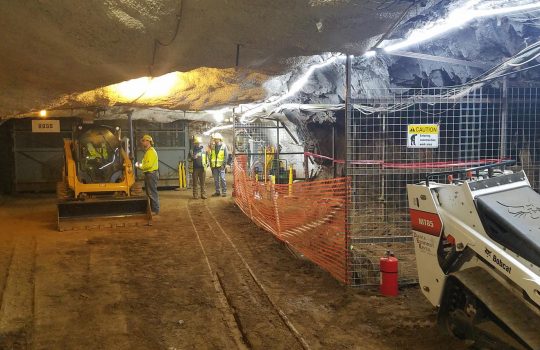
Fermilab has finalized an agreement with construction firm Kiewit-Alberici Joint Venture to start pre-excavation work for the Long-Baseline Neutrino Facility, which will house the enormous particle detectors for the Deep Underground Neutrino Experiment. The South Dakota portion of the facility will be built a mile beneath the surface at the Sanford Underground Research Facility in Lead, South Dakota.

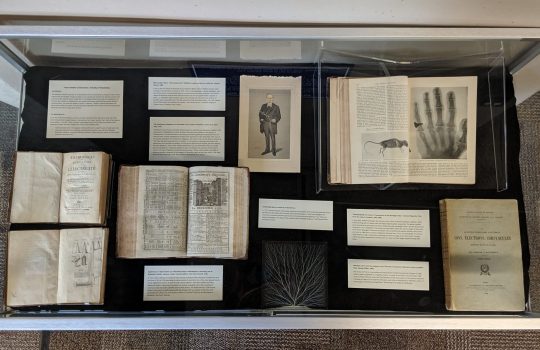
Visit the display case in the Fermilab Art Gallery to view scientific journals from the 17th and 18th centuries. Photo: Valerie Higgins

Influential works in history of physics on display at Fermilab

In a new series of exhibits in the Fermilab Art Gallery, the Fermilab Archives will feature influential works loaned by the private collection of a Fermilab scientist. It kicks off with the current exhibit, which features works from the 17th and 18th centuries. Each display, which will rotate approximately once a month, will consist of several volumes illustrating a common theme in the evolution of physics.

Cosmic-muon detector technology earns R&D 100 Award for Fermilab and its partners

The new technology is a miniaturized version of a sensor developed for the CMS experiment at the Large Hadron Collider. But instead of being used for discovery science, the sensors are developed to screen cargo by detecting muons, particles that penetrate materials such as concrete and lead. Scientists at Fermilab, Los Alamos National Laboratory and the Nevada National Security Site designed, assembled and tested the small, slim sensors, which could replace bulkier screening technologies.