Public

1311 - 1320 of 2562 results

All hands on deck

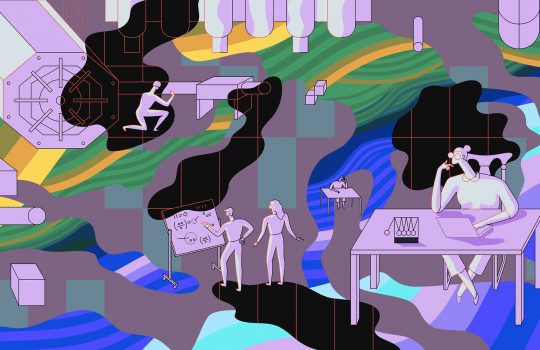
    Some theorists have taken to designing their own experiments to broaden the search for dark matter. The trend of theorists proposing experiments has become so common that it’s almost expected of new students entering the field. The hope is that flooding the field with new ideas could finally lead to the discovery of dark matter.
    MINERvA successfully completes its physics run

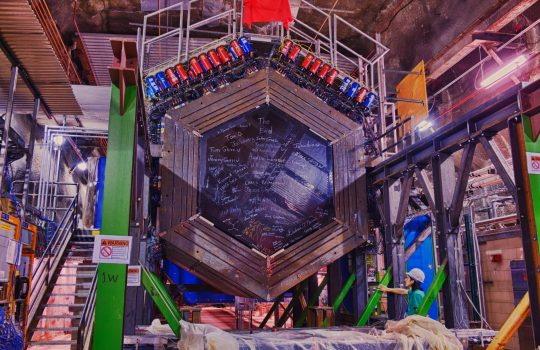
    On Feb. 26, a team on Fermilab’s MINERvA neutrino experiment gathered around a computer screen to officially conclude its data acquisition. Even with the data collection over, the work marches on. MINERvA now turns its attention to analyzing the data it has collected over the past nine years of its run.

    Why physicists tried to put a ferret in a particle accelerator

      From Atlas Obscura, April 2, 2019: In February 1971, physicists at National Accelerator Laboratory began testing the biggest machine in the world: a ring-shaped, 200-billion-electronvolt proton synchrotron particle accelerator. The stakes were high. They soon ran into a perplexing problem: Magnets that were essential to its operation kept failing. The low-tech solution proposed for this high-tech trouble? A ferret named Felicia.

      Considering the whole student

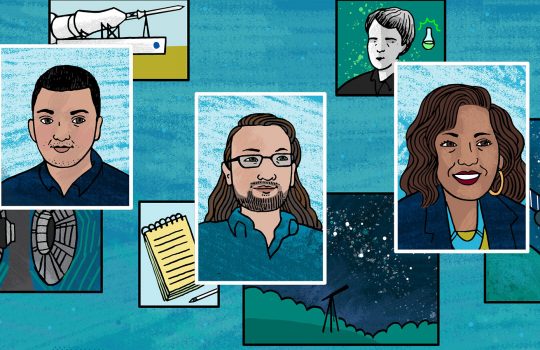
        Students come into science from a variety of backgrounds, facing a variety of circumstances. The Fisk-Vanderbilt Master’s-to-Ph.D. Bridge Program, a partnership between Fisk and Vanderbilt universities in Nashville, is meant to take that into account. It helps students overcome external hurdles to reach their potential in Ph.D.-level STEM research. Meet three scientists connected by the program.

        Firing on all cylinders

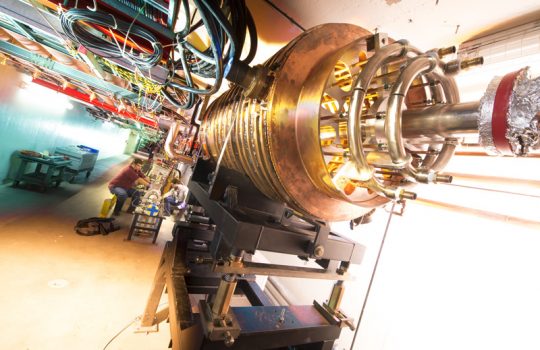
        It’s always great when every one of Fermilab’s nine particle accelerators are turned on and provide beam. With the lab again firing on all accelerator-cylinders, we thought it would be a good time to provide a rundown of each of the members of Fermilab’s accelerator complex. Get to know Fermilab’s suite of accelerators and storage rings.

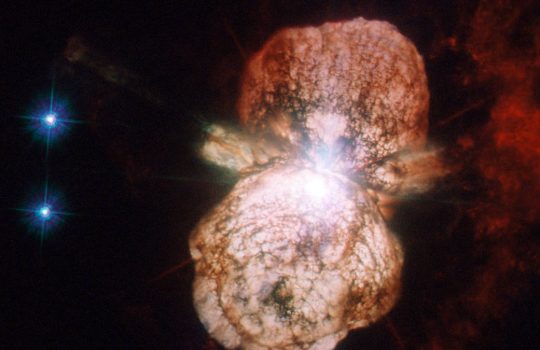
        A supernova's shockwave ejects the outer layers of the star in a catastrophic blast that can briefly shine more brightly than entire galaxies. Image: NASA

        Waiting for neutrinos

        Particle detectors recorded neutrinos from supernova SN1987A hours before telescopes saw the first light. Thirty years later, scientists around the world are eager to detect neutrinos from another one. The international Fermilab-hosted Deep Underground Neutrino Experiment will be looking for them. These neutrinos can tell us more about supernovae themselves and may hint at new physics that could upend the Standard Model of particle physics.

        To Ph.D. or not to Ph.D.

        Respondents to Symmetry’s survey about what it’s like to earn a Ph.D. in particle physics or astrophysics offer their views of the experience. Nearly 2,000 people worldwide complete the scientific rite of passage each year. Yet for many people, the process remains mysterious.
        The more than 300 responses to Symmetry’s survey described a challenging, multifaceted experience that goes far beyond job training, and even beyond the scientific goal of studying the fundamental nature of the universe.