LBNF

21 - 30 of 149 results

‘Truss’le and bustle

    From Black Hills Pioneer, July 22, 2020: Since late 2019, work has been underway on the Long-Baseline Neutrino Facility conveyor system at the Sanford Underground Research Facility in South Dakota. The system will carry more than 800,000 tons of rock excavated from the site of the international, Fermilab-hosted Deep Underground Neutrino Experiment 4,850-feet below the surface. A major milestone for the project was met on July 20 as the 120-foot section of the truss, which will house the conveyor, was erected above the highway.

    House panels use “emergency” to boost NIH, DOE science budgets

      From Science, July 7, 2020: Spending panels in the U.S. House of Representatives have begun voting on bills to fund the government, and a few of them made use of an emergency mechanism to beef up research budgets. The national laboratories funded by the Department of Energy’s Office of Science is a big winner, receiving a one-time boost of $6.25 billion next year under a plan approved by a House spending panel, including funding for the Long-Baseline Neutrino Facility hosted by Fermilab.

      Crews create a blast to take the Deep Underground Neutrino Experiment to the next stage

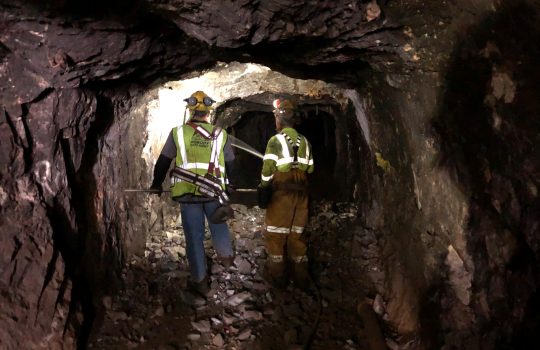
      Construction workers have carried out the first underground blasting for the Long-Baseline Neutrino Facility, which will provide the space, infrastructure and particle beam for the international Deep Underground Neutrino Experiment. This prep work paves the way for removing more than 800,000 tons of rock to make space for the gigantic DUNE detector a mile underground.

      Why the U.S. is betting it all on the most puzzling particle in the universe

        From Gizmodo, May 18, 2020: Neutrino physics is a trek into the unknown, one that the United States physics community has chosen to pursue full-on. A flagship experiment called LBNF/DUNE will lead the search, in pursuit of answers that may take decades or more to find. Fermilab Deputy Director for Research Joe Lykken, DUNE spokesperson Ed Blucher, and DUNE scientists Chang Kee Jung and Elizabeth Worcester talk about how neutrinos will enhance our understanding of the universe.

        Fermilab and the University of Bern join forces for neutrino research

          From the University of Bern, May 2020: The University of Bern and Fermilab partner on three neutrino projects aimed at a thorough study of some postulated properties of the ghostly particle: MicroBooNE, SBND and the Deep Underground Neutrino Experiment, the latter to be considered the world’s ultimate neutrino observatory.

          Declaração conjunta entre os governos do Brasil e dos Estados Unidos da América sobre a 5ª Reunião da Comissão Mista Brasil-EUA de Cooperação Científica e Tecnológica Brasília

            From March 6, 2020: Durante a 5ª Comista, os dois países adotaram um Plano de Trabalho em Ciência e Tecnologia para o período de 2020 a 2023, que estabelece as prioridades comuns descritas acima. Também foram firmados acordos de cooperação na área de cooperação científica em Física de Partículas de Alta Energia entre o Fermilab (Laboratório de pesquisa científica do Departamento de Energia dos EUA) e a FAPESP e outro acordo na mesma área entre o Fermilab e a UNICAMP.

            Fermilab, UNICAMP and São Paulo Research Foundation collaborate on major international projects for neutrino research

            Under a new agreement, the University of Campinas and the São Paulo Research Foundation will play important roles in the Long-Baseline Neutrino Facility and the international Deep Underground Neutrino Experiment, hosted by Fermilab.

            Brasil e Estados Unidos estreitam parceria estratégica em ciência e tecnologia

              From Brazilian Space, March 10, 2020: Durante a 5ª Comista, os dois países adotaram um Plano de Trabalho em Ciência e Tecnologia para o período de 2020 a 2023. Também foram firmados acordos de cooperação na área de cooperação científica em Física de Partículas de Alta Energia entre o Fermilab e a Fundação de Amparo à Pesquisa do Estado de São Paulo e outro acordo na mesma área entre o Fermilab e a Universidade de Campinas.