
SBND scientists complete assembly of large neutrino detection system
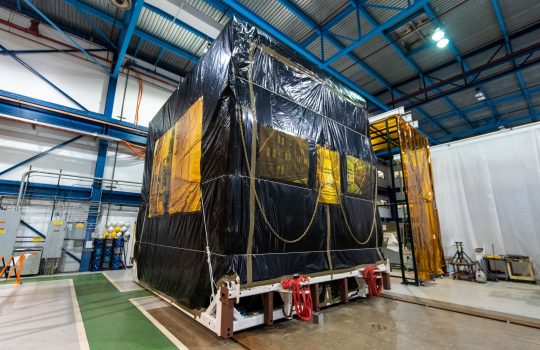
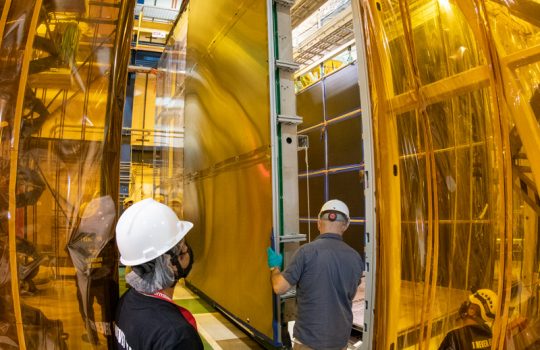
An international group of scientists has finished the assembly of the large neutrino detection system for the Short-Baseline Near Detector at Fermilab.
71 - 80 of 539 results
An international group of scientists has finished the assembly of the large neutrino detection system for the Short-Baseline Near Detector at Fermilab.
From Science, September 29, 2022: Fermilab’s DUNE and Japan’s Hyper-K experiments are building similar yet different projects that will study neutrino oscillations and search for CP violation in hopes it will lead to answers on how the newborn universe generated more matter than antimatter. Read more on how these two projects are progressing, how they differ and how they might answer more about the elusive neutrino.
From Science News, September 22, 2022: Emily Conover explains in this video why the universe contain so much more matter than antimatter told through the lens of a classic, 8-bit video game, with matter and antimatter locked in an epic battle for cosmic supremacy. Experiments like DUNE will examine ghostly subatomic particles known as neutrinos to provide clues.
From Syracuse University, September 18, 2022: Researchers at Syracuse University have received two new grants that will expand their work with physicists from around the world on projects that include MicroBooNE, DUNE and NOvA. The support comes from the NSF and DOE and will enable graduate and undergraduate students to work on everything from detector construction and operation at Fermilab and Syracuse, to final data analysis and software development.
Scientists are using a detector originally designed to study neutrinos to pin down an elusive nuclear physics measurement.
From Phys.org, August 3, 2022: Fermilab’s NOvA experiment reports analysis on oscillation data delivering some of the most accurate estimates to date describing neutrino oscillations and providing important hints on two important aspects of neutrino physics—the ordering of neutrino masses and the degree of charge-parity (CP) violation. These results set the stage for the next generation of “long-baseline” experiments, like Hyper-K and DUNE, which will dramatically boost our ability to probe elusive aspects of neutrino physics.
Physicists take on the mystery of the missing (and extra) neutrinos.
From The Big Think, July 8, 2022: Science writer and astrophysicist Ethan Siegel explores how the design of Fermilab’s DUNE experiment aims to detect neutrino oscillations from one flavor into another when neutrinos travel 1300 km through the earth.
From Physics Today, July 2022: Anne Heavey, senior technical editor at Fermilab describes how teams from around the world are developing and constructing detector components for the world’s largest cryogenic particle detector, the Deep Underground Neutrino Experiment (DUNE).
From The Big Think, June 28, 2022: Fermilab’s Don Lincoln explores the possible existence of a fourth neutrino known as “sterile neutrinos.” With the LSND, Mini BooNE and MicroBooNE experiments displaying anomalies from the Standard Model of physics, could this fourth neutrino really exist?