Muon antineutrino oscillation spotted by NOvA
From Physics World, June 7, 2018: The best evidence yet that muon antineutrinos can change into electron antineutrinos has been found by the NOvA experiment.
1681 - 1690 of 2562 results
From Physics World, June 7, 2018: The best evidence yet that muon antineutrinos can change into electron antineutrinos has been found by the NOvA experiment.
From Science News, June 6, 2018: Fusion may have a dark side. A shadowy hypothetical process called “dark fusion” could be occurring throughout the cosmos, suggests a new study by Fermilab scientist Sam McDermott.

Some scientists spend decades trying to catch a glimpse of a rare process. But with good experimental design and a lot of luck, they often need only a handful of signals to make a discovery.
From WTTW’s Chicago Tonight, June 5, 2018: A team of physicists announced findings that could reveal the existence of a mysterious new type of particle known as a sterile neutrino. The finding by Fermilab’s MiniBooNE happens to come with several Chicago connections.
From Seeker, June 17, 2018: The Deep Underground Neutrino Experiment wants to solve one of the biggest mysteries in science today, namely, why do we exist? Fermilab scientist Bonnie Fleming appears in this 6-minute explainer video.
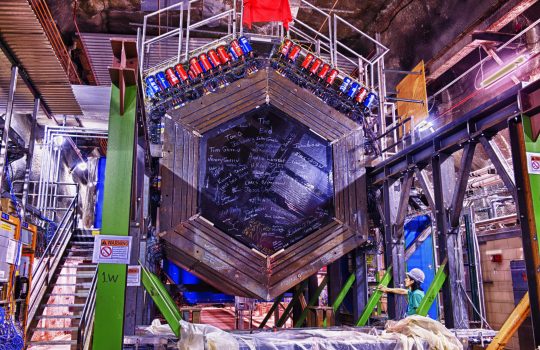
Fermilab’s MINERvA experiment gives a boost to the particle physics field by sharpening a model of a frequent, pesky phenomenon.
From New Scientist, June 12, 2018: NOvA has confirmed that antineutrinos oscillate, detecting muon antineutrinos morphing into electron antineutrinos with more certainty than we’ve ever had before.
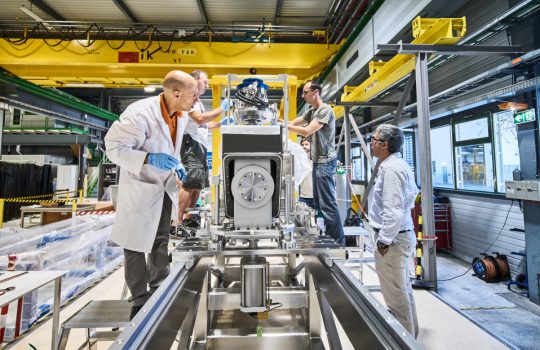
A groundbreaking ceremony at CERN celebrates the start of the civil-engineering work for the High-Luminosity LHC. Fermilab is leading the U.S. contribution to the HL-LHC, in addition to building new components for the upgraded detector for the CMS experiment.
From Science, June 4, 2018: Don’t toss out your particle physics textbooks just yet. A team of particle physicists, including MiniBooNE collaborators, announced results that could point to an exotic new particle called a sterile neutrino. But the situation is more ambiguous than some reports suggest. Although the new data bolster one argument for the sterile neutrino, other evidence has weakened significantly in recent years.
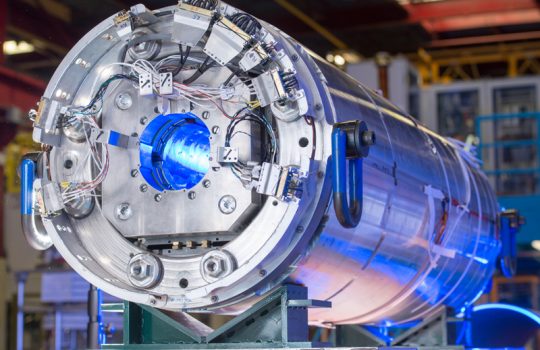
When complete, the HL-LHC will produce five to seven times more proton-proton collisions than the current LHC — thanks in part to important collider components contributed by Fermilab.