NMSU physics department awarded $1.26 million DOE grant
From KRWG, June 26, 2018: The three-year grant will fund New Mexico State University physics faculty, students and postdoctoral researchers for three projects: SeaQuest, MicroBooNE and PHENIX.

1661 - 1670 of 2562 results
From KRWG, June 26, 2018: The three-year grant will fund New Mexico State University physics faculty, students and postdoctoral researchers for three projects: SeaQuest, MicroBooNE and PHENIX.
From Texas A&M University, June 26, 2018: Toback points to CDF’s impact in its landmark 700th paper published last year in Physical Review D and in how it’s shed new light on the production rate of charm quarks.
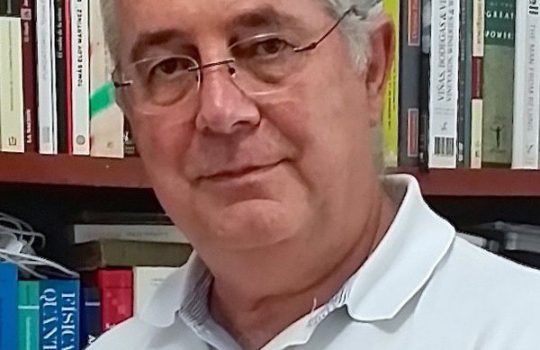
Ronald Shellard, director of the Brazilian Center for Research in Physics, discusses the past, present and future of Brazil-Fermilab scientific collaboration.
From ABC7 Chicago, June 10, 2018: Fermilab is featured on ABC show Built to Last, picked up by dozens of ABC affiliates. The 13-minute segment includes interviews with Tim Meyer, Valerie Higgins and Rhonda Merchut. Scroll to episode 5. Fermilab segment starts at 1:31.
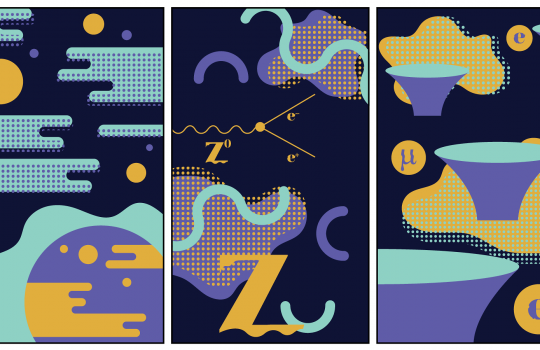
These are the event displays of Large Hadron Collider physicists’ dreams.
From Universe Today, June 20, 2018: A Fermilab astrophysicist recently conducted a study that indicates how a sufficiently advanced civilization might be able to harvest Local Group stars and prevent them from expanding outward.
From Russia Today, June 21, 2018: Expansion of the universe, thought to be further accelerated by dark energy, is flinging matter apart, while galaxies are being pushed away from each other. This is a challenge alien technologies will have to deal with in order for them to survive, Fermilab’s Dan Hooper writes in a new study.
From Science News, June 19, 2018: Fermilab physicist Dan Hooper proposes that, to offset a future cosmic energy shortage caused by the accelerating expansion of the universe, a super-advanced civilization could pluck stars from other galaxies and bring them home. It’s a far-out idea, tackling a dilemma in a future so distant that human beings can hardly fathom it: 100 billion years from now, each neighborhood of the universe will be marooned as if on a cosmic island, with resources from the rest of the universe inaccessible.
From CNN, June 19, 2018: Fermilab scientist Don Lincoln explains how studying neutrinos became an intellectual industry. There were dozens of independent experiments telling a consistent story, each reporting similar values for the parameters being studied. Well, except for one.
From Nachrichten Welt, June 18, 2018: German publication picks up Don Lincoln’s Live Science article on MiniBooNE and its search for the sterile neutrino.