Uncategorized

1 - 10 of 12 results

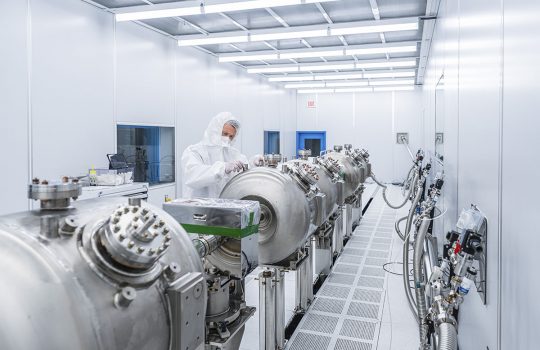
Superconducting radio-frequency cavities are being assembled and tested for installation at the Proton Improvement Plan-II, part of the Fermilab Accelerator Complex. By fine tuning the cavities’ resonance, scientists can optimize accelerator performance. Credit: Ryan Postel, Fermilab

DOE selects Fermilab-led AI initiative to advance particle accelerator performance

In a project selected for funding by the Department of Energy’s Genesis Mission, Fermi National Accelerator Laboratory and partners from other national laboratories, universities and industry will apply artificial intelligence and machine learning to enable precise and adaptive resonance control in particle accelerators. Their work aims to lower operating costs by millions of dollars each year and improve accelerator performance, driving scientific discovery.

Director of Fermilab Norbert Holtkamp, second from right, speaks during a panel discussion held on the final of day of 2026 DPF at Fermilab. Credit: JJ Starr

Scientists travel to Fermilab to discuss future of high-energy physics

Fermilab recently hosted over 500 physicists for the American Physical Society’s biennial Division of Particles and Fields meeting. With presentations by Fermilab Director Norbert Holtkamp and CERN Director-General Mark Thomson, the meeting provided particle physicists the opportunity to come together and consider the future of high-energy physics research.

Fermilab team members in front of the 14th and final superconducting cryomodule built for the high-energy LCLS upgrade. Credit: JJ Starr, Fermilab

Fermilab completes its part in upgrading world’s most powerful X-ray laser

Fermilab sent its final contribution for the high-energy upgrade of the superconducting accelerator for SLAC’s X-ray laser, LCLS. The technology they developed will be transferred to industry for semiconductor-chip production and will be used in the Proton Improvement Plan-II, one of Fermilab’s flagship projects.

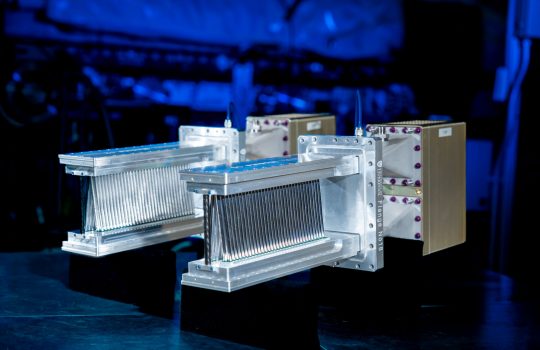
ion trap chip

DOE national quantum research centers reach breakthrough towards building scalable quantum computers

A partnership between the Quantum Science Center and the Quantum Systems Accelerator, two U.S. Department of Energy national quantum information science research centers, has enabled a breakthrough by Fermilab and MIT Lincoln Laboratory. Researchers used cryoelectronics to control ion traps, a key step toward realizing scalable quantum computers.