PIP-II

71 - 80 of 90 results

Fermilab breaks ground on new particle accelerator

    From ABC7, March 15, 2019: Fermilab broke ground on a new particle accelerator project Friday.
    The new machine will power cutting-edge physics experiments for years to come by allowing scientists to study invisible particles called neutrinos, which may hold the key to cosmic mysteries.
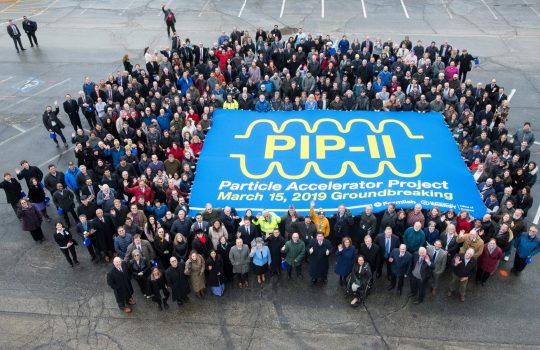
    Shortly after breaking ground on the PIP-II accelerator project on Friday, March 15, Fermilab employees were joined by the governor of Illinois, six members of Congress and partners from around the world in this group photo. Photo: Reidar Hahn

    Fermilab, international partners break ground on new state-of-the-art particle accelerator

    The March 15 ceremony marks the start of work on PIP-II, a major new accelerator project at Fermilab. The PIP-II accelerator will power the long-term future of the laboratory’s research program, including the international Deep Underground Neutrino Experiment.

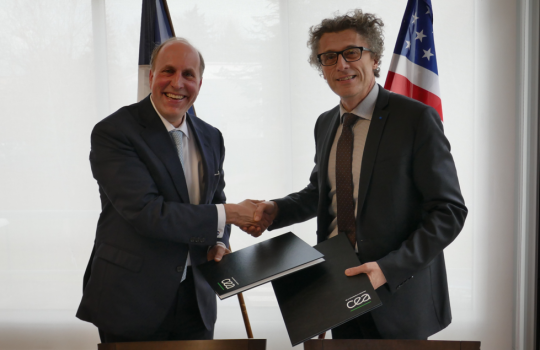
    United States and France express interest to collaborate on construction of superconducting particle accelerator at Fermilab and the Deep Underground Neutrino Experiment

    Agencies in the United States and France have signed statements expressing interest to work together on the development and production of technical components for PIP-II, a major particle accelerator project with substantial international contributions. In addition, the French agencies also plan to collaborate on DUNE, an international flagship science project that will unlock the mysteries of neutrinos.

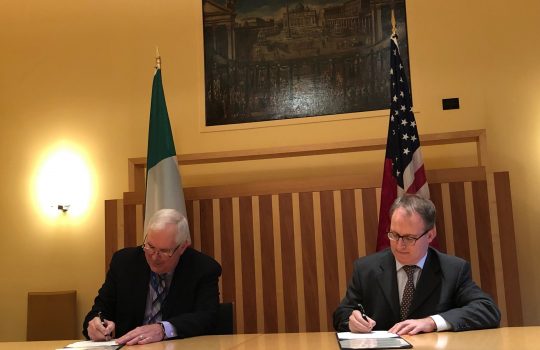
    U.S. Department of Energy and Italy’s Ministry of Education, Universities and Research to collaborate on particle accelerator construction at Fermilab

    The agreement launches a multinational collaboration to build a powerful new accelerator at DOE’s Fermilab complex. Italy and its National Institute of Nuclear Physics will provide major contributions to the construction of the 176-meter-long superconducting particle accelerator that is the centerpiece of the PIP-II project.