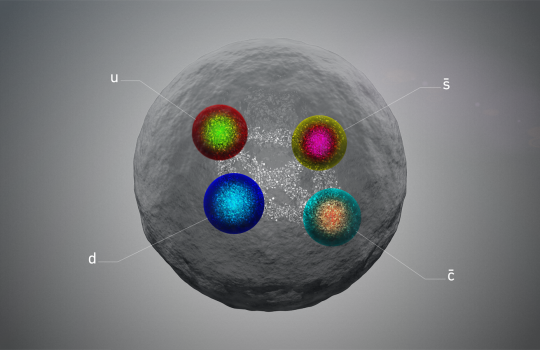
LHCb discovers longest-lived exotic matter yet
The newly discovered tetraquark provides a unique window into the interactions of the particles that make up atoms.

31 - 40 of 238 results
The newly discovered tetraquark provides a unique window into the interactions of the particles that make up atoms.
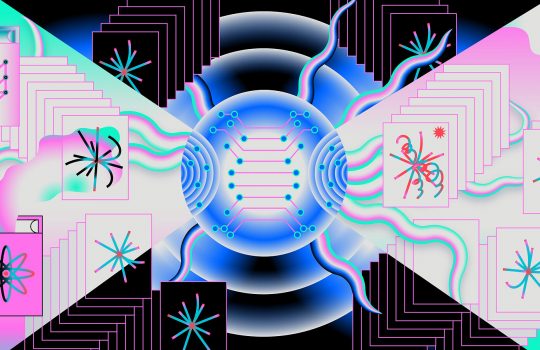
Fast electronics and artificial intelligence are helping physicists working on experiments with massive amounts of data, such as the CMS experiment, decide which data to keep and which to throw away.

Scientists discovered a new particle by comparing data recorded at the Large Hadron Collider and the Tevatron.
from CERN, June 21, 2021: Yesterday, CERN held a first stone ceremony for Science Gateway, the Laboratory’s new flagship project for science education and outreach.
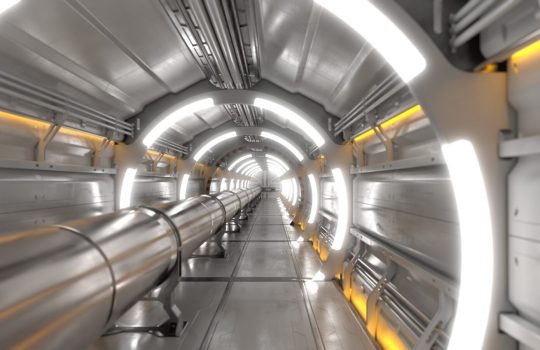
What does it take to envision and build a seemingly impossible particle accelerator? The results of these discussions will shape the next 100 years of particle physics research.
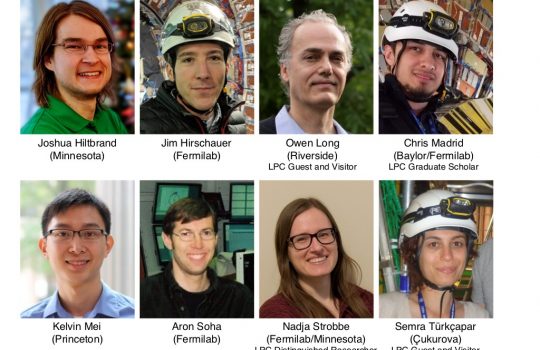
U.S. CMS physicists from Fermilab and associated universities collaborating under the umbrella of the LPC make up a team that is the first to perform a new kind of search for “stealthy” supersymmetry that does not result in an obvious signature of large energy imbalance. Instead, the LPC team is looking for collisions that result in an unusually large number of particles in the detector. CMS recently published a briefing explaining their analysis.
From the CERN Courier, March 9, 2021: The discovery of an odderon, predicted to exist almost 50 years ago, was the result of a collaboration between CERN and Fermilab using data from the Large Hadron Collider as well as Fermilab’s DZero experiment. The results were presented at a CERN physics talk and are reported in a joint publication on the observations that were made in December 2020.
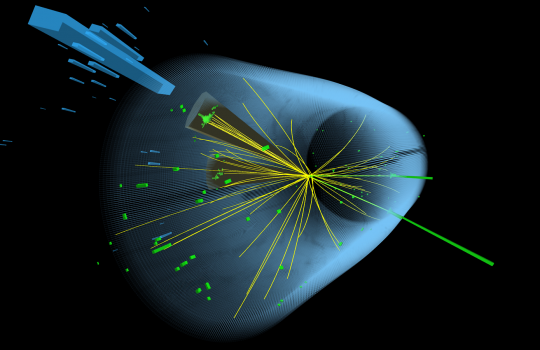
Higgs-boson pairs could help scientists understand the stability of our universe. The trick is finding them.
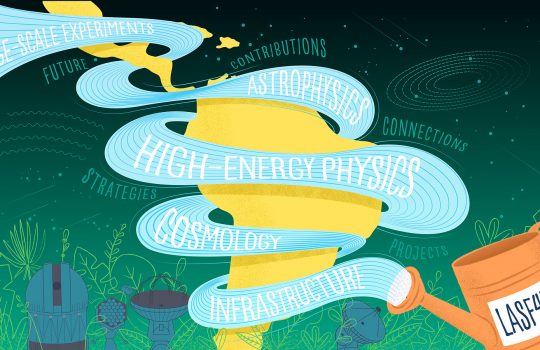
Scientists in Latin America recently published the first coordinated plan for the region’s research in high-energy physics, astrophysics and cosmology. Fermilab scientist Marcela Carena was part of the group that collected input for the report. Here, she weighs in its significance.
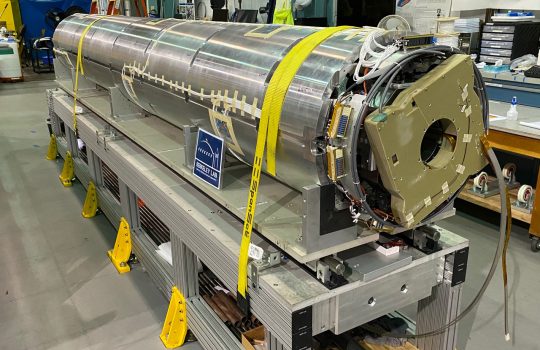
The U.S. Department of Energy has given the U.S. High-Luminosity Large Hadron Collider Accelerator Upgrade Project approval to move full-speed-ahead in building and delivering components for the HL-LHC, specifically, cutting-edge magnets and accelerator cavities that will enable more rapid-fire collisions at the collider. The collider upgrades will allow physicists to study particles such as the Higgs boson in greater detail and reveal rare new physics phenomena. The U.S. collaborators on the project may now move into production mode.